This feature offers an introduction to the contemporary art scene of Lisbon, Madrid and Rome through the lens of three dynamic artists. All featured on WeDirectory, we invite you to discover the unique approaches taken by each artist that contribute to their craft and follow the artists whose work resonates with you most.
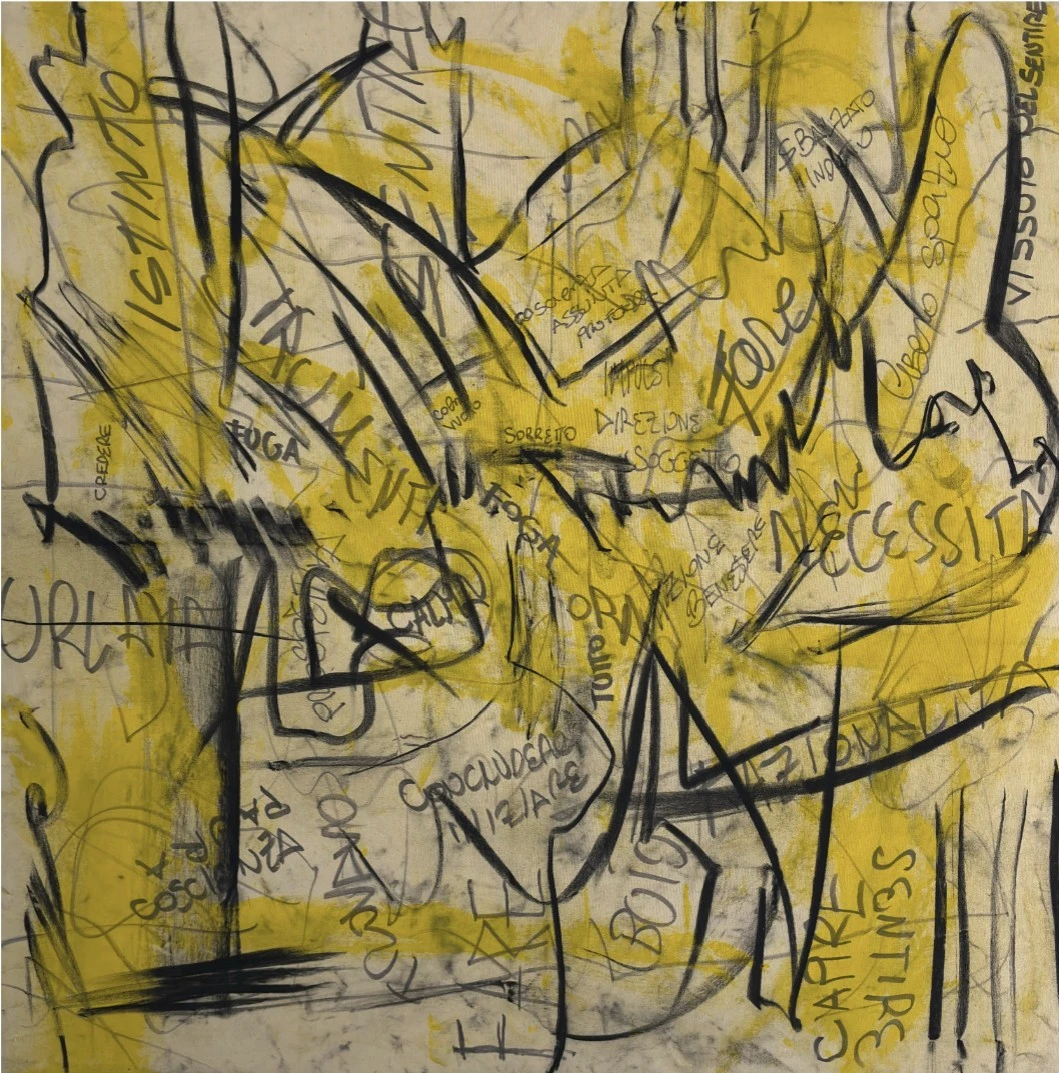
Niccolò Fornari’s Ricerca (2024). Medium: vinyl emulsion, charcoal and promarker on canvas. Featured image courtesy of Niccolò Fornari.
Niccolò Fornari
Traditional fine art mediums are undoubtedly at the heart of Niccolò Fornari’s artistry. Despite initially practicing in fashion design and architecture, the skills acquired from his study of those disciplines arguably allowed Fornari to formulate a diverse foundation needed to successfully execute his future work.
Having graduated from the Accademia di Belle Arti in Rome, as well as interning as a studio assistant at a letterpress laboratory, Fornari incorporated his strong relationship with text and lettering in his paintings. This resulted in a range of artwork produced by Fornari that utilized letters and words as a tool to communicate directly with each observer. In his pieces, words take shape in a variety of ways: in some, they unravel into an amalgamation of strands that bleed out across the canvas and weave together again. Art deviates from the declarative for Fornari, giving us explicit starting points to begin our own interpretation.
What arrives are abrasive pictorials that explore the dichotomy between the intelligible and the illegible. Overwhelming swathes of colour appear numerous times in Fornari’s work, forming striking canvases that are broken apart by contrasting bold strokes.
Ricerca (pictured above) is a classic example of this. Directly translating to “search” or “look for” from the original Italian, Ricerca features ardent yellows among smears of charcoal that look as if they have been clawed out onto the canvas. Here, language becomes anthropomorphized and fights aggressively against the invasive colour. What begins to sprawl over the canvas and overlay the sea of yellow is a map, where phrases become islands for the observer to pause and catch their breath.
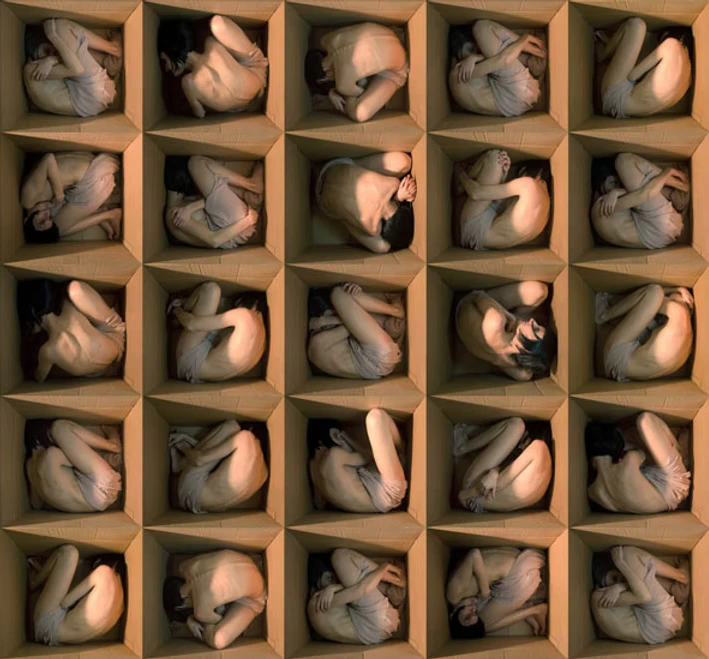
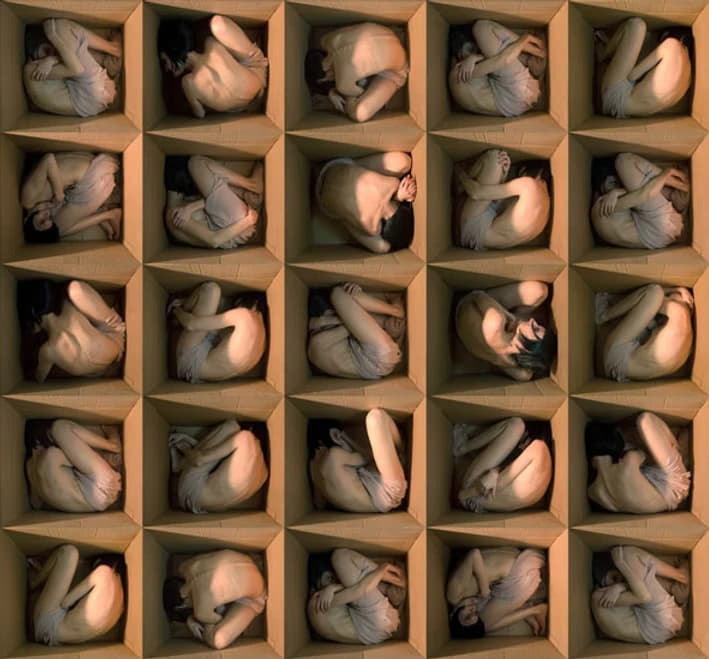
Alicia Moneva’s incubadas (2011). Medium: digital photography. Featured image courtesy of Alicia Moneva.
Alicia Moneva
Shaped by an interdisciplinary of both science and humanities, Alicia Moneva has bridged her studies of biological sciences, philosophy and psychology together along with her architectural experience to make artwork that explores the human presence and how it can impact spaces.
Situated in Madrid, Moneva analysed identity and belonging in her earlier works by using photography as her primary medium. Always accompanied by her videObras (video-works), Moneva’s photos combine her own work with Photoshop to convey multiple examples of the human experience into a single piece, creating pieces that are deeply rooted in the fluidity of emotion and of the body itself.
In many of her works, including incubadas (pictured above), Moneva shoots from an overhead view that strips away any notion of privacy. incubadas, meaning “hatched” or “incubated” in English, is a particularly provocative example of Moneva’s use of intimate perspective: here, the human body can be observed almost nude, situating the observer in a position that feels uncomfortably voyeuristic. Suffering, struggle, fear and uncertainty can all be ascertained from the same model that is posing similarly in multiple angles.
Moneva’s hunger for learning has taken her down a new creative path. After personal circumstances affected her photography work, she has since turned to artificial intelligence (AI) programs. Through the creation of AI artwork, Moneva continues to feel her way through themes concerning the individual condition on a deeper level through digital image creation and video editing.
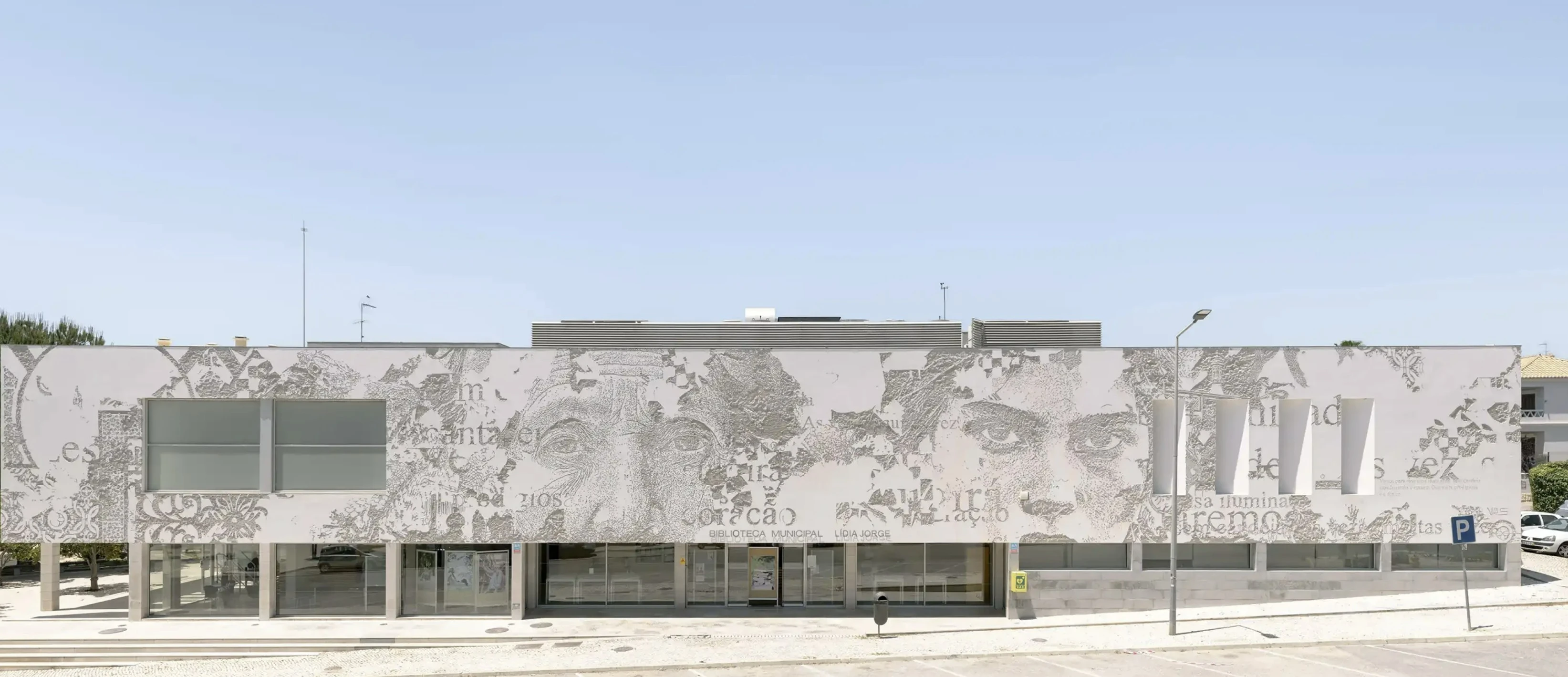
Vhils’ Scratching the Surface project (2024), situated at Biblioteca Lídia Jorge in Albufeira, Portugal. Featured image photographed by Alexander Silva.
Vhils (Alexandre Farto)
Award-winning Portuguese artist Alexandre Farto, known internationally under the pseudonym Vhils, utilises a variety of mediums to visualise his own relationship with the urban environment. Growing up in Seixal, a suburb known for its intensive urban development, Vhils was inspired to approach his surroundings as living archives. By eroding away layers of plaster and concrete, he began to uncover the stories of the past lying dormant by carving them out.
Currently based in Lisbon, Vhils studied at the University of the Arts London and since then he has participated in a variety of solo and group exhibitions that have spanned the globe. Vhils continues to challenge conventional engagement with portraiture and public art by directly engaging with the rapid urbanisation of his environment on such a large scale. Unashamedly investigating the tensions caused by this, Vhils has made countless buildings across the world subjects for his Scratching the Surface project (pictured above). This unconventional practice uses various public surfaces to Vhils’ advantage by exposing his artistic convictions in pieces that cannot go unnoticed by the human eye.
Extending beyond his carved mural work, Vhils has produced impressive amounts of art across tilework, digital art, and dioramas (to name a few). To say he is a multifaceted artist is a massive understatement. Vhils has even used light as a medium to create his illuminating Overexposure series, where once again, the human impression and the urban experience meld together and become a primary driving force for his inspiration.