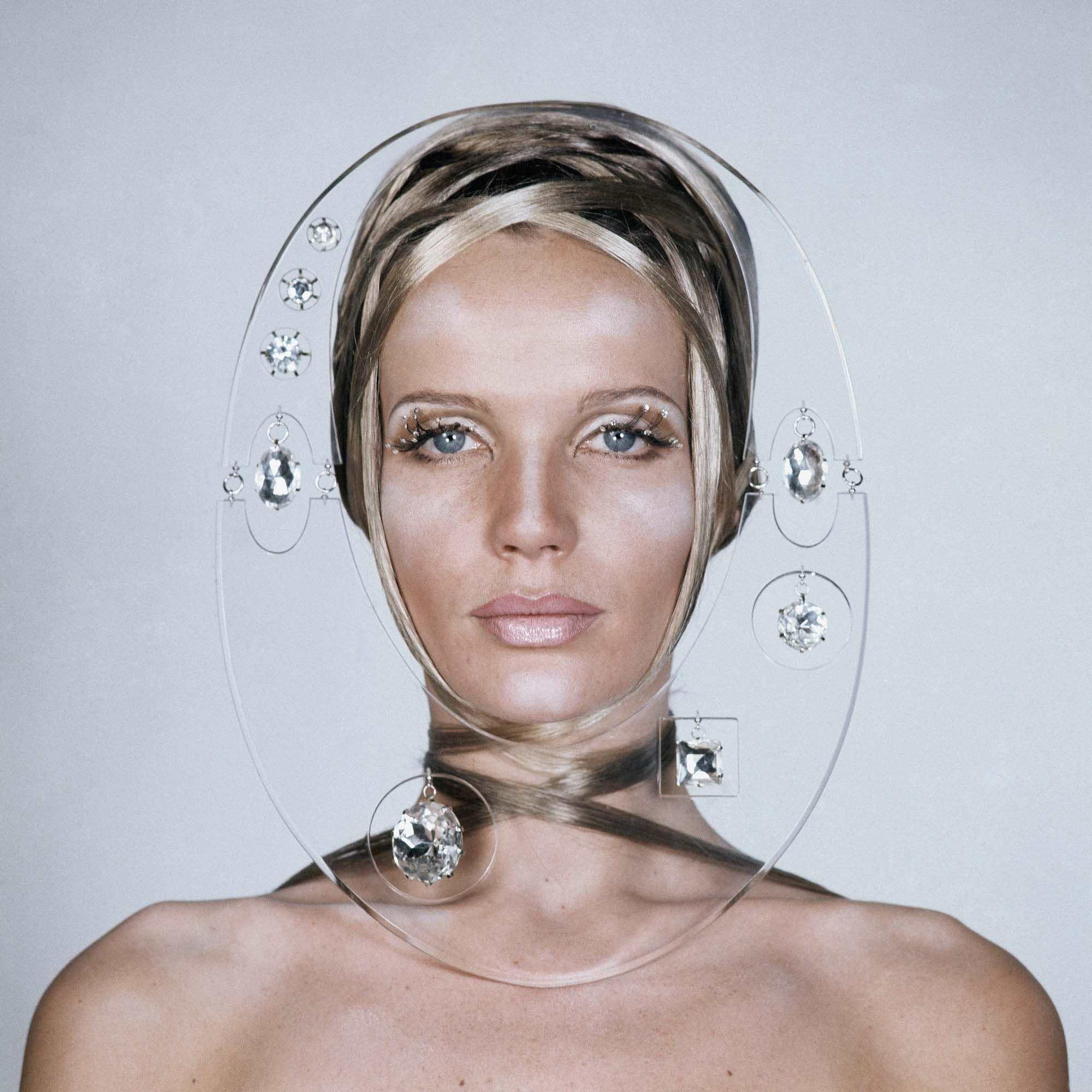
Symmetrical studio beauty portrait of model Veruschka photographed straight-on from her bare shoulders up against a pale gray background. Her head and neck are framed by a large, flat oval transparent acrylic headpiece extending from her crown to her collarbones, accented with faceted clear crystals in round, oval, and square cuts suspended within circular and geometric cutouts along the clear rim. Her smooth blonde-and-brown hair is tightly sculpted in crisscrossing ribbons across her crown, curving closely along her cheeks and winding snugly around her neck. Gazing directly into the camera with a serene expression, she wears futuristic makeup with frosted pearlescent highlights across her cheekbones and eyelids, glossy pale pink-nude lips, and curled eyelashes tipped with tiny sparkling silver beads.
5 min

25.11.2026

Veruschka 1939–2026

By Ruslan Khabiev

Remembering Veruschka (1939–2026): how a Prussian countess who lost her childhood to the Nazis became Vogue’s 1960s muse, starred in Blow-Up, and turned her body into art.

On November 25, 2026, the fashion world lost another icon: Veruschka, the first German supermodel, died. My mind went straight to an oversized book of her images that the photographer Ali Mahdavi had once given me in Paris. I opened it right away and began looking through the shoots of a great model.

A heavy volume, nearly broadsheet in size. On the very first spread, Irving Penn, 1966: her signature dramatic eye makeup, sculptural hair, and the composed gaze that belongs only to people who know their exact worth. Not arrogance. Confidence. The distinction matters.

I turn the page.
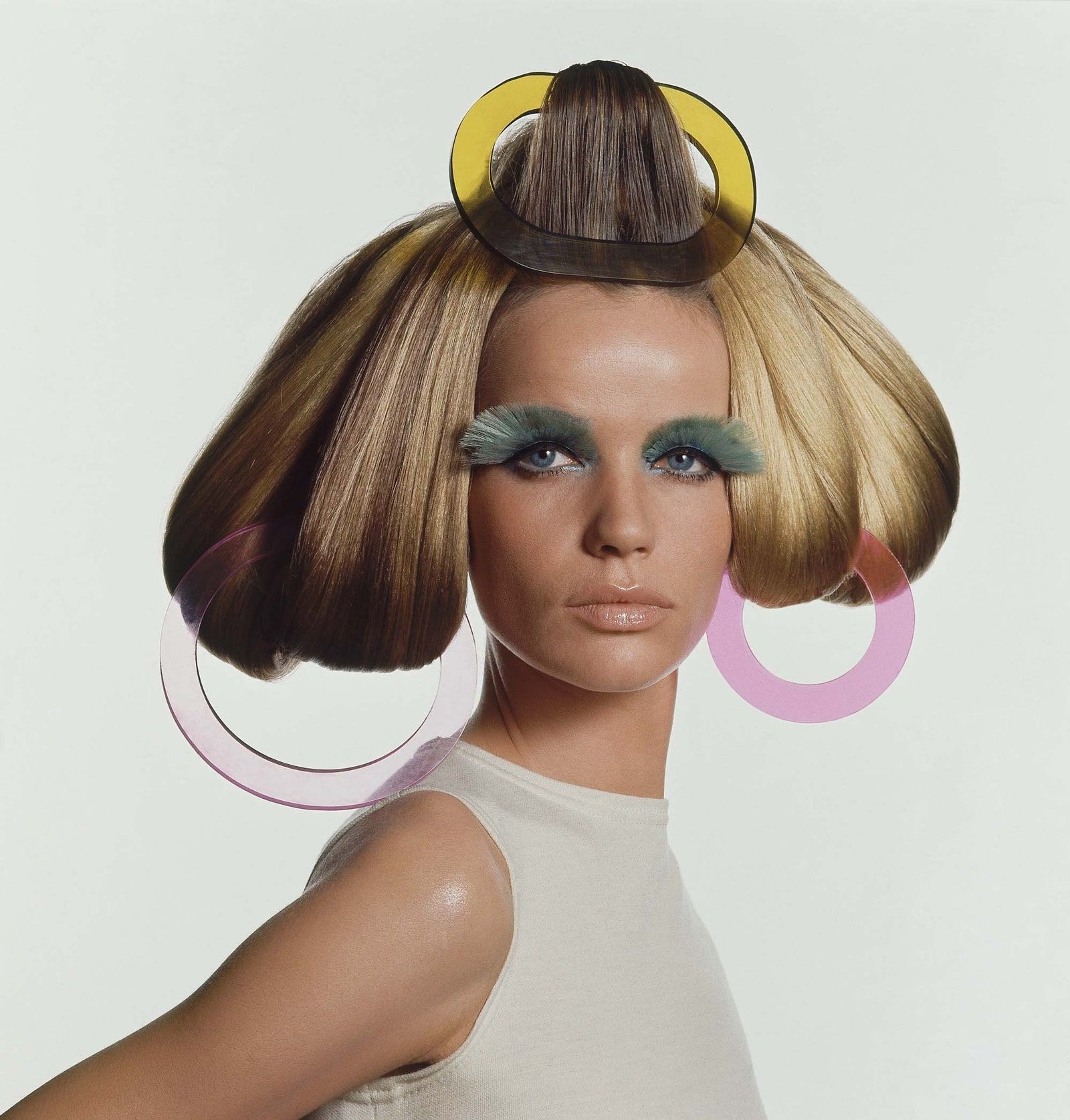
Studio portrait of model Veruschka photographed by Richard Avedon for Vogue in 1966 against a plain light-gray background. Shown from the chest up in a cream sleeveless top with her torso angled to the side and her head facing directly into the camera, she wears a sculptural, voluminous blonde hairstyle threaded with oversized translucent plastic rings—a yellow-and-brown ring at the crown and two pink rings looping through the puffed sides—paired with dramatic fluffy turquoise false eyelashes and glossy pale nude lips.

Photographed by Irving Penn, Vogue, June 1966

“I Lost My Childhood”

Vera Gottliebe Anna Gräfin von Lehndorff-Steinort was born on May 14, 1939, in Königsberg (now Kaliningrad) and spent her early years at Steinort, the family estate in East Prussia - today the Polish village of Sztynort. It was an old Prussian world of hunts, libraries, ancestral portraits, and the conviction that it would last forever. Everything ended in September 1944. Her father, Count Heinrich von Lehndorff-Steinort, was arrested and executed at Plötzensee Prison in Berlin for his part in the failed July 20 plot to assassinate Hitler. Vera was five. Under the Nazi policy of “Sippenhaft”—collective family liability - her mother was sent to a labor camp, while Vera and her sisters were placed in an SS children’s home in Bad Sachsa. The estate was confiscated.

When the war ended, they were freed - with nowhere left to go. East Prussia was divided between the Soviet Union and Poland; Steinort fell to Poland. The home she had known no longer existed. The family drifted from place to place, and Vera attended thirteen schools. “I lost my home, but lost childhood is a better description,” she later recalled.
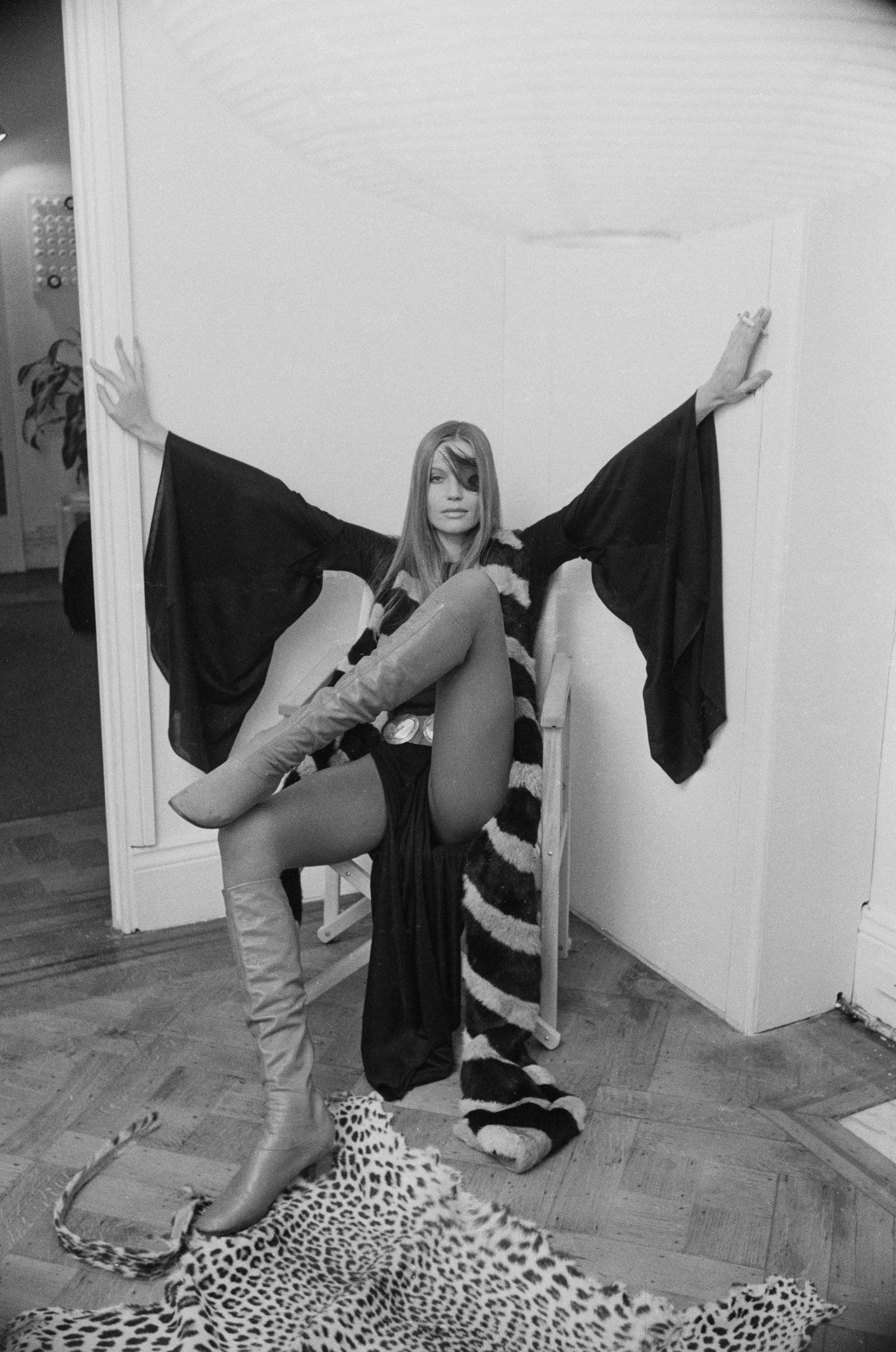
Full-length black-and-white portrait of model Veruschka seated dramatically in a light wooden folding chair angled in the corner of a white-walled room. Stretching both arms wide and upward against the walls with her fingers splayed—holding a cigarette between the fingers of her left hand—she sits with her left leg bent high across her body and her right leg extended downward onto a spotted leopard-skin rug on the wooden parquet floor. She wears a flowing black maxi dress with oversized, draped bell sleeves, a high slit, and an embellished medallion belt, paired with knee-high light leather boots and a long, boldly striped black-and-white fur scarf trailing from her shoulders onto the floor. With her long, straight, center-parted hair framing her face and a dark strand sweeping across her left eye, she gazes directly into the camera beneath the soft edge of an overhead round paper lantern, with a doorway and potted plant visible along the far left.

1971Photo: Getty Images

Florence

In the late 1950s, she found herself in Florence, studying painting. She was around twenty. Tall - six feet - with a face that led Richard Avedon to call her “the most beautiful woman in the world”: chiseled cheekbones, a steely blue gaze, full lips, and champagne-blonde hair that changed shape with every photograph. The Italian photographer Ugo Mulas spotted and photographed her. It was a discovery, though neither of them yet knew of what.

Her early years in the profession, as with so many greats, were difficult. Agencies told her: too tall, too angular, too much of everything. There was no place for German models in fashion then—neither visually nor culturally. In the public eye, Germany was not yet a country anyone wanted to associate with beauty.

So she renamed herself. Vera became Veruschka - a Russian-style diminutive of Vera, at once ironic and tender. “Little Vera.” It was a new identity. She moved to New York and Paris and began building it from scratch.
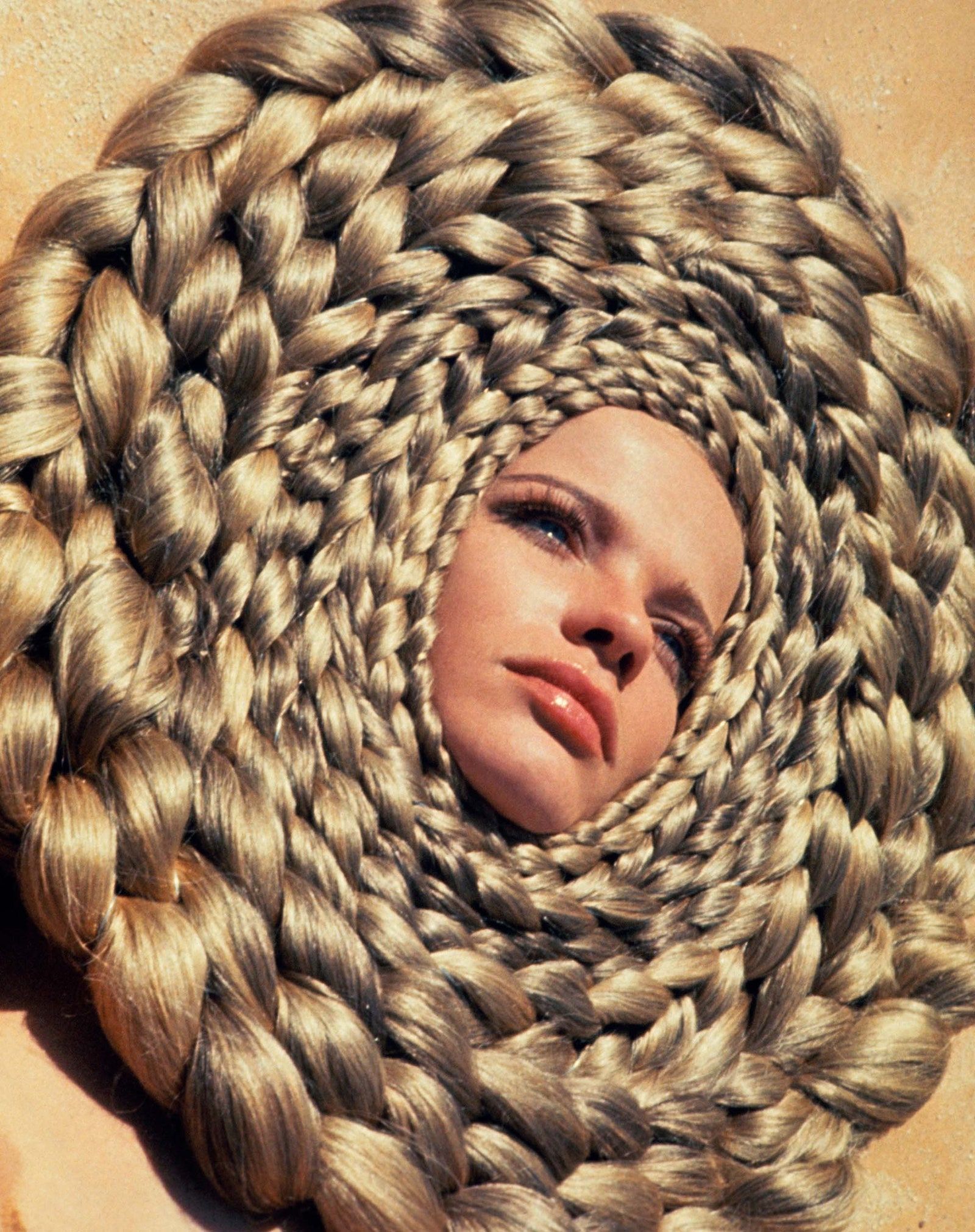
Overhead color beauty photograph of model Veruschka's face framed at the center of a massive, sculptural concentric spiral of thick golden-blonde braids. Coiling tightly around her head from finer inner plaits to chunky outer braids that fill nearly the entire frame, the circular arrangement of glossy, sunlit hair rests on pale golden sand visible in the upper corners and lower right, with a glimpse of bare skin and shadow peeking out at the bottom left. Tilted diagonally in warm direct sunlight, Veruschka gazes upward and slightly away from the camera with dark, heavily mascaraed eyelashes, softly defined brows, and glossy peach-toned lips.

Photographed by Franco Rubartelli, Vogue, April 1967

New York, Diana Vreeland, and the Beginning of Everything

In the early 1960s, Diana Vreeland became editor of American Vogue. Her name meant one thing: if she chose you, you existed. If she didn’t, you could be the most beautiful woman in the world and it made no difference.

Vreeland chose Veruschka more than once.

The next few years produced some of the richest collaborations in the history of magazine photography. Richard Avedon shot her in minimalist studio setups where her body became sculpture - poses that took the breath away. Irving Penn made architecture of her: stark light, exact shadows, not a wasted inch in the frame. David Bailey photographed her with the brash London freedom that set him apart from everyone else.

Franco Rubartelli became her partner in both life and work. Lover and collaborator. Together they created a series of shoots that upended the idea of what a fashion story could be. In April 1967, he photographed her for Vogue in a sculptural hairstyle resembling a whirlwind of braids framing her face from every side. In 1968, they traveled to Arizona and returned with an editorial that helped launch the career of the young designer Giorgio di Sant’Angelo: Veruschka in the desert, wrapped in his draped designs, looked as though the clothes had emerged on their own - from the earth and the wind.
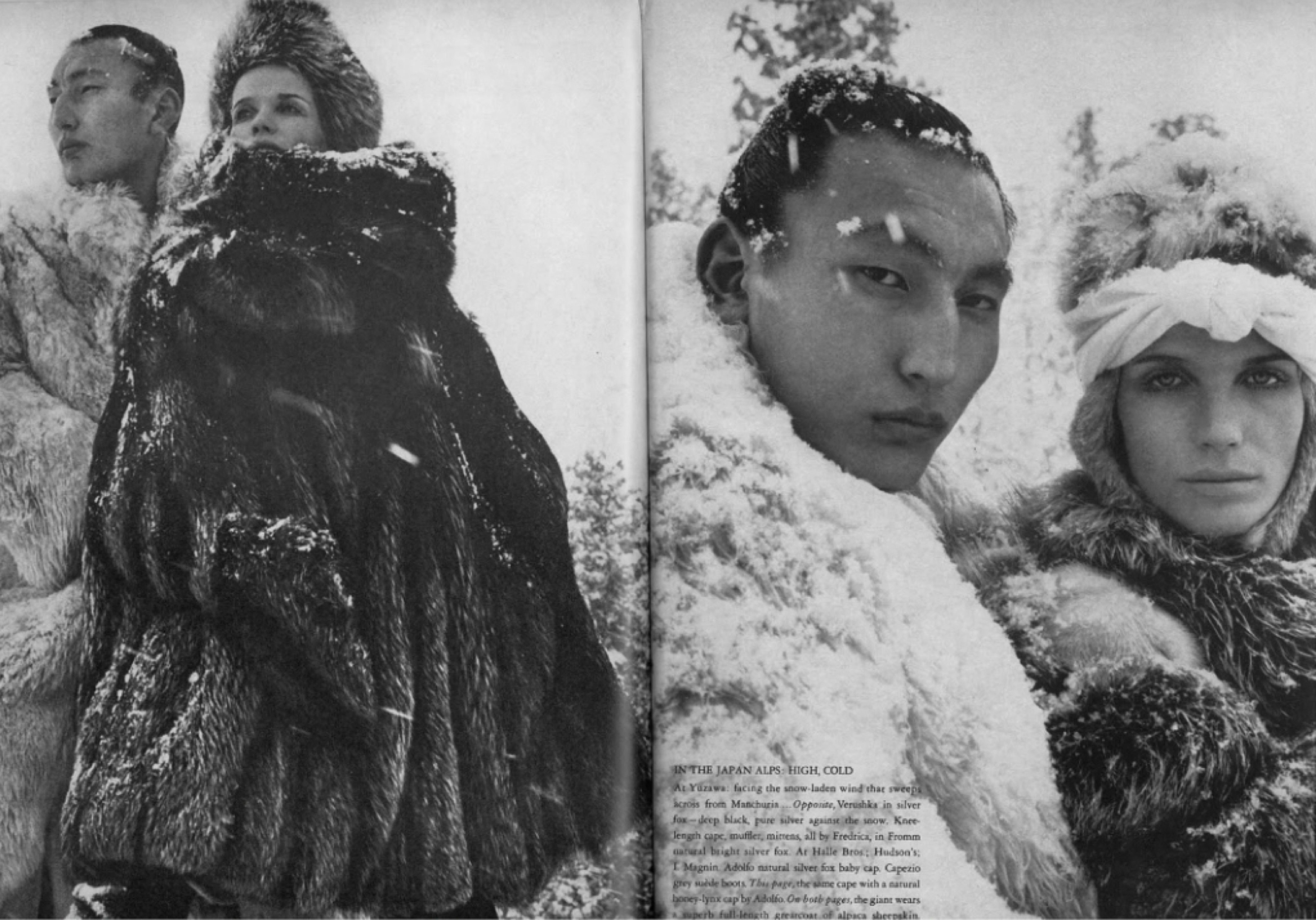
Black-and-white double-page magazine editorial spread featuring model Veruschka and a tall male companion photographed outdoors in falling snow in the Japan Alps. On the left page, Veruschka stands in the foreground wrapped in a voluminous dark silver-fox fur cape, high muffler, mittens, and fur cap dusted with snowflakes, looking upward while the man—wearing a plush pale alpaca sheepskin greatcoat with slicked-back dark hair—stands behind her gazing off to the left. On the right page, a close-up portrait shows the pair side by side against faint snowy evergreen branches: the man turns intently toward the camera with snowflakes resting on his dark hair and brow, while Veruschka looks directly into the lens in the dark fur cape and a fluffy pale lynx-fur cap tied across her forehead with a knotted white cloth band. A small block of printed caption text titled

“The Great Fur Caravan”: 1966 Vogue. Photographer: Richard Avedon.

​

In 1966, Avedon and Vogue mounted a shoot that went down in history as “The Great Fur Caravan.” They traveled into the mountains of Japan - twenty-six pages, oversized furs, an eight-foot wig, snow. Diana Vreeland’s idea was to tell an epic love story between a European woman and a Japanese man. They tried desperately to find a man taller than Veruschka. It was no easy task. Eventually, they heard about a sumo wrestler standing more than six feet ten. Veruschka recalled: “He was a thin sumo wrestler, much taller than me. He was so tall he couldn’t fit in the car, and we had to take out the front seat so he could sit in the back.” The result exceeded every expectation. Diana was thrilled. It was one of the most expensive and ambitious editorials in the magazine’s history.
At the peak of her career, Veruschka earned $10,000 a day - money most people at the time could not even dream of.

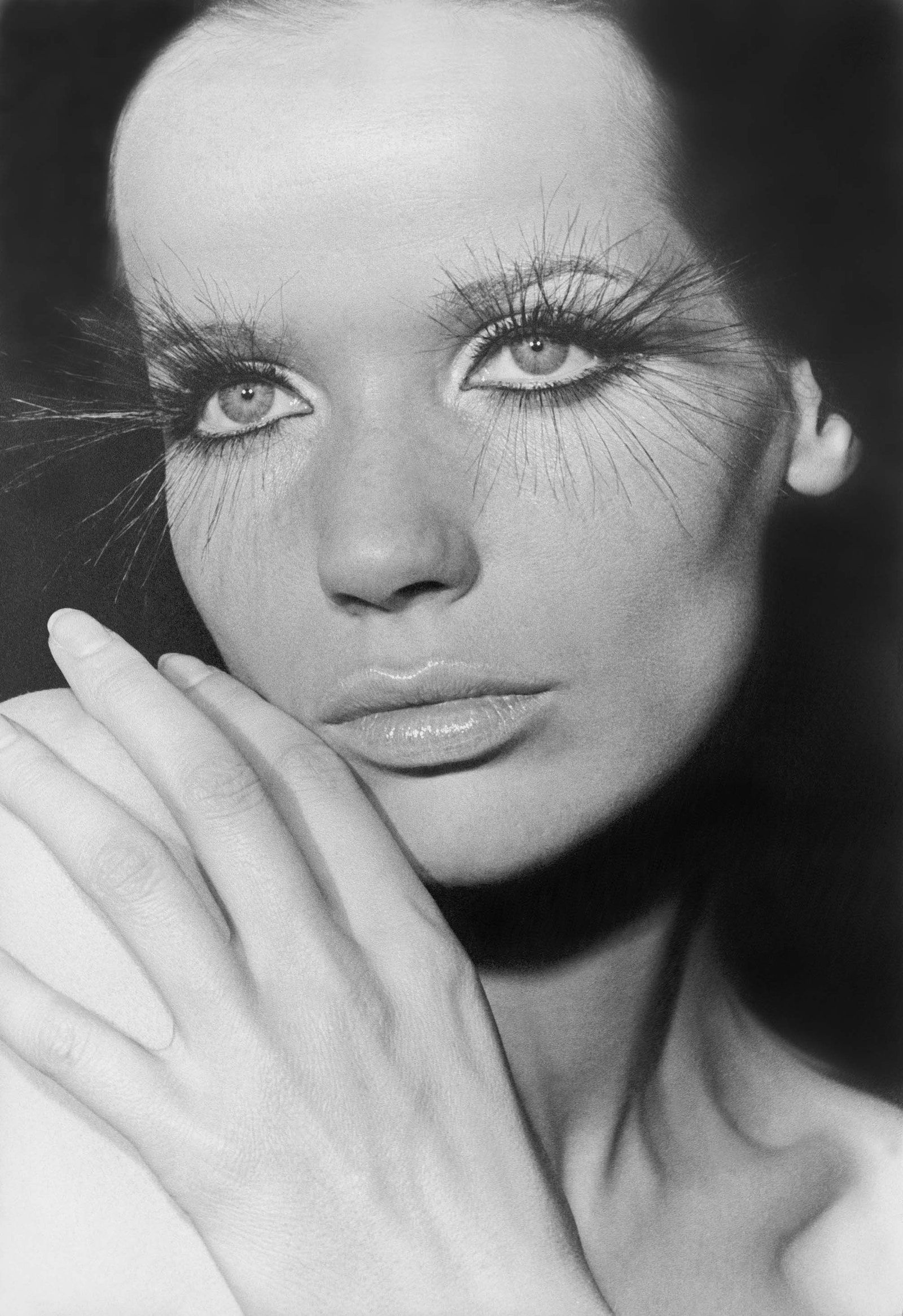
Close-up black-and-white beauty portrait of model Veruschka against a solid black background. With her hair slicked tightly back into the darkness, leaving her high forehead and left ear exposed, she tilts her head slightly and gazes directly into the camera with an intense, composed expression and glossy, slightly parted lips. Her eyes are rimmed with dark eyeliner and dramatic, extravagantly long, wispy false eyelashes radiating from both her upper and lower lash lines past her eyebrows and across her upper cheeks. In the lower left foreground, her slender left hand rests gently over her bare right shoulder near her jawline, sculpted by soft, high-contrast studio lighting.

Photographed by Franco Rubartelli, Vogue, January 1968

“An Indomitable Career of Beauty”

Susan Sontag - who later wrote the introduction to her book Trans-Figurations - called Veruschka’s an “indomitable career of beauty.” It was an exact phrase, and it applied to more than her body. Veruschka worked with her face the same way she worked with everything else: as a material with no fixed state.

Her beauty was never decorative. It was conceptual. A bouffant teased to the ceiling - and alongside it, within the pages of the same magazine, in the same year, her hair gathered into an origami knot, tight and geometrically precise. Her lashes were doll-like and silky, or painted in Technicolor, or so long they seemed to cast shadows. On her lids, a sheer wash of pastel pigment, almost like watercolor. Graphic, hard-edged liner, without compromise. Glossy pink lips, like those of someone who had just stepped out of the water.

It was a face reinvented every time. Vreeland understood this better than anyone: Veruschka was not a mannequin, but a co-author of the image. She arrived on set with ideas. She knew what she wanted in the frame.

Black-and-white photograph from the studio photoshoot scene in Blow-Up (1966) featuring actor David Hemmings and model Veruschka. On the left, Hemmings—wearing a loose long-sleeved shirt and trousers with shaggy light hair—crouches on the dark studio floor in three-quarter rear profile, holding a 35mm camera up to his eyes with both hands to photograph Veruschka at close range. On the right, Veruschka crouches barefoot in a black sequined sleeveless mini dress with high side cutouts, kneeling on one knee with her other knee drawn up and her arms crossed over her body, one hand lifted expressively beside her shoulder. With her long, tousled light hair cascading over her shoulders, she faces the photographer in profile with her eyes half-closed and mouth open in an animated expression, set against a utilitarian studio with a white brick wall, a dark cabinet, and an equipment-lined workbench in the background.

Michelangelo Antonioni “Blow-Up“ 1966

Blow-Up

I keep turning the pages - and there it is: a still from Michelangelo Antonioni’s Blow-Up. 1966. Veruschka appeared in the film for only a few minutes, yet those minutes were discussed for decades.

In the scene, she walks into the studio of a cynical photographer, played by David Hemmings, and lies down before his camera. He hovers over her, commanding her body like an object, the shutter clicking like automatic fire. It plays like a manifesto. Antonioni filmed the underside of the profession: the photographer’s power over the model, the body as an object of manipulation, an intimacy that means nothing. Yet on screen, Veruschka was no victim of that system. She was its engine. She knew light, angles, and how a camera works better than Hemmings’s character did.

The director could hardly have missed whom he was filming. He was shooting a woman who had made herself - and cast her to play herself. It was more honest than any fiction.

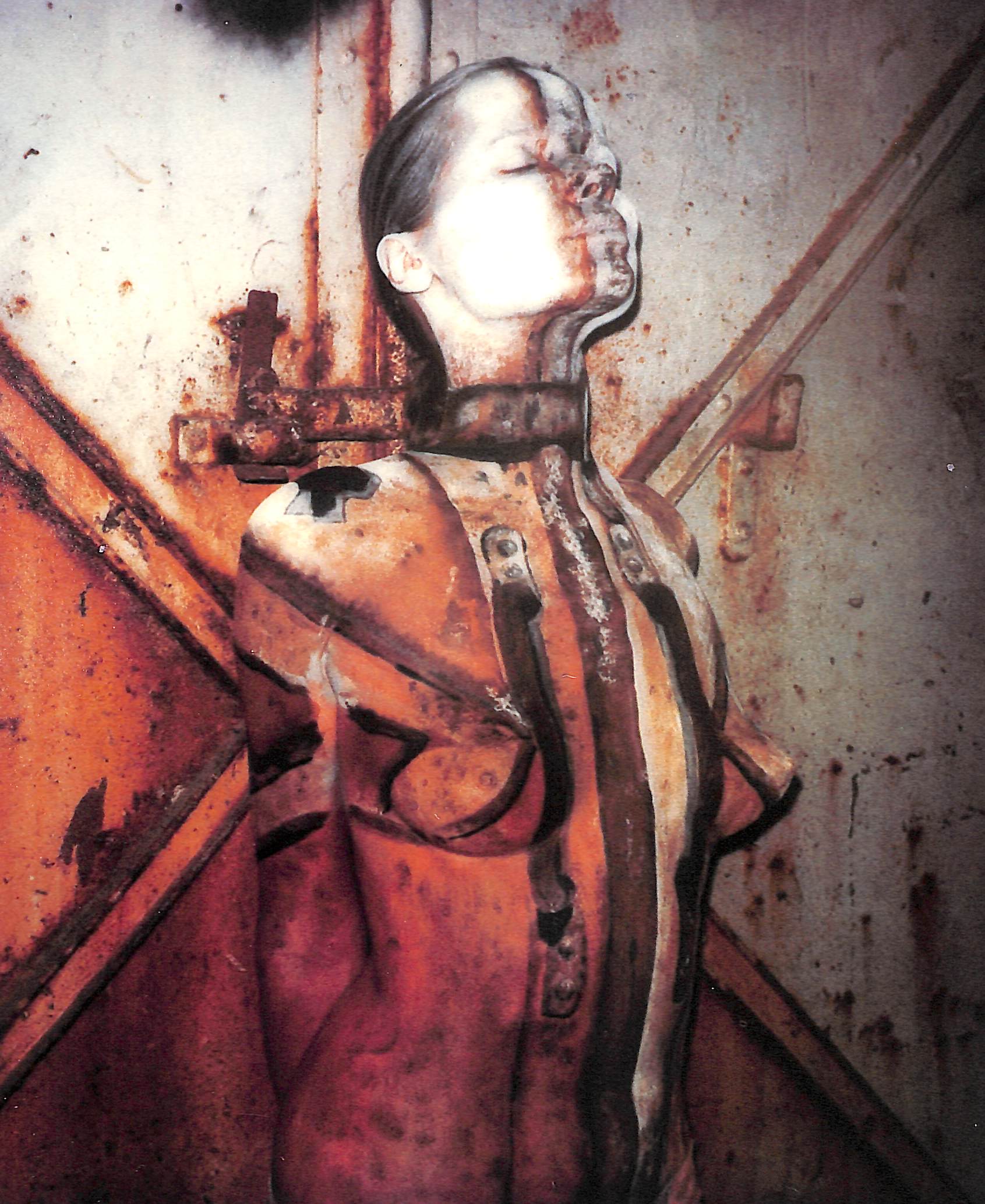
Color body-painting camouflage photograph of Veruschka standing from the hips up against a heavily rusted, weathered steel door. Positioned in three-quarter profile facing right with her arms held behind her back, her hair slicked tightly back, and her eyes closed with her chin tilted slightly upward, her bare body and face are intricately painted in mottled rust-orange, peeling white, grime-streaked gray, and dark brown to merge seamlessly with the corroded industrial surface. The trompe-l'oeil body paint replicates the door's vertical seam splitting down the center of her face and torso, two dark riveted iron straps running down her chest, diagonal structural bars across her shoulder and arm, and a dark metallic collar painted around her neck that aligns directly with a rusted iron latch bolted to the door behind her.

"Veruschka Trans-Figurations" 1986

A Living Canvas

In the early 1970s, Veruschka left commercial fashion. She said the industry had become “too bourgeois,” too uniform, too predictable.

Instead, she began working with the artist and photographer Holger Trülzsch on a project that took several years. They called it Trans-Figurations: Veruschka transformed her body into stone, wood, brick walls, animals, desert landscapes. Painted from head to toe and laid onto the ground, she dissolved—literally—into the surface she was portraying. The illusion was complete. Where she had been, there was now only a wall.

It was the logical conclusion to everything she had done before. Veruschka had always worked with disappearance. First she disappeared from her own name, becoming someone else. Then she began disappearing physically - into camouflage, into pattern, into nature. Where other models sought recognition, she sought invisibility.

Over the years, she worked with Salvador Dalí and Peter Beard, walked the runway for Thierry Mugler, and returned occasionally for rare shoots with Steven Meisel and Helmut Newton.

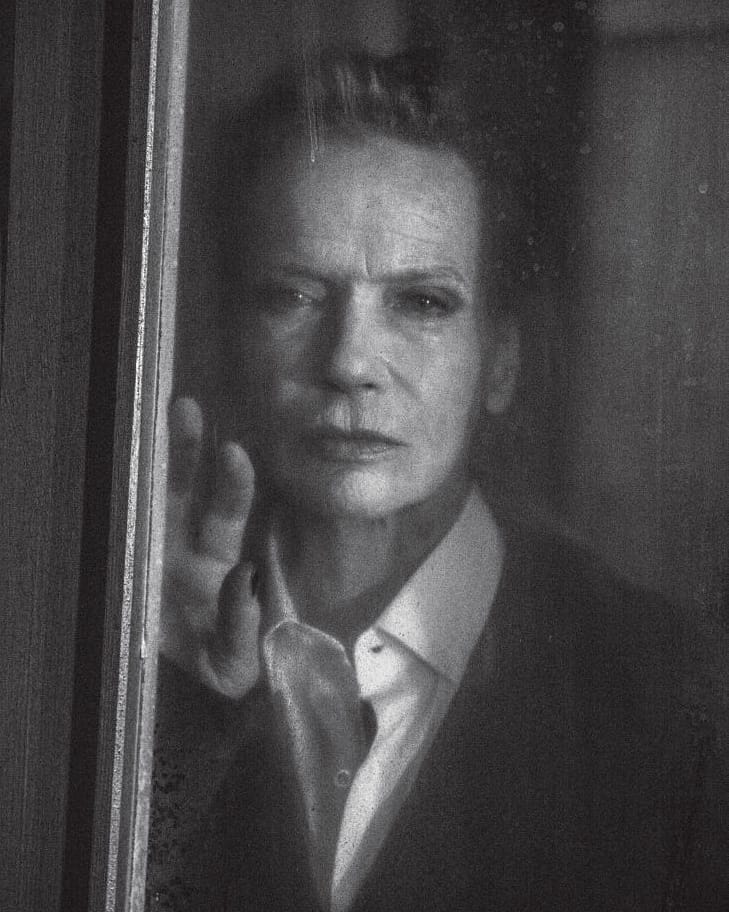
In 2017, Acne Studios cast her in its Resort 2018 lookbook. She was seventy-eight. She arrived, put on the collection’s cropped jackets and wide-leg trousers, slicked her hair back, and stood before the camera with the same poise she had carried fifty years earlier. No nostalgia. No “retired legend.” Just a woman who knows how to wear clothes—and knows more about it than anyone else in the room.

Grainy, atmospheric black-and-white portrait of an older Veruschka photographed from the chest up through a slightly dusty, reflective glass windowpane, with a vertical window frame lining the left edge. Standing closely behind the glass with her hair brushed back off her forehead, she gazes directly toward the camera with a solemn, contemplative expression and lightly furrowed brow, resting the fingers and palm of her right hand gently against the pane beside her cheek. Dressed in a crisp, unbuttoned white collared shirt beneath a dark jacket, she emerges from a softly shadowed interior, veiled by fine film grain and subtle reflections across the glass.

Photo taken by Just Loomis in Berlin.

Berlin

In her final years, she lived in Berlin. Now and then, she gave interviews. She spoke about her father - about how his execution had defined everything that followed. About how someone who loses everything at five sees possessions and fame differently. “Fame, I mean, it’s like a bubble, in a way,” she once said. “It’s like something glittery, and it goes, and it can be forgotten fast.”

I close the book. On the cover is her name, in large letters, without a surname. Simply: Veruschka. As with people who no longer need one.

​