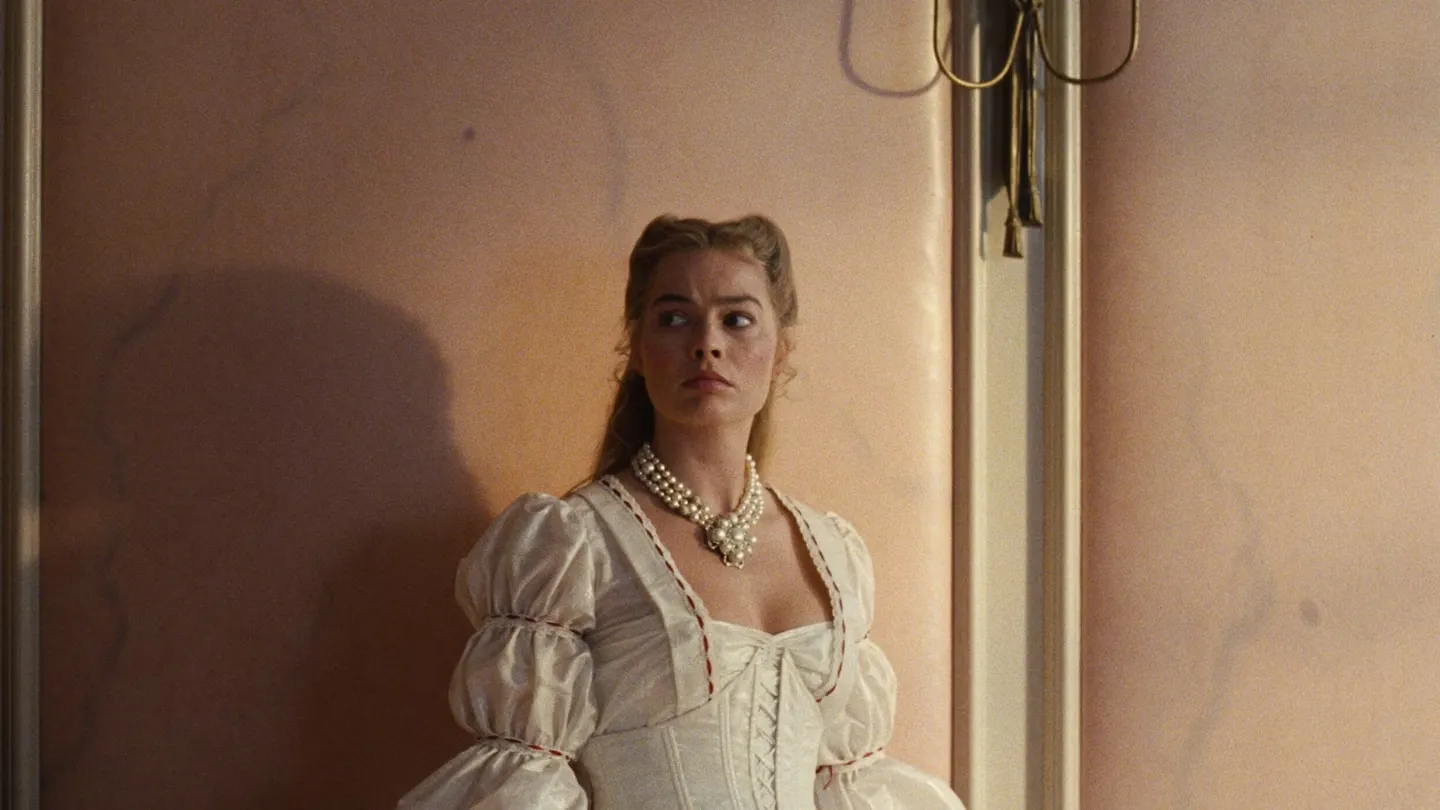
A cinematic still from Wuthering Heights featuring a woman portrayed by Margot Robbie standing in a windswept landscape, dressed in period costume, with soft natural light and muted tones creating a moody romantic atmosphere.
14 min

02.03.2026

The Beautiful Decay of Wuthering Heights (2026)

By Tuba Meltem Pekol

Emerald Fennell’s Wuthering Heights (2026) explored through fashion and visual illusion, revealing how aesthetic perfection conceals emotional decay and the slow loss of self.

A World Built on Visual Illusion

Emerald Fennell, with striking visual aesthetics, offers a smooth yet unsettling ode to tragedy in Wuthering Heights 2026 adaptation. The film delivers a fantastical vision that never follows the story by the book. Its challenging approach to conventional manner and devotion, as the viewer already keeps a fixed image in mind, pushing them to search for something beyond that existing story. From the very beginning, the whole sequence revolves around how magical realism regarding artistic direction, costumes, set design, and visual world blends in perfect harmony. In this respect, although a ‘magical’ reality is revealed, the ‘reality’ aspect raises some questions marks and doubts in the audience’s mind. Especially, what the style aims to convey is revealed here. In doing so, Fennell presents not only a narrative that integrates visual aesthetic into the story but also a structure that constructs its own reality. Neither the characters nor the setting are specified in linear time or in a historically grounded world. These are the traces of intrusive narrations between timelines. The shifting costumes across different periods, moving from the gloom of the Victorian era to a more isolated yet colorful contemporary structure, create a sense of reinterpretation in the new Wuthering Heights. Modes of perception have been developing and transforming their existing patterns in every field, replacing them with a subjective narrative. Moreover, art is incorporated into a brand-new understanding of reality, the accuracy of which is not questioned. In Wuthering Heights (2026), visual beauty – manifested through meticulously crafted costumes and intimate set design – operates not as mere aesthetic pleasure but as a structural metaphor for spiritual confinement. The film constructs a world in which the external elegance of dress and décor intensifies, while concealing the harsh truth. Following this transformation, the idea that “dying is an art” is romanticized in Fennell’s mind, reflecting a slowly dying or withered self.

​

Childhood, Home and the Origins of Desire

From the very beginning, the film’s melancholic and dreadful atmosphere included strict rules of the Victorian era with a somber visual narrative, features a shocking scene in which a young boy, whom we will later come to know by name, is pulled out by a savior. A place called someone’s ‘home’ is where all idealization and social impositions are seemingly left outside. In this environment, this is the first time Heathcliff experiences his own existence which stumbled on being saved and finding acceptance as a friend by Catherine Earnshaw, the daughter of the house. Here, film engages with the first meeting of the characters, the audience witness how their love blossomed in childhood, and evolved over time. Cinematically diving into darken colors, transitions from the cliffs, and shots of vast landscapes display the rigid conventions of the era, all setting showing how the Victorian World can ever be represented real in originally. Catherine and Heathcliff, not only provide a fresh perspective on the story but also, through their free movement around these spaces, reveal a clash in the individuality and societal expectations created by society. By responding to the lifestyle imposed by society, they navigate the confusion with a new level approach in Wuthering Heights. The metaphorical darkness of the main sets is softened in scenes children included, especially through Cathy’s perspective, which alleviates the heaviness of the atmosphere.
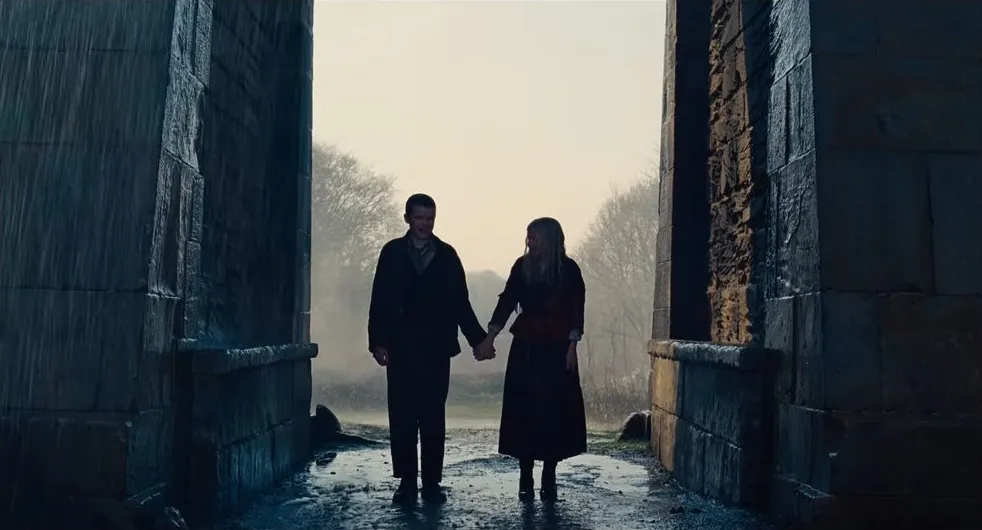
Catherine Earnshaw and Heathcliff walk hand in hand beneath a large stone archway in a cinematic still from Wuthering Heights, silhouetted against soft misty light in a rural landscape. Courtesy of Warner Bros. Pictures

​Young Catherine Earnshaw & Heathcliff in Wuthering Hights (2026). Courtesy of Warner Bros. Pictures © Warner Bros.Warner Bros.© Warner Bros.

Ahead of unfortunate events, Catherine and Heathcliff stand in a dark corner, waiting for the rain to stop, while she speaks of the brightest blue sky which ‘cannot be covered up by anything’ no matter what. Ultimately, Catherine and Heathcliff remain like a blue spot, preserving their identities without compromise. The composition is entirely driven by emotion, reflecting the principle of thought. The self looms out of visual narrative within the existing discourse, at times becoming a crucial detail that turns down the movie’s general overview.

​

Costume as Identity and Performance

The colors, costumes, and creative direction rooted in the essence and central idea of the story capture the audience’s attention, referencing both the composition’s content and its spiritual dimension. This becomes even more apparent when the characters enter a new phase in their lives. Indeed, the narrative primarily focuses on the female heroine’s journey. Her mentality, selfhood, and conduct, viewed through this lens, reflect a life somewhat removed from reality. Jacqueline Durran’s art direction is now more prominent and stunning in conveying the fluid emotions of the grown Catherine Earnshaw (Margot Robbie), which inhabit a fantastical realm. In Gothic cinema, the flow of information from the unknown is often balanced by expressions of magical reality. This effect is achieved through intriguing costume choices that defy expectations and evoke a dreamlike quality reminiscent of a runway show.

​

Costumes from different time periods disrupt temporal perception, symbolizing how the self is constrained within existing reality. Drawing inspiration from widely recognized fairytales, Jacqueline Durran and Emerald Fennell collaborate successfully to create a fresh perspective on Wuthering Heights. The audience first meet Cathy as a young lady, she is still not a proper portrayal for Victorian values. Her cottagecore appearance matches her messy hair, which sways from side to side, evoking the girl she once was, living wild in the countryside. While the dress conveys a strength without compromising individuality, the corset detail simultaneously reveals how society gradually takes over that individuality. At the same time, her relationship with Heathcliff reaches a new level of intimacy compared to their deep-rooted childhood friendship. On the theme of “love”, Cathy sees herself as a mirror image of Heathcliff, identifying with him and expressing a divine connection between their souls. Her ‘sacrifice’ reflects not only devotion but also a fear of fully inhabiting the radical identity she shares with him.
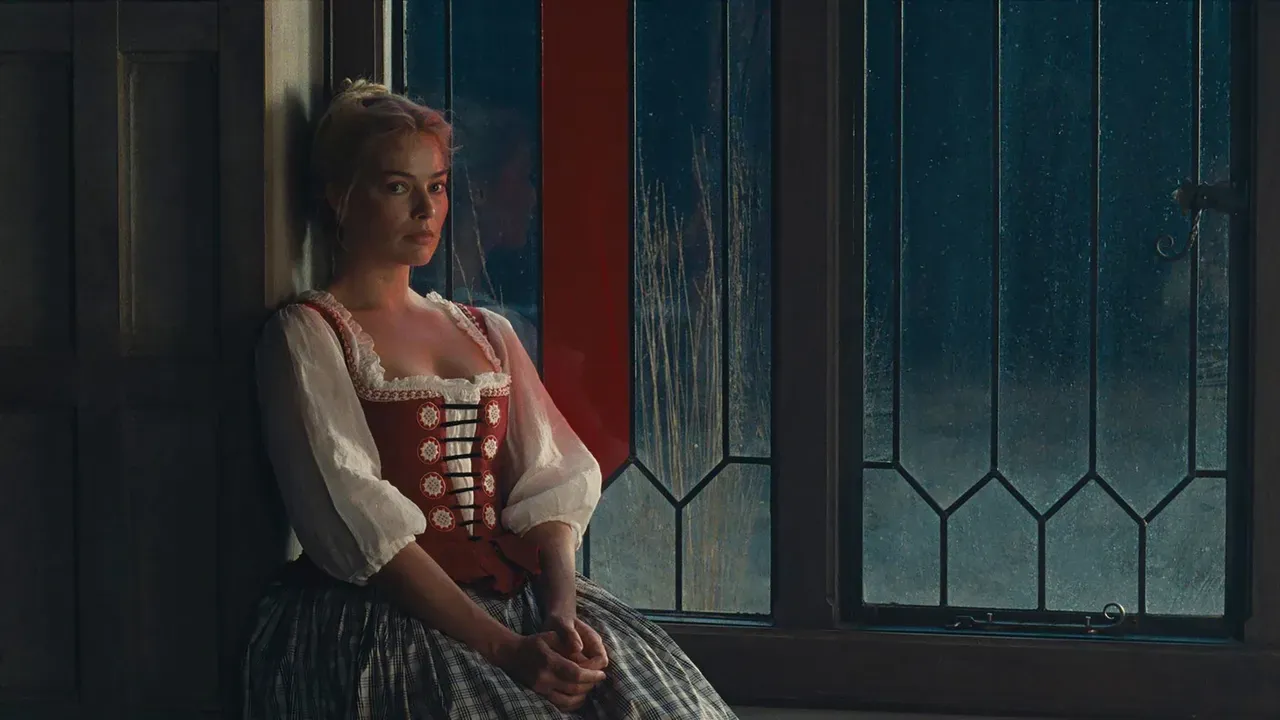
Catherine Earnshaw sits by a leaded glass window in a cinematic still from Wuthering Heights, wearing a cottagecore inspired dress reminiscent of a traditional German milkmaid style, softly lit in a moody period interior

Catherine Earnshaw, dressed in a “cottagecore” style reminiscent of a traditional German milkmaid dress. Courtesy of Warner Bros. Pictures © Warner Bros.

​

By idealizing Heathcliff as the embodiment of their shared essence, she displaces her own agency onto him, surrendering her freedom in the belief that he will carry it for her. At this point, Catherine serves up idealization, choosing social stability over authentic selfhood, convinced she has no alternative but to give up her identity. Her secret confession of love for Heathcliff to Nelly marks one of the movie’s pivotal turning points. Kneeling on the chessboard-like floor of the set, Catherine is unable to hold back her tears is a reference to the difficult choice she has made to survive. Catherine emerges as a heroine figure, bearing this suffering with resilience in both literary work and the film.

​

The story overall focuses on the female protagonist, Catherine Earnshaw, suffering as she turns away from her only love to adhere to the societal expectations and values of that era. In this respect, the character's choice to marry for social status instead true love restricts the freedom of her true self, betraying not only her love but also her own identity. This message is conveyed to the audience through visual imagery in the later sequences of the film. In particular, the moment when Catherine accepts her fate, standing in a wedding gown in a brightly lit area, holding a bouquet, emphasizes the wretchedness of her situation. Her expressionless face is barely visible beneath a veil, creating an aesthetic that allows the viewer to perceive beauty in ruin through a half-dead silhouette. The resemblance isn’t mentioned explicitly but the scene maybe a recreation of an Alexander McQueen’s 2006 runway show, which featured a Kate Moss hologram soaring through the air in a white dress.
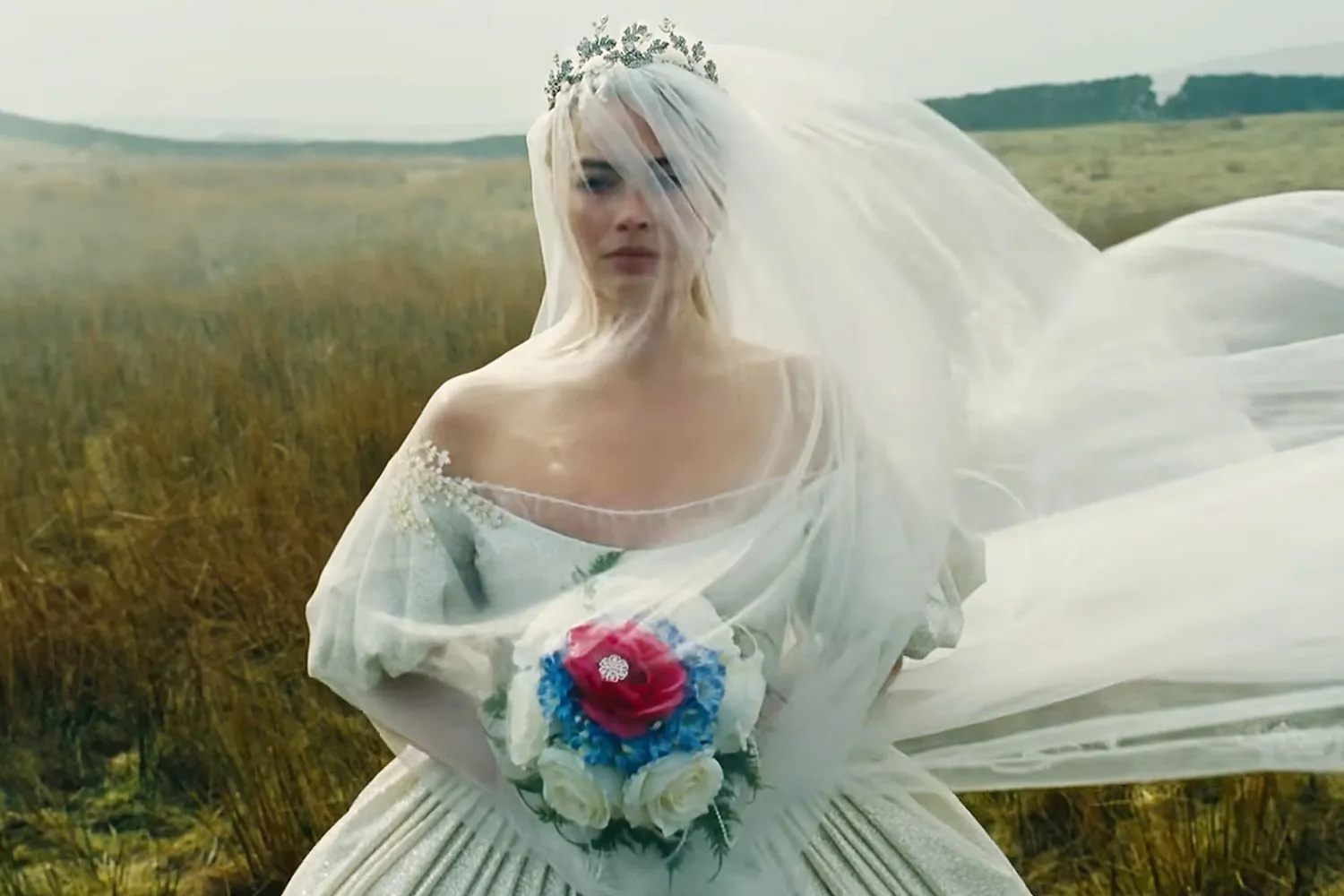
Margot Robbie as Catherine Earnshaw in Wuthering Heights, standing in an open moorland landscape wearing a flowing bridal gown and veil, holding a bouquet as wind moves through the scene in a romantic cinematic still

Margot Robbie as Catherine Earnshaw in Wuthering Heights (2026). Courtesy of Warner Bros. Pictures © Warner Bros.​

​

This creates an aesthetically pleasing, fantastical image while her soul is wrenching. The fashion-led approach, attuned to intense feelings, stylishly offers how a person can experience dying slowly, day by day, as an art. Still, she prefers to maintain her attitude while sharing the stage with Heathcliff at her father’s funeral. The self is already isolated and lost its core, so even death cannot inflict pain anymore. The film suggests that wedding and funeral ceremonies hold a similar emotion due to transition from white to darker color palettes.
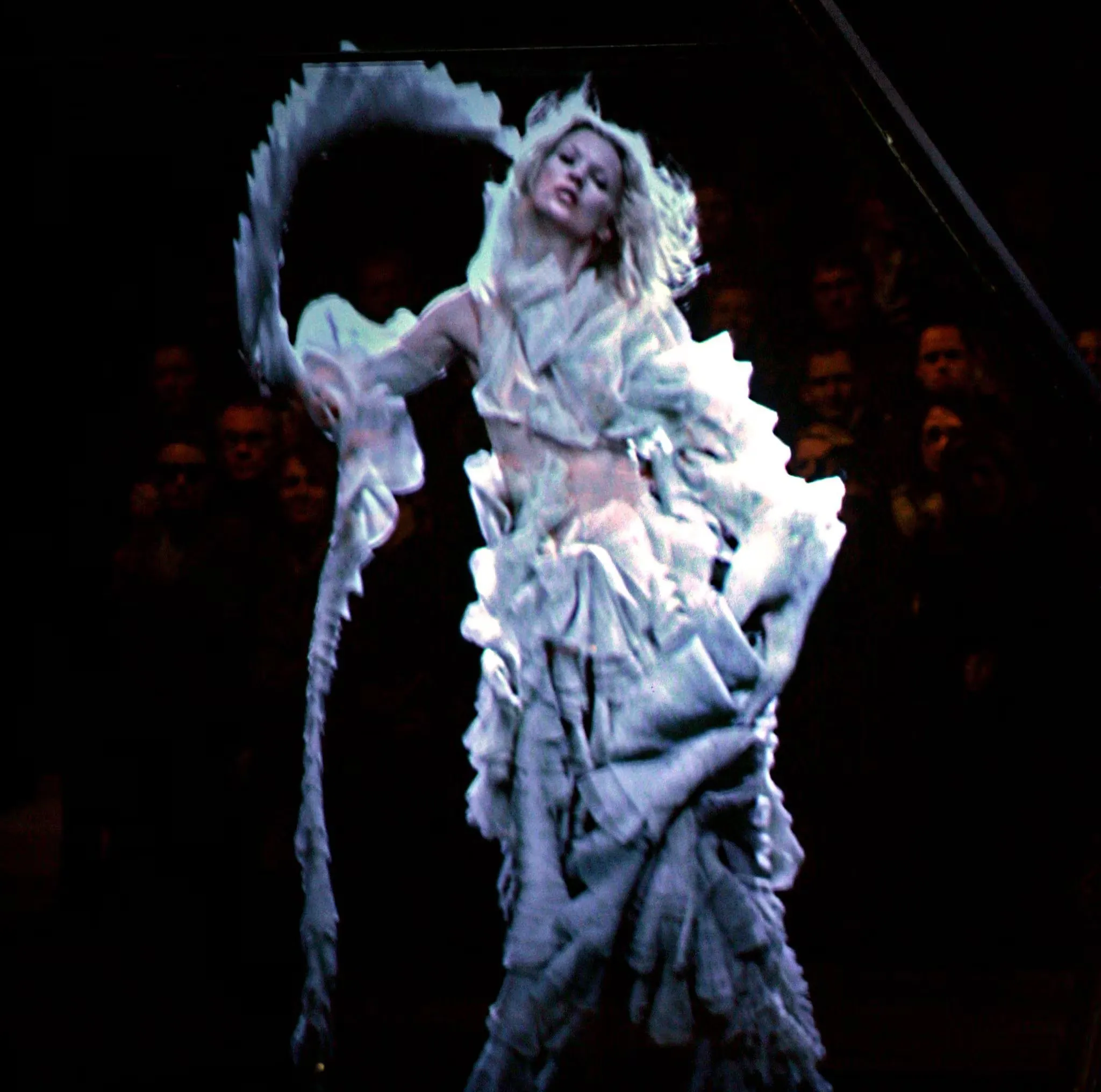
Kate Moss appearing as a hologram during the Alexander McQueen runway show in 2006, suspended within a glass pyramid and surrounded by dramatic theatrical lighting in an iconic fashion moment

Kate Moss Hologram, Alexander McQueen Runway Show 2006.​

​

The Illusion of Domestic Perfection

Remembering the idea of being at home from Catherine’s childhood memories is replaced by the discovery of Edgar Linton’s mansion, and thus the meaning of home redefined once again. Unlike the original Wuthering Heights and other Victorian-era settings, the ambience now depicts more vivid colors, that leave behind the previously pale tones. Catherine finds herself in this new realm has similarity to Alice’s long fall down the rabbit hole, ending up in Wonderland. Much like Alice, Catherine’s curiosity leads her into trouble and captivates her in this deceptive, seemingly perfect, and isolating world. While it initially fuels her excitement, it soon ensnares her, presenting an illusion of perfection that masks a subtle captivity, in which her body and being feel trapped.
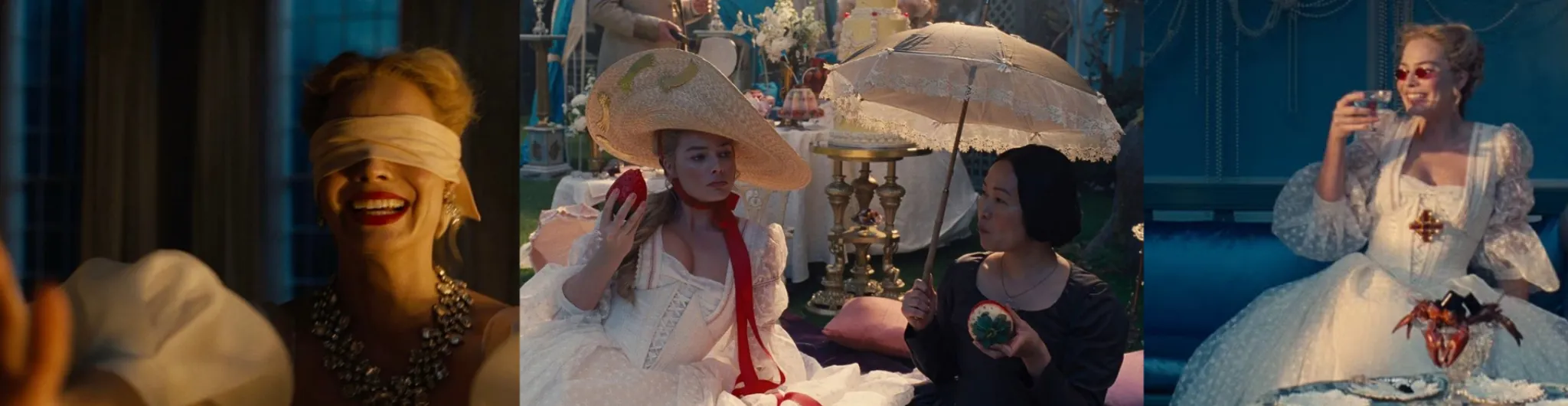
Catherine Earnshaw, portrayed by Margot Robbie, attends a lavish garden party alongside Nelly, portrayed by Hong Chau, shown across cinematic scenes featuring ornate period costumes, decorative hats and an elegant social gathering atmosphere

Catherine Earnshaw (Margot Robbie) & some events (garden party) attend with Nelly (Hong Chau). Courtesy of Warner Bros. Pictures © Warner Bros.​​

​

Whereas the painful truth of being a woman condemns one to eternal loneliness, it also traps her in an idealized world. Life settles into an illusion where truth cannot be denied but is rendered symbolic. This is what happen in magical realism: the pain still there albeit in a less obvious way. Catherine’s behavior demonstrates how hard she struggles to find a new direction, whether by wearing red glasses or covering her eyes with a piece of fabric, alluding to the famous saying, “looking at the world through rose-colored glasses.” In the film, magical realism arises as a result of evoking this pain. Normally, a person attempting to adapt to a new identity remains unaware that her spirit is slowly fading. Catherine cannot consider herself a part of Edgar’s household. Instead, the enchanted life there possesses her, and the viewer perceives her as someone performing amidst entertaining moments.

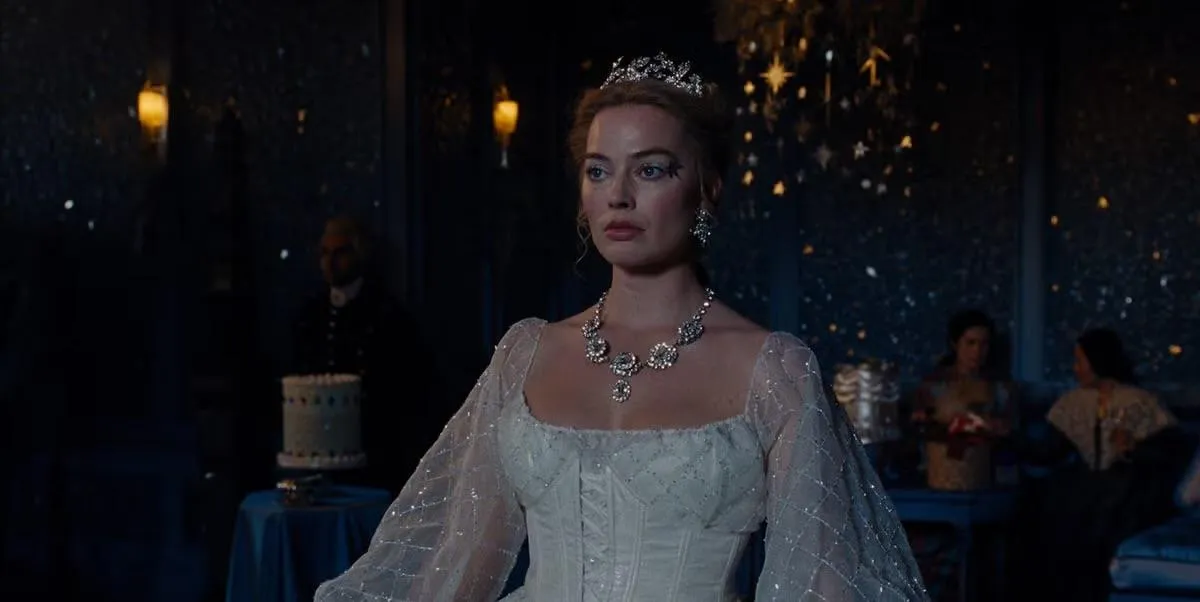
Catherine Earnshaw, portrayed by Margot Robbie, stands in an elegant ballroom wearing a white period gown, tiara and jeweled necklace, surrounded by soft candlelight during a formal evening gathering scene from Wuthering Heights

Margot Robbie as Catherine Earnshaw in Wuthering Heights (2026). Courtesy of Warner Bros. Pictures © Warner Bros.​

​

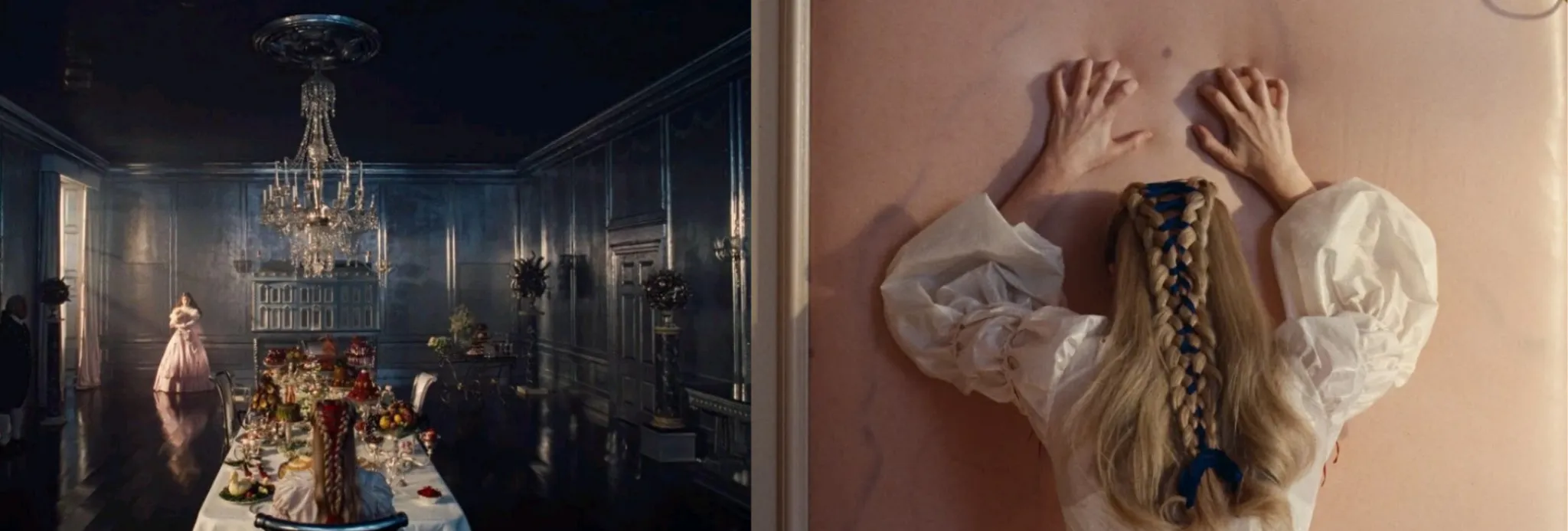
Physically, she is at the present, much like a doll designed for her by Isabella; yet her spirit is elsewhere, with Heathcliff. Based on this, she stares at this world with a certain coldness. Remembering The Snow Queen whose heart numbed in accordance with her loss. She has lost both the home she once considered her own so does identity, including her connection with Heathcliff.  Actually, her attitude cannot be considered as freezing, she protects the fragments of her soul that equals to Heathcliff. Similarly, Alice (from the fairy tale) finds out something is wrong in her new home, Wonderland, since she senses her body is held captive and feels like a stranger in this artificial world. Inspired by Catherine’s freckles, the room is perfectly designed to quietly embody personified loneliness and the entrapment of being female. Her hair, now tightly bound and carefully arranged, visually symbolizes neatness and confinement. The more perfect her outward appearance becomes, the more unbearable her inner pain grows. Despite her decaying soul, there are small routines she can still control in subtle ways such as her meals, cakes and sweets, and her forms of entertainment. The entire set around Edgar Linton’s house, is a representation of intrinsic aspects of Victorian Era that are constructed and maintained within the community. Yet the narrative frame distracts Catherine from awakening to her true identity. Though the brightly-colored aesthetics, like the gilded interiors in Mary Antoinette, appear lavish, the house remains no different from a prison.

Split cinematic still from Wuthering Heights showing an opulent dinner setting Catherine Earnshaw attends alongside a contrasting scene of Catherine pressed against a wall inside a symbolic room inspired by the freckles on her face, evoking themes of confinement and social entrapment.

Split still from Wuthering Heights (2026) showing a dinner setting Catherine Earnshaw attends alongside a scene of Catherine pressed against a wall inside a symbolic room inspired by the freckles on her face. Courtesy of Warner Bros. Pictures © Warner Bros.​

​

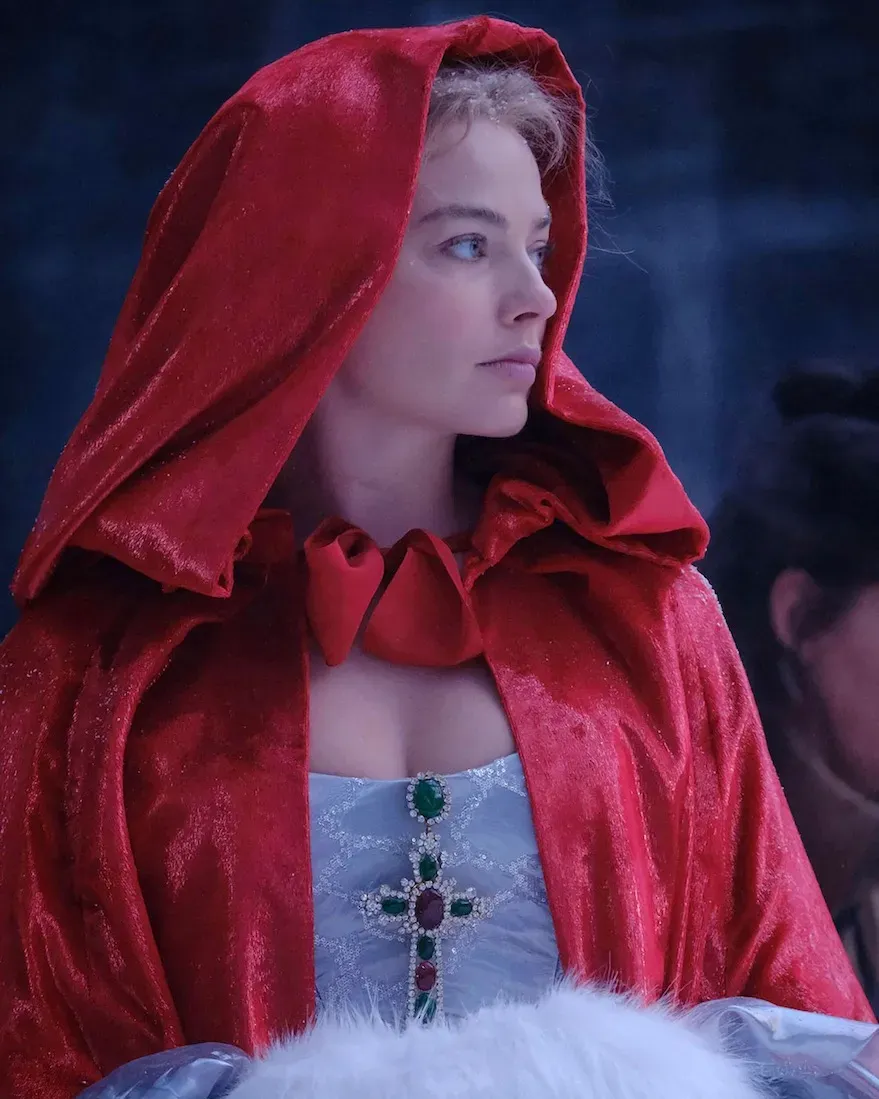
Small pleasures embedded throughout the scenes are coupled with repressed desires, eternal despair and emotional gaps. Catherine’s resistance lies not in open defiance, but in her inner, untamed essence that refuses to be erased. Apparently, the surroundings arrange her suffering by consuming. Overall, the film manipulates the audience on silence heavier than the dialogues, bringing the plot a fresh perspective. What it is meant to be by representation is that alludes to aesthetic way of reality or a settled order, while simultaneously rejecting the judgements as if hints there is a possible and direct reality of description. The sequence of events and Catherine’s fate shift dramatically as her identity begins to fade. Outside the Edgar’s house, the most authoritative figure is Catherine’s father, whose misplaced assumptions shape her perception and generate narrative tension for the audience. To visit her father, the visual ambience operates the imagery of the Little Red Riding Hood, with the young girl comes across a wolf in disguise. Except for Catherine, the other characters remain firmly within the Victorian diegesis. This intertextuality presents upcoming latent danger which will come from her father’s abusive behaviors upon her. His authority deepens the meaning of the scene. Even when Catherine enters her father’s space appearing in full control, there is still something unhinged her inside. For this, this sequence not only brings a critical lens on cultural restriction, but also sentimentality how the father figure exerts control towards her identity.

Catherine Earnshaw, portrayed by Margot Robbie, wearing a vivid red hooded cloak over a jeweled period dress, shown in a cinematic close up from Wuthering Heights against a cool toned atmospheric background

Margot Robbie as Catherine Earnshaw in Wuthering Heights (2026). Credit: Capital Pictures / Alamy Stock Photo

​​

Performance, Collapse and the Aestheticized Self

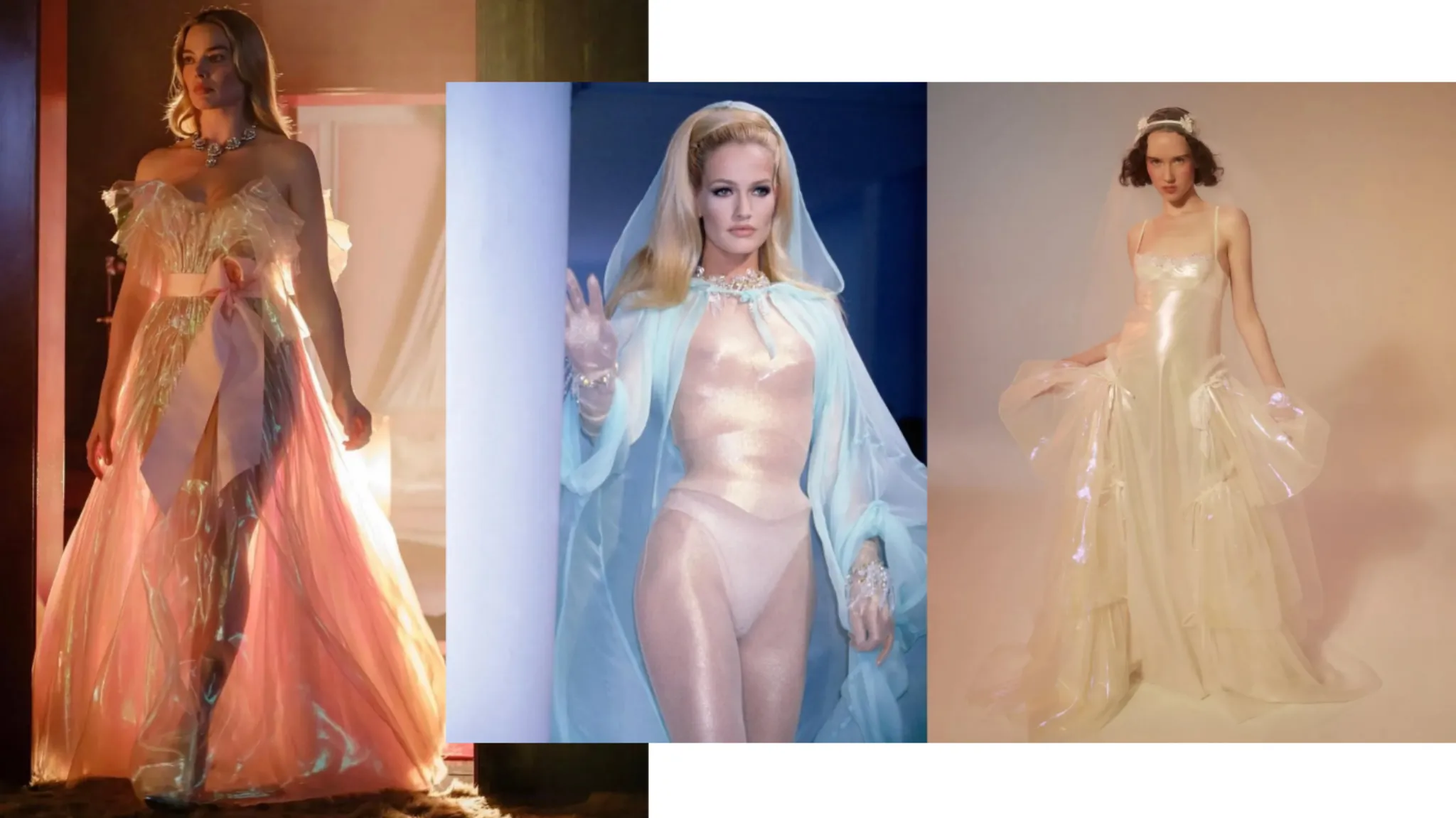
Delivering the stages of her physical collapse present a spectacle akin to the tragedy of Moulin Rouge. Now, Catherine shares the ill fate of Satine that becomes both performer and victim of the world that confines her; her body weakens as her inner life intensifies. In this context, identity is neither stable nor secure rather it is staged, aestheticized, and ultimately sacrificed within spaces that promise glory but deliver captivity. The film evolving in a course that Catherine’s identity seems detached from the viewer; she turns into an actress awaiting her next move. Since the story now transformed into a show, she strives for her life depends on it. The costumes gain heightened prominence in these sequences. Regardless of her pain or ruined make-up, “the show must go on”. 

Visual comparison of Catherine Earnshaw’s dreamlike wedding night dress worn by Margot Robbie in Wuthering Heights, shown alongside costume inspirations referenced by designer Jacqueline Durran, including a Thierry Mugler Spring Summer 1996 runway look at center and a design from Honor NYC Spring 2024 Collection VIII at right.

​Catherine Earnshaw’s (Margot Robbie) dreamlike wedding night dress (Courtesy of Warner Bros. Pictures © Warner Bros.​) & inspirations from Jacqueline Durran’s perspective, Thierry Mugler spring/summer 1996 look (middle), Part of Honor NYC’s Spring 2024 Collection VIII lineup. (on the right)

​

The wedding night dress cannot be separated from fairy-tale-like look, which intentionally serves the film’s magical structure, leaving the audience uncertain whether it is real or not. At the same time, Durran’s inspiration draws from a mix of Thierry Mugler spring/summer 1996 collection and Honor NYC, thematically communicating with the audience. As Catherine increasingly alters into a performer, she no longer attunes on her own life; the costume ceases to function merely as clothing. It objectifies her and shapes her lifestyle. As in many fashion shows, the concept arranged for the gaze is important than any single subject. It is fair to say that female identity here is replaced by Victorian ideals.

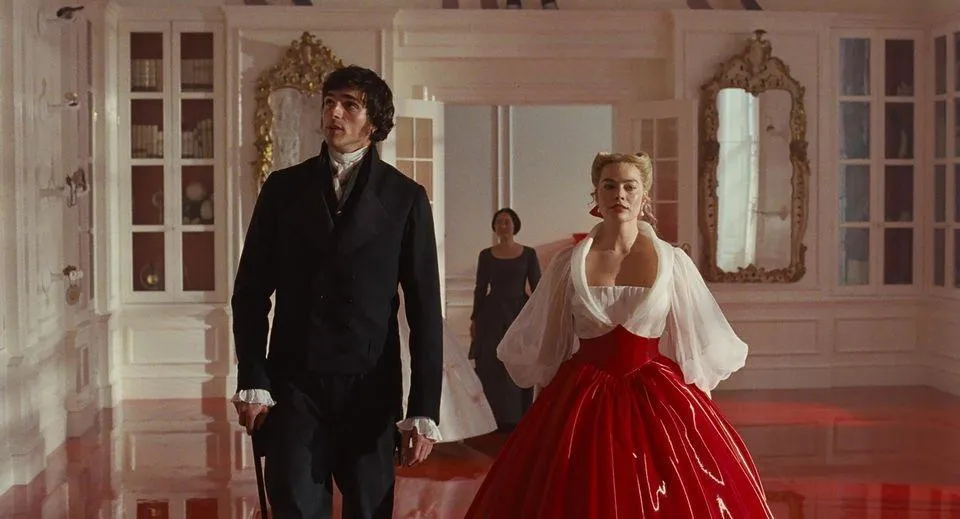
Heathcliff, portrayed by Jacob Elordi, walks beside Catherine Earnshaw, portrayed by Margot Robbie, as Nelly follows behind in a grand interior hallway, evoking a homecoming scene recalling earlier days in Wuthering Heights

Heathcliff (Jacob Elordi), Catherine (Margot Robbie) & Nelly (Hong Chau) show up home scene like good old days.​ Courtesy of Warner Bros. Pictures © Warner Bros.​

​

Returning home means reunite with Heathcliff which Catherine’s supposed identity is shattered, and the pretending is over. This is the female heroine’s struggle for identity which is connected with the theme of love to Heathcliff even there is no specific issue. Her vibrant red dress gives her a powerful look. The color of red symbolizes the blood, courage and sacrifice. She must have been reborn and somebody’s life must have passed on to her. This is the moment resurrects the desires and unspoken emotion in rough. The erotic attraction between Catherine and Heathcliff takes into account a powerful rebellion that disturbs Catherine's social identity with Edgar. The thing between them more than a desire or artificial order imposed by the system. Such a love that contradicts formed life cannot last forever, theirs is doomed for tragedy. Consequently, the film unfolds the most powerful conflict Catherine’s “slowly dying” or withered self, even it seems to be aesthetic perfection. The whole novel and the movie questions the possibility of freedom. After taking its source from literature, Emerald Fennell undoubtedly gives successful example of remake. At its core, the film’s storytelling acknowledges its fictionality while exploring broader truths on the verge of tragedy.​

Date

02.03.2026

Tags
Film & MediaWuthering Heights 2026Emerald Fennell film analysisWuthering Heights adaptationMargot Robbie Catherine Earnshawgothic cinema aestheticsfilm costume design analysisJacqueline Durran costumesvisual storytelling cinemaliterary adaptation filmmagical realism filmfeminist film analysiscontemporary gothic cinema