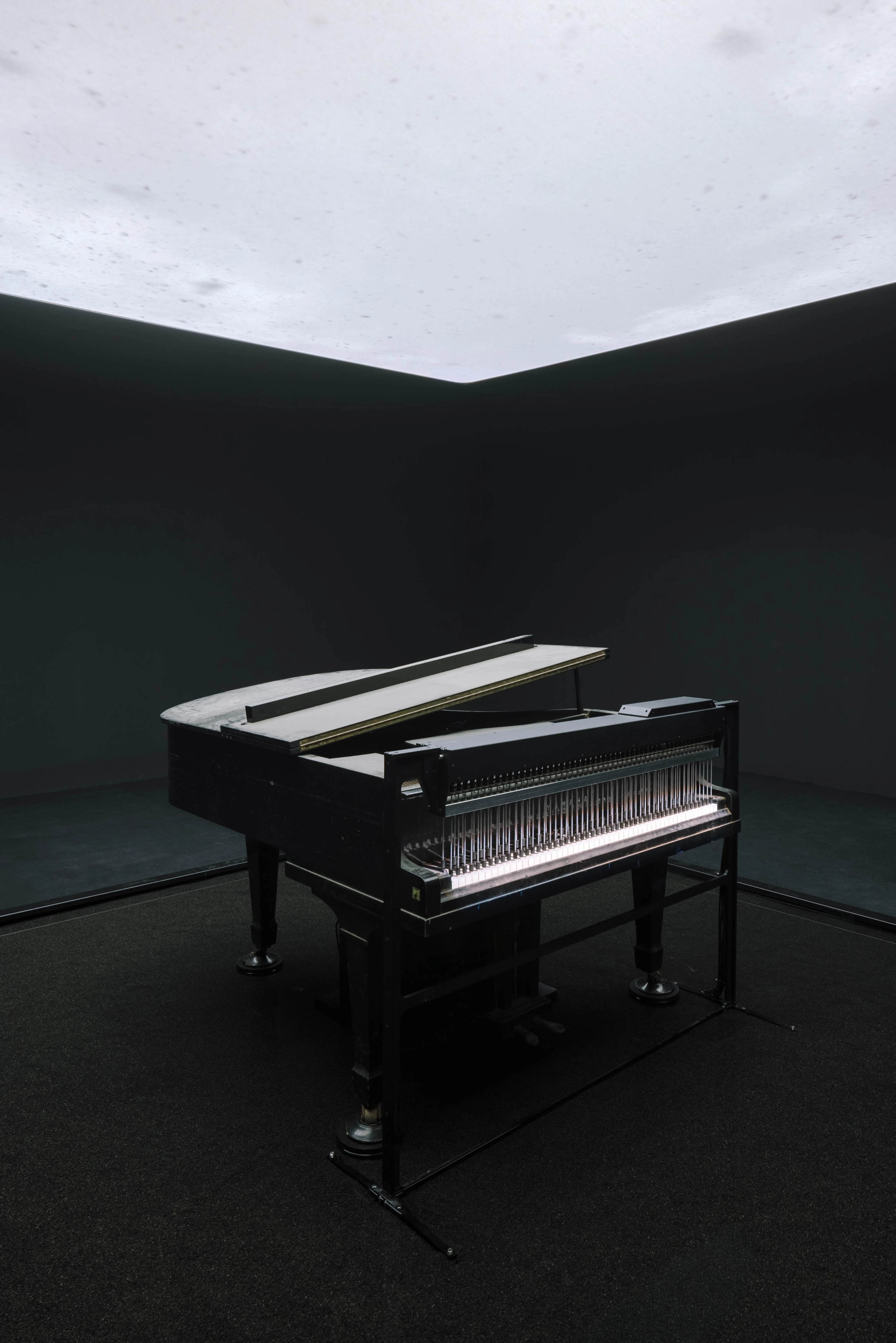
Enveloped in the darkness of an endless night, a damaged, out-of-tune piano plays a lone, sculptural note. Its keys move as if guided by an invisible choreographer’s hand. A gray sky of silent snow provides a counterpoint to the tub of water on which the piano rests. Depth, magic, and charm intertwine in the work of an artist who has effortlessly navigated the worlds of electronic and pop music for over four decades, crossing various genres, from contemporary compositions to original soundtracks, and has even ventured into performance and the visual arts.
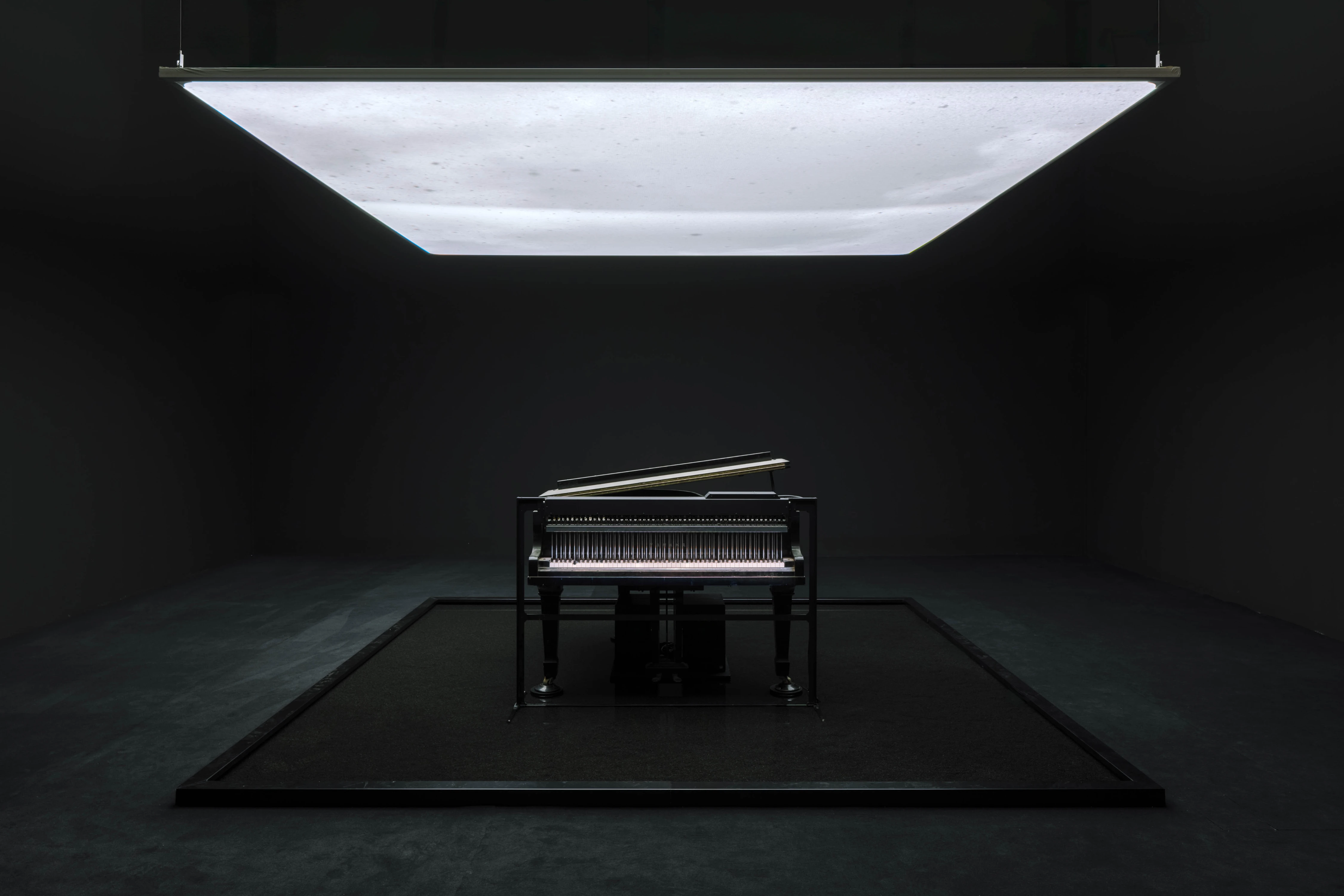
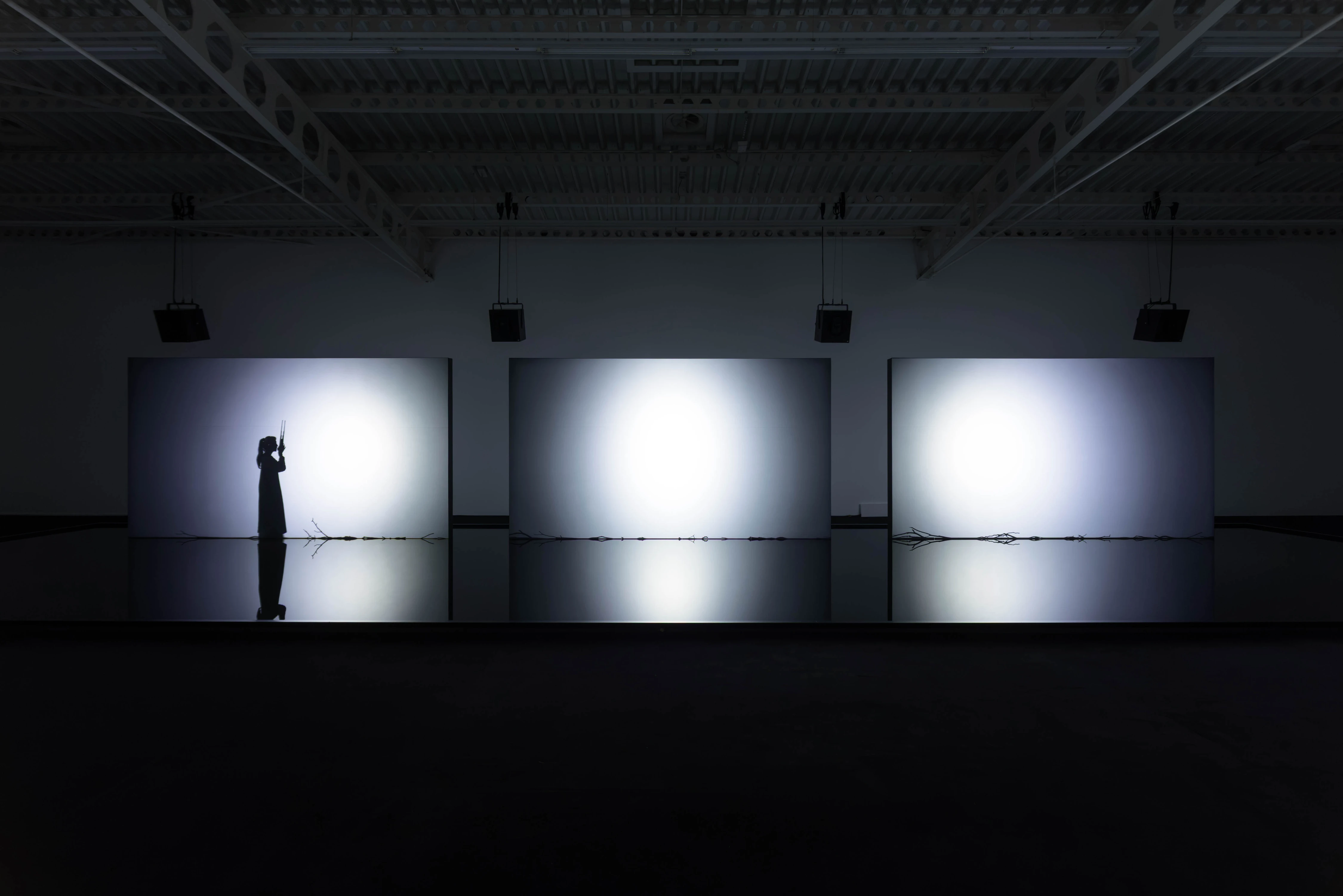
Ryuichi Sakamoto | seeing sound, hearing time, Ausstellungsansicht / Exhibition view, Hamburger Bahnhof – Nationalgalerie der Gegenwart, 11.9.2026 – 20.6.2027, IS YOUR TIME, 2017/2024, Ryuichi Sakamoto with Shiro Takatani © The Estate of Ryuichi Sakamoto / KAB Inc, Photo: Jacopo La Forgia
Ryuichi Sakamoto and Installation Music: Giving Sound a Physical Dimension
Ryuichi Sakamoto. seeing sound, hearing time at the Hamburger Bahnhof – Nationalgalerie der Gegenwart is the first major European retrospective dedicated to the late Japanese composer and artist. Sakamoto was a tireless experimenter drawn to technology and its flaws: error, interference, deterioration, and chance. He was an innovator long before terms such as “techno,” “ambient,” and “digital networking” became commonplace. He gained international recognition in Tokyo in the late 1970s as the co-founder of Yellow Magic Orchestra, a pioneering trio that combined electronic music, synthesizer technology, and digital production methods in unprecedented ways. Simultaneously, he developed an extremely diverse solo career, composing soundtracks for renowned directors such as Nagisa Oshima, Bernardo Bertolucci, and Alejandro González Iñárritu. Over the course of his prolific artistic journey, he received many prestigious awards, including an Academy Award for The Last Emperor (1987), two Golden Globes, and a Grammy. Beginning in the early 2000s, presenting music as an art form, primarily through installations, became increasingly important in his work. Through his collaborations with renowned artists from the fields of visual arts, film, and media, Sakamoto has created intricate soundscapes that bridge the gap between hearing and seeing, transforming the intangible, invisible, and inaudible into physical forms. Spanning approximately 1,500 square meters, the exhibition aims to explore the concept of "installation music" — music situated three-dimensionally in space — a field in which Sakamoto was a pioneer. The project brings together seven works organized into five sound environments which were conceived in collaboration with media artist Shiro Takatani, artist and musician Carsten Nicolai, and filmmaker and artist Apichatpong Weerasethakul.
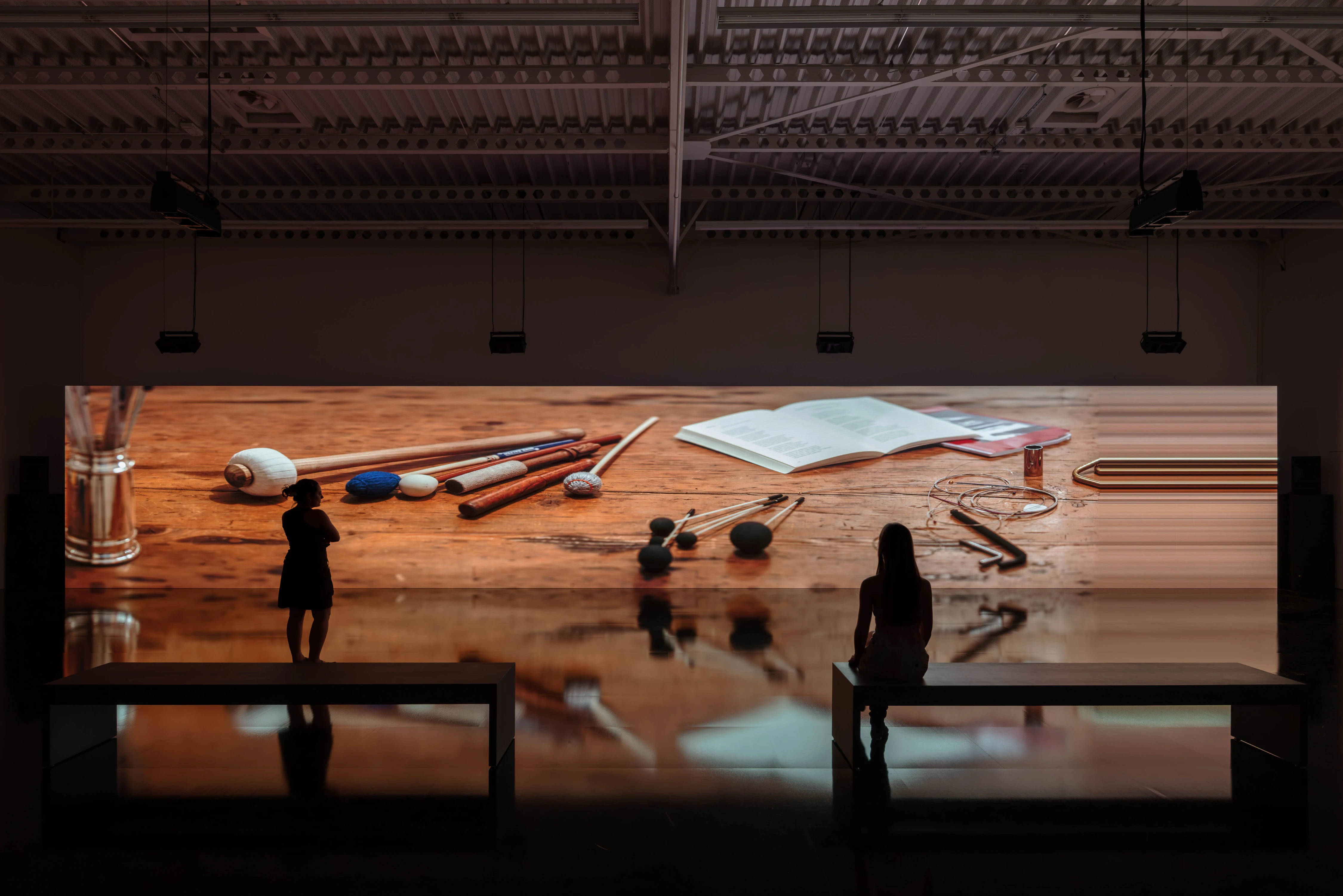
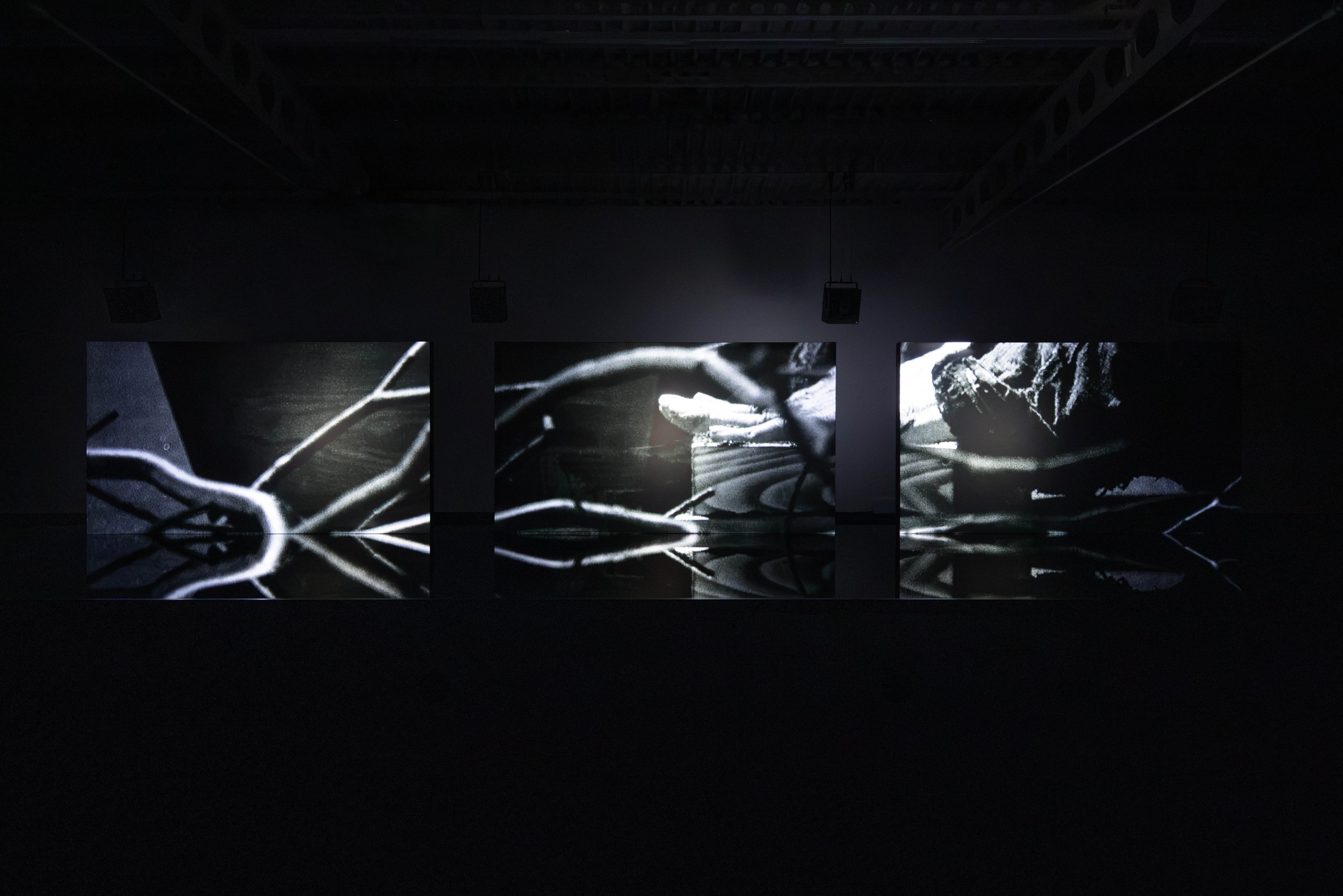
Ryuichi Sakamoto | seeing sound, hearing time, Ausstellungsansicht / Exhibition view, Hamburger Bahnhof – Nationalgalerie der Gegenwart, 11.9.2026 – 20.6.2027, async-immersion, 2023, Ryuichi Sakamoto + Shiro Takatani © The Estate of Ryuichi Sakamoto / KAB Inc, Photo: Jacopo La Forgia
Ryuichi Sakamoto’s Perception of Time: Beyond Chronological Succession
seeing sound, hearing time is part of the 30 Years Hamburger Bahnhof anniversary program showcasing Sakamoto’s ability to blend sounds, images, natural phenomena, and technology. It blurs the boundaries between music and visual art while delving deeply into the central theme of his work: time. As he himself stated, music is an "art of time" that exists only in time. Music is a dimension of becoming, not a linear succession of moments, but rather something that manifests as it disappears: the interval between two sounds, the trace of what has just happened, a presence already permeated by its absence.
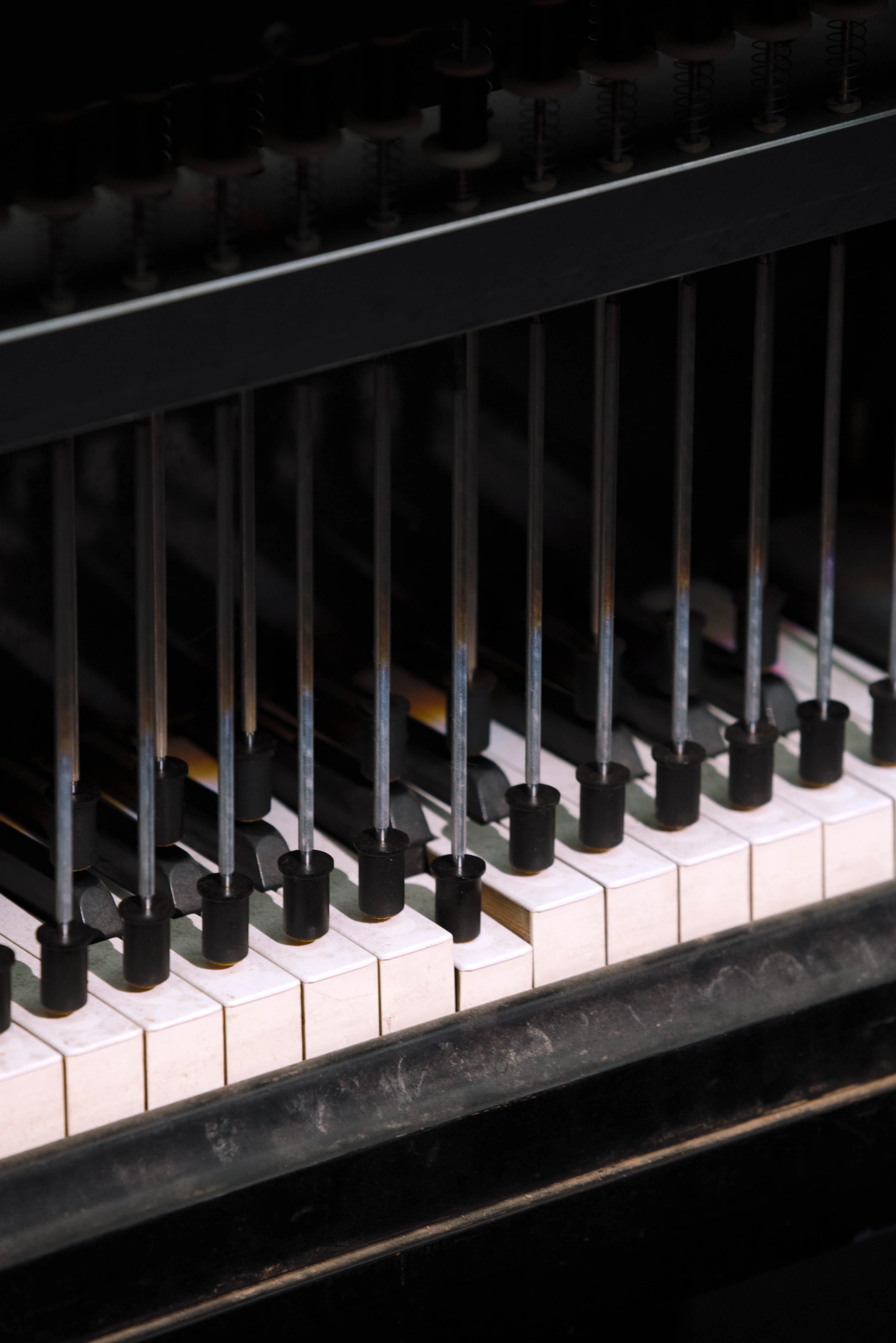
Sakamoto was always curious about how people from different cultures, both ancient and modern, perceived, experienced, and philosophically explained time. He was also curious about how music can transform our experience of time. The concepts of fragility, finitude, impermanence, and transience are prevalent throughout the exhibition, particularly in the artist’s later works. Confronted with a serious illness, the artist developed an increasingly austere and essential aesthetic. Nevertheless, he expanded the field of perception by engaging all the senses through sound and transforming it into a bodily experience—a dynamic network of relationships through which sensations and environments shape and generate one another. The show opens with the poignant melancholy of IS YOUR TIME (2017/24), an installation created in collaboration with Takatani, a member of the Japanese art collective Dumb Type and a longtime collaborator. The piano I mentioned at the beginning of this text was damaged by the Great East Japan Earthquake and subsequent tsunami in 2011. It is now placed inside a tank of water. The catastrophe stripped the piano of its original function, yet it simultaneously serves as a testament to the unstoppable force of nature. An automatic mechanism activates the keys based on seismological data from around the world, converting it into sound signals. Thus, earthquakes occurring anywhere on the planet produce unpredictable, imperfect, and unfinished sounds.
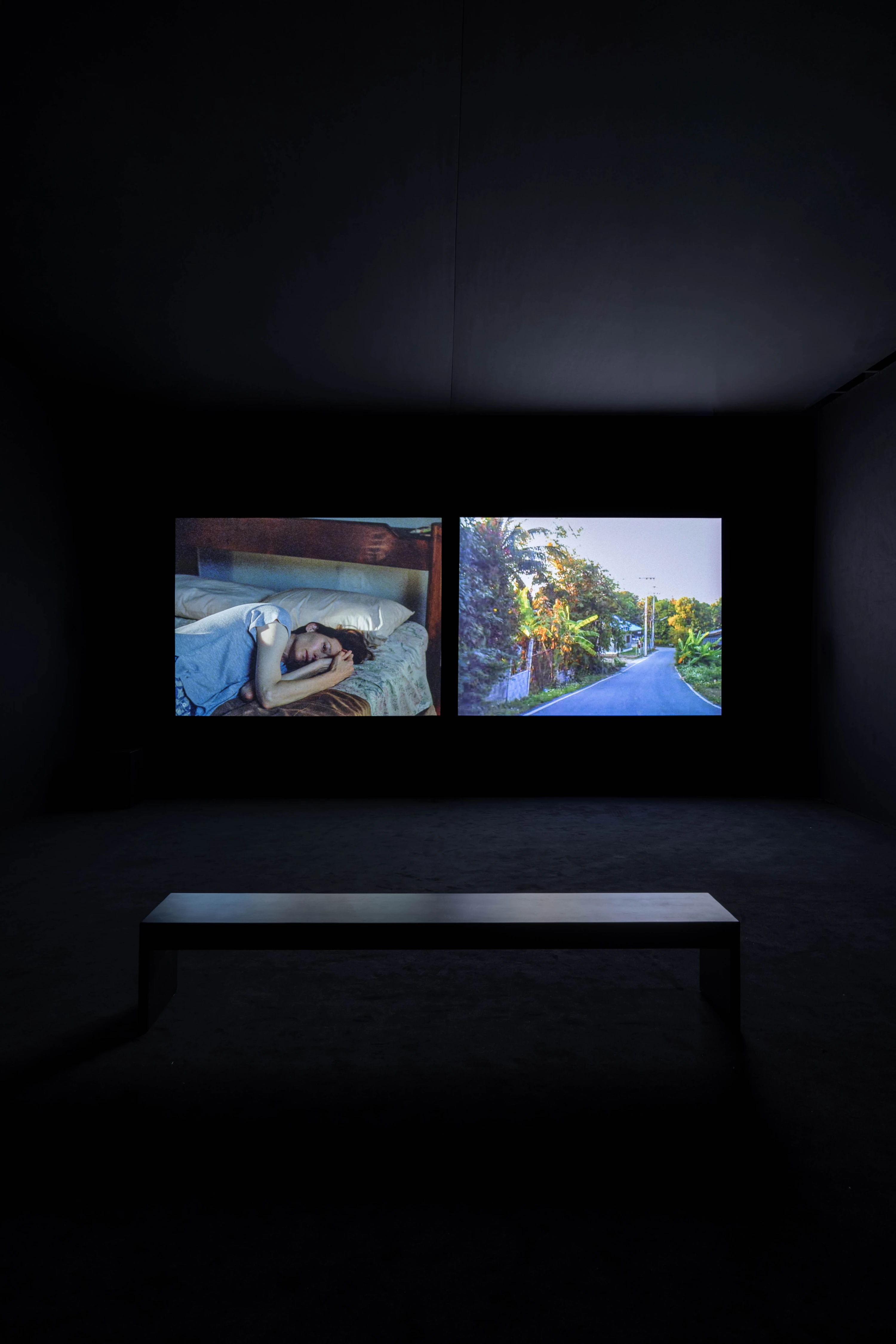
Ryuichi Sakamoto | seeing sound, hearing time, Ausstellungsansicht / Exhibition view, Hamburger Bahnhof – Nationalgalerie der Gegenwart, 11.9.2026 – 20.6.2027, async-immersion, 2023, Ryuichi Sakamoto + Shiro Takatani © The Estate of Ryuichi Sakamoto / KAB Inc, Photo: Jacopo La Forgia
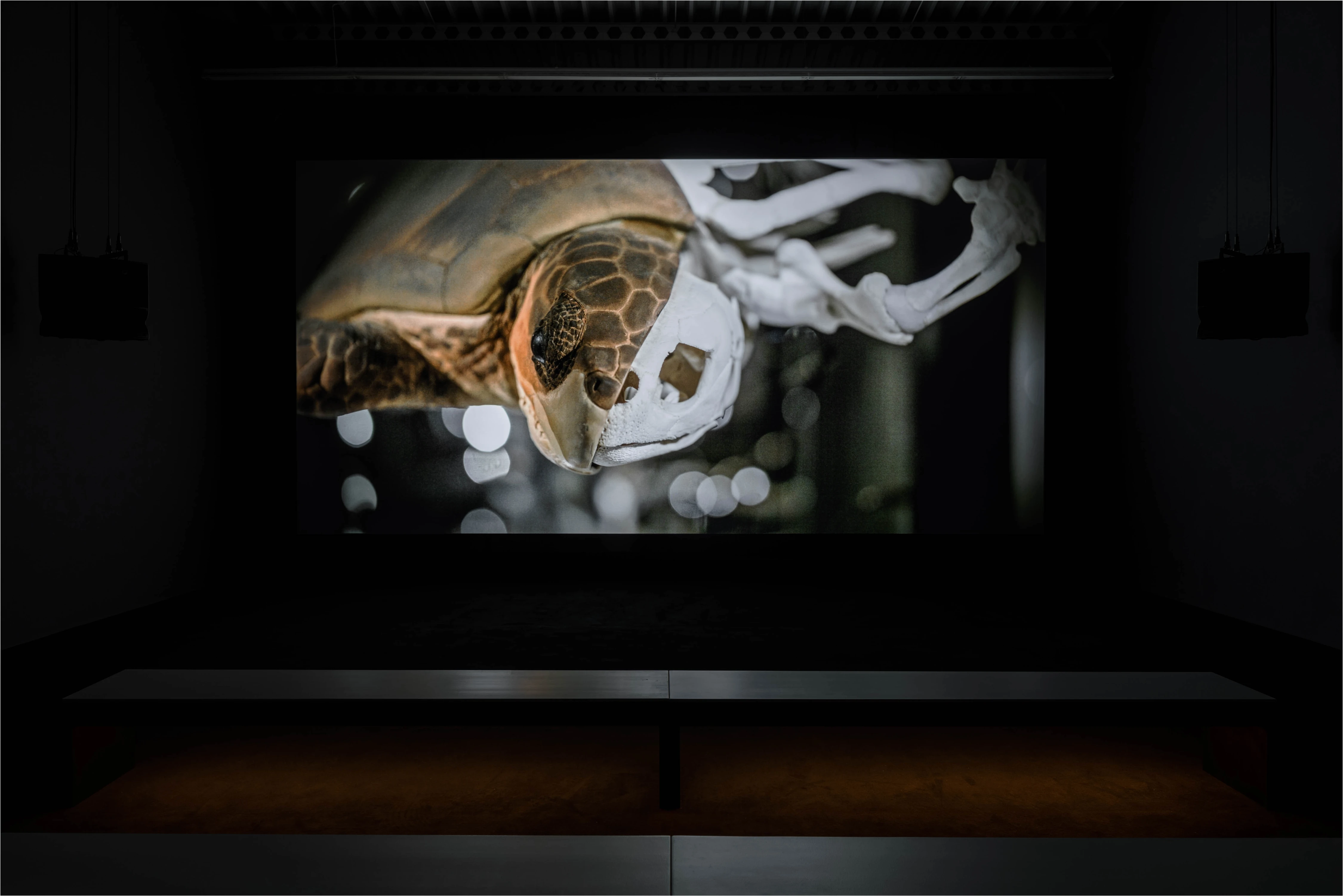
Ryuichi Sakamoto | seeing sound, hearing time, Ausstellungsansicht / Exhibition view, Hamburger Bahnhof – Nationalgalerie der Gegenwart, 11.9.2026 – 20.6.2027, async-immersion, 2023, Ryuichi Sakamoto + Shiro Takatani © The Estate of Ryuichi Sakamoto / KAB Inc, Photo: Jacopo La Forgia
The subsequent installation, async–immersion (2023), was developed with Takatani based on the album async. Fourteen audio channels transform the music into a three-dimensional environment. Viewers are enveloped by sound coming from every direction. On the eighteen-meter-long LED wall in front of them, fragments of Sakamoto’s New York studio—including the piano, books, instruments, and plants—emerge and disappear through lines, pixels, and layers. The image and music are deliberately asynchronous, each proceeding at its own rhythm. This produces two parallel temporalities that liberate the concept of time from chronological succession.
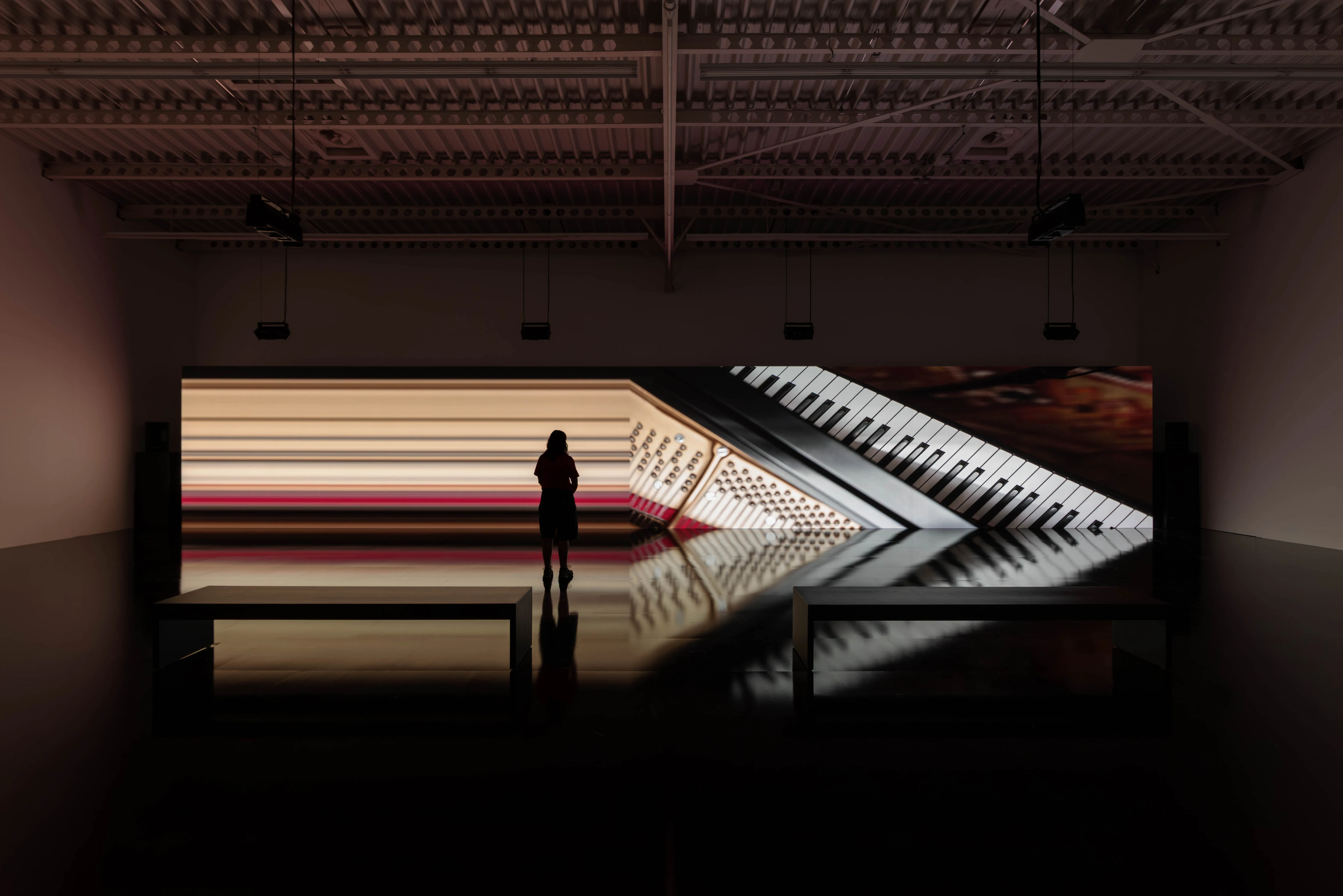
Ryuichi Sakamoto | seeing sound, hearing time, Ausstellungsansicht / Exhibition view, Hamburger Bahnhof – Nationalgalerie der Gegenwart, 11.9.2026 – 20.6.2027, async-immersion, 2023, Ryuichi Sakamoto + Shiro Takatani © The Estate of Ryuichi Sakamoto / KAB Inc, Photo: Jacopo La Forgia