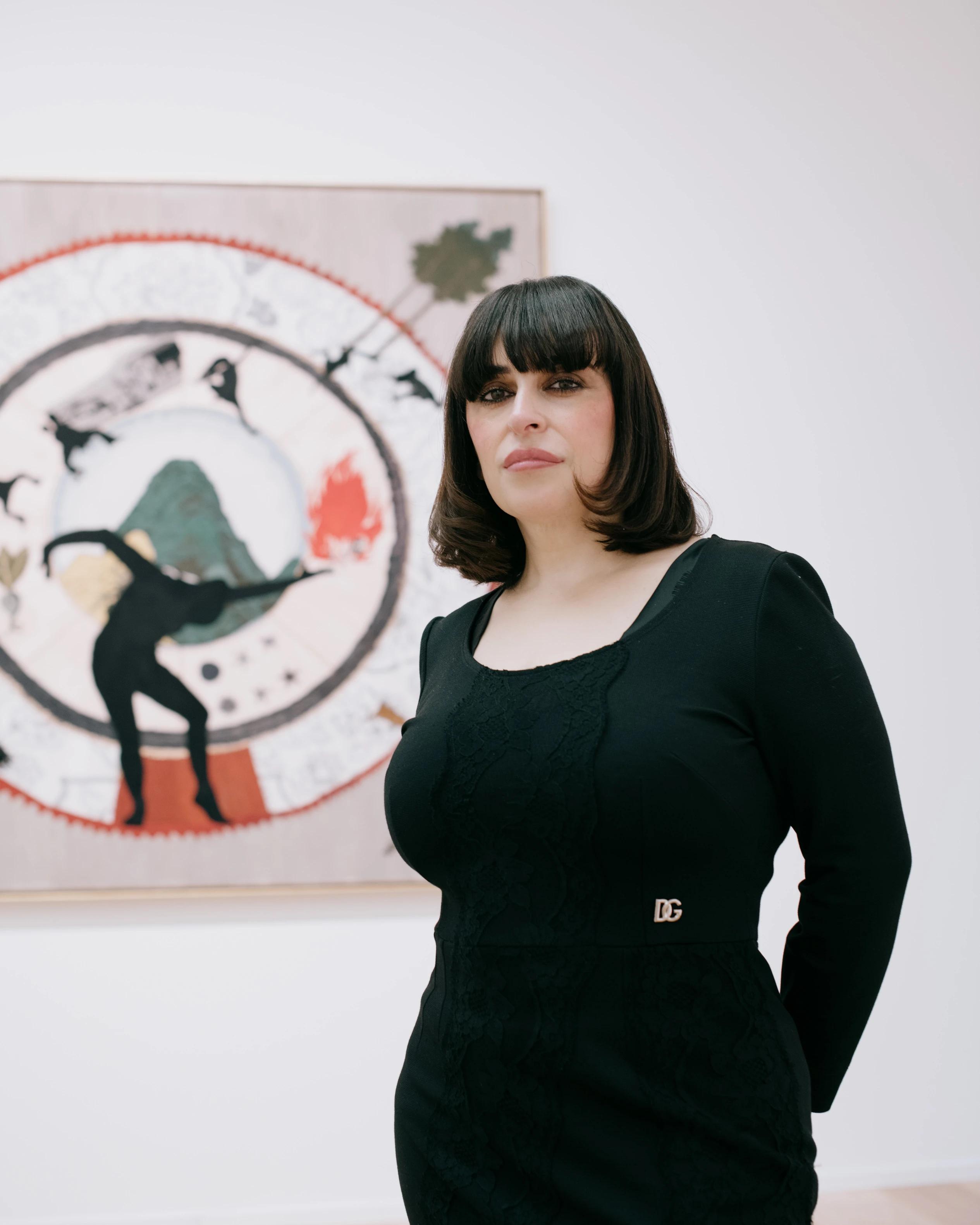
Marinella Senatore (b.1977, Italy), is a multidisciplinary artist whose practice spans performance, cinema, music, drawing, installation, light sculpture, painting, collage and textile. Senatore redefines the boundaries between artistic creation and collective participation. The idea that art can activate processes of individual emancipation and social transformation is central to her work. She transforms the diversity of human experience into a space for dialogue, negotiation, and cultural production.
In 2012, she founded The School of Narrative Dance (SOND), a nomadic, free, and non-hierarchical school conceived as a platform for shared learning. The critical significance of her work lies in its challenge to traditional hierarchies between artists and audiences, as well as between individual authorship and collective intelligence. Before Art Basel Miami, where the Mazzoleni gallery will present a selection of her works, we met with Senatore to discuss three projects reflecting different aspects of her artistry: “I Contain Multitudes,” a luminous installation created for Chicago’s Millennium Park, “An Expanded Baroque Crown,” a new commission by Faena Art for Miami Art Week, and “The Theatre of Commons”, a series of hand-embroidered tapestries created in collaboration with the Chanakya School of Craft in Mumbai. These projects are all distinct expressions of her artistic practice, united by a desire to reconsider how art can generate a sense of belonging, memory, and collective awareness.
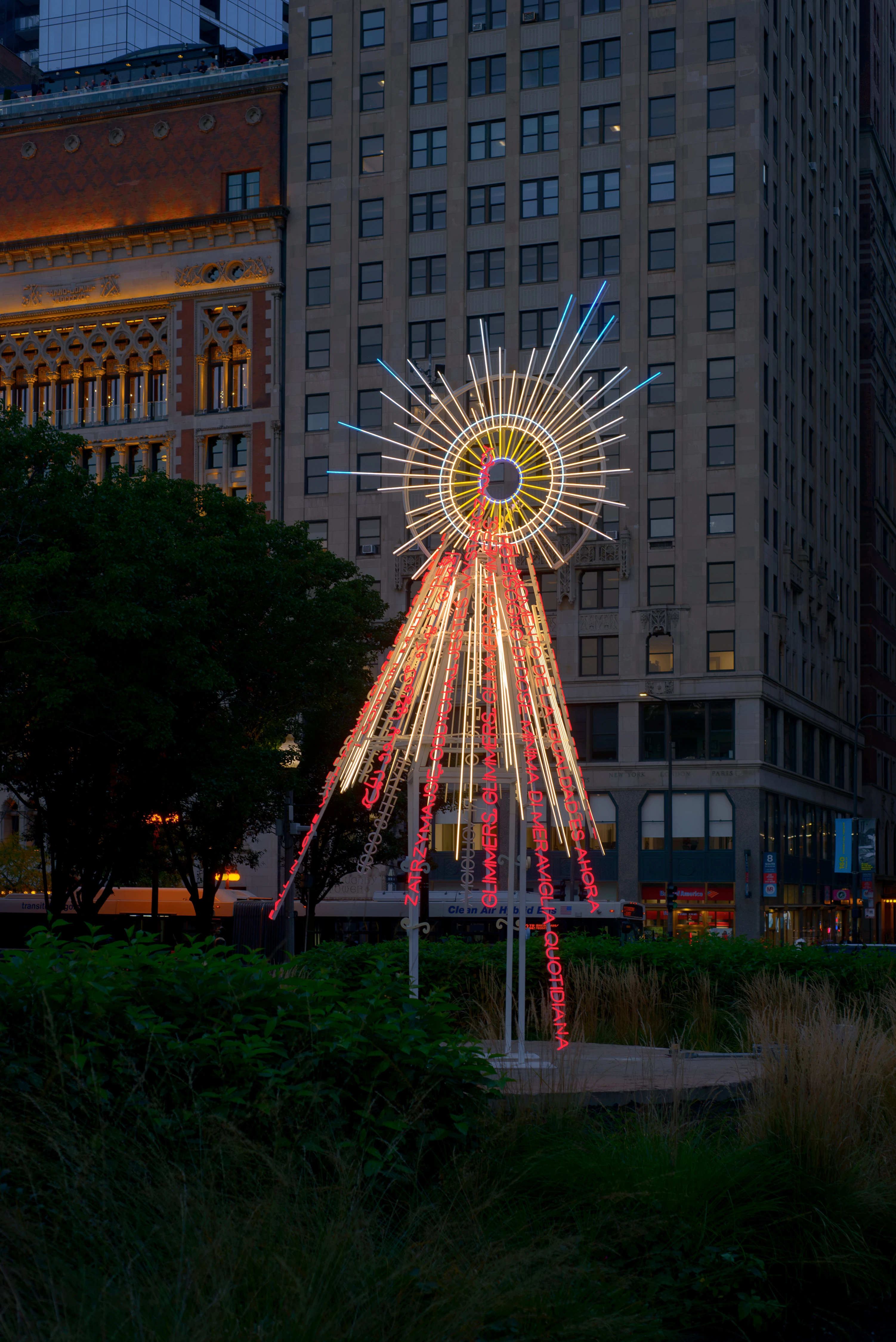
Marinella Senatore, I Contain Multitudes, 2026, Millennium Park. Photo courtesy of the Millennium Park Foundation.
"I Contain Multitudes": The Monument as a Space for Connection
Until autumn 2027, the entrance to Chicago’s Millennium Park on the corner of Madison Street and Michigan Avenue features a monumental light installation by Senatore, which was commissioned by the Millennium Park Foundation. Standing at about six meters tall, the piece is titled after a famous line by Walt Whitman. Unfolding as a temporary architecture of light and words, it displays messages of solidarity, inclusion, and self-determination in different languages. These phrases belong to the artist’s recurring vocabulary: “We Rise by Lifting Others,” “Bodies in Alliance,” and “Dance First Think Later.” When placed within the urban environment, they take on the character of public declarations addressed to a diverse multitude. The choice of Chicago is particularly meaningful. Historically shaped by migration, industrial transformation, and social tensions, the city provides a compelling context for an artistic practice that views public spaces as places where identities and forms of belonging are continually negotiated. Located at one of the park’s busiest entrances, the installation transforms a transit area into a potential meeting point. Here, Senatore offers a new perspective on her renowned luminarie, light installations and luminous sculptures that are among the most recognizable expressions of her work. These structures use light sources to create ephemeral architectural forms and geometric, ornamental, or figurative patterns. The artist reimagines traditional elements associated with popular and religious festivities, particularly in southern Italy, through a process of aesthetic and conceptual transformation.
“I draw on the language of Baroque art as a visual and conceptual device to celebrate community. My luminarie are produced in the Italian region of Puglia in collaboration with specialized artisans who have inherited technical knowledge passed down through generations. I am inspired by the pyrotechnic machines that belonged to a culture of spectacle during the 16th and 17th centuries. These machines transformed dynastic celebrations, coronations, religious festivities, and even funerals into grand collective performances.” This reference extends beyond folklore and beyond any sterile or nostalgic revival of popular customs and traditions. “I'm interested in this device's ability to function as a portal and create spaces for gathering and community, which is central to my artistic practice. Drawing on the traditions of luminarie and the Baroque allows me to create special spaces that become places of connection where extraordinary things can happen. The temporary nature of these structures is also key to my thinking. They are not permanent, nor do they obstruct the view.”
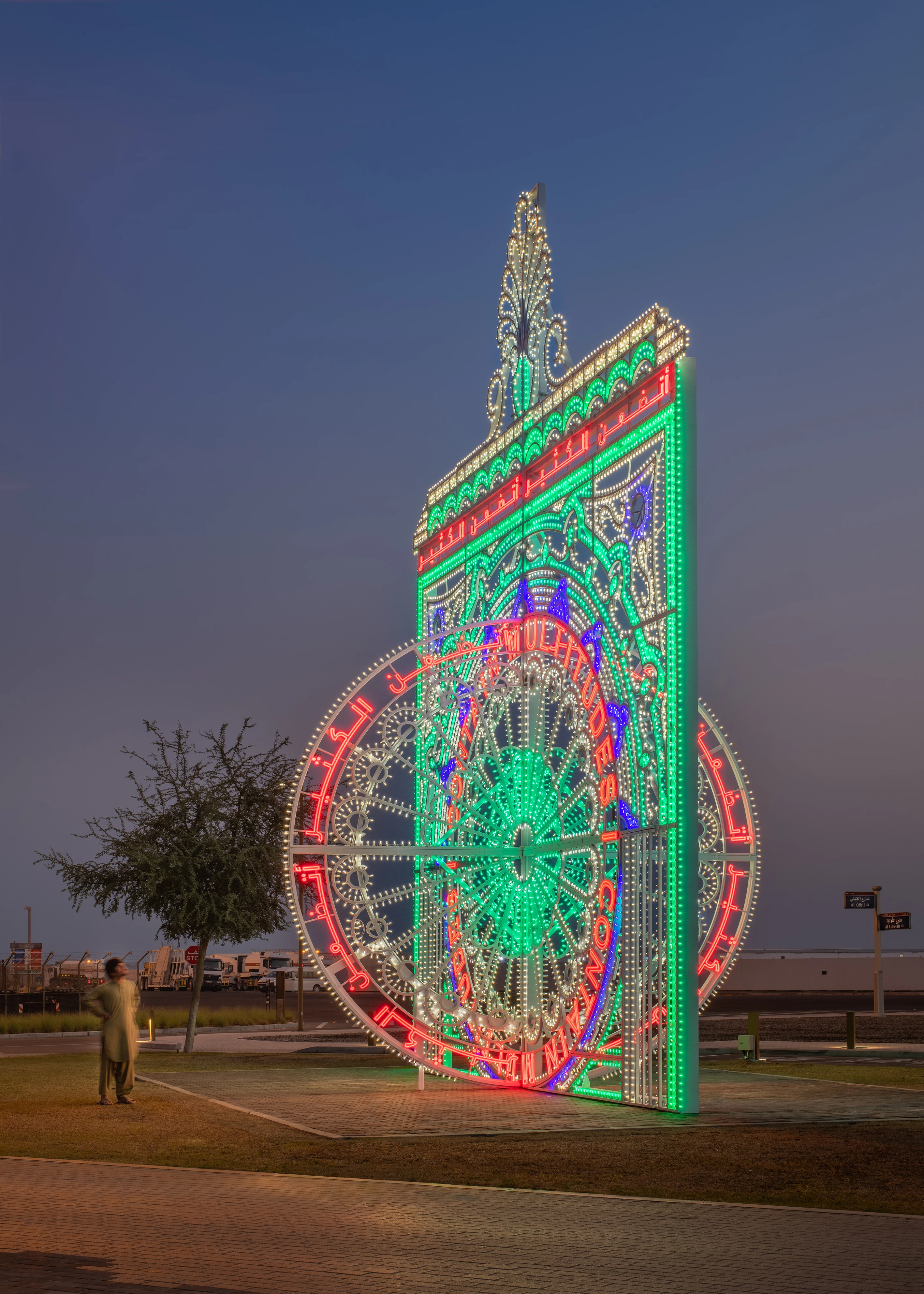
Marinella Senatore, I Contain Multitudes, 2026, Public Art Abu Dhabi Biennial 2026-27. Photo: Mazen Jannoun.
Senatore’s reinterpretation of luminarie reflects her understanding of the contemporary monument. She describes it as “an expanded idea of the monument, one that considers it not solely from a commemorative perspective as a stable historical testimony to the past, but rather as an instrument operating here and now for everyone, activating the surrounding space.” Her words resonate with the broader debate surrounding the function of monuments and the need to reconsider not only how societies construct and transmit public memory but also where monuments are situated. These locations are never neutral, but rather reflect specific cultural and political hierarchies.
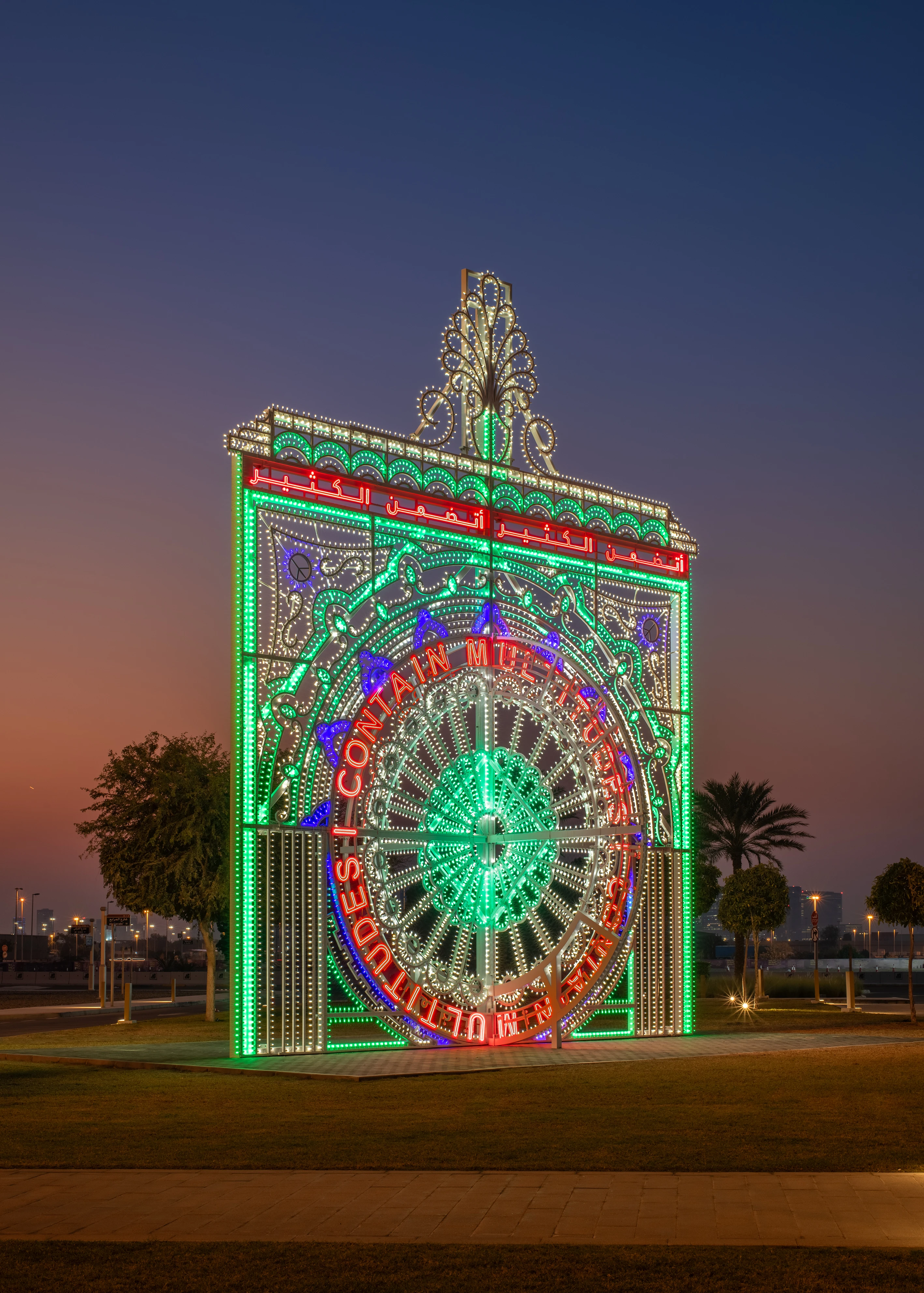
Marinella Senatore, I Contain Multitudes, 2026, Public Art Abu Dhabi Biennial 2026-27. Photo: Mazen Jannoun.
“An Expanded Baroque Crown”: A Public Square Within a Square
The same concerns underpin the site-specific installation commissioned by Faena Art for Miami Art Week 2026. From December 1 to 6, the work will be presented at the Faena Cathedral as part of a public art programme that also features Christopher Joshua Benton’s “A Lore Supreme.” Organized by Faena Art and supported by Chase Sapphire Reserve, this initiative presents a model of public art based on accessibility and participation. The installations are free and aim to transform the Faena District into gathering places for communities, artists, and visitors. Despite their different formal languages, the two projects share the idea that an artwork is an open structure whose meaning isn't limited to the physical presence of the object, but rather emerges through the experiences and relationships it enables. “I collaborated with Faena Art in 2016 through The School of Narrative Dance for 'Tide by Tide,' a public procession that was transformed into a participatory artistic experience curated by Claire Tancons,” she recalls. In “An Expanded Baroque Crown,” Senatore once again examines the relationship between ritual, celebration, and community through a luminous structure that reinterprets the form of a Baroque crown. Traditionally associated with authority and power, the crown is stripped of its symbolic function and transformed into accessible architecture designed to be inhabited. The installation is designed for visitors to move through. “This includes people with disabilities and those who are not guests of the hotel,” Senatore emphasizes. Located in an area known for its luxury hospitality, The Faena Cathedral has been temporarily transformed into a space where the boundaries between public and private are continually renegotiated. Free access to the installation transcends artistic appreciation and prompts questions about how places are perceived, experienced, and shared.
“The expanded crown transforms into an inhabitable luminaria that becomes a square within a square. The community will be able to use it as early as the inauguration. This creates what philosopher Judith Butler calls ‘bodies in alliance,’ referring to the political and transformative power of bodies coming together in public spaces. This concept is fundamental to me.” The luminaria will host readings, musical performances, dance, poetry, and other collective activities developed in collaboration with O, Miami, an organization dedicated to promoting poetry and cultural participation. “My aspiration is to create spaces where people can meet, develop a sense of agency, and feel that the artwork belongs to them.” The phrase “The Word Community Feels Good” further reinforces the centrality of collective experience. Inspired by Zygmunt Bauman’s book Community: Seeking Safety in an Insecure World (2001), the passage is part of the artist’s recurring vocabulary and emblematic of a practice that understands art as a dynamic construction shaped through ongoing dialogue and negotiation. The art’s generative power depends on the presence and interaction of people.
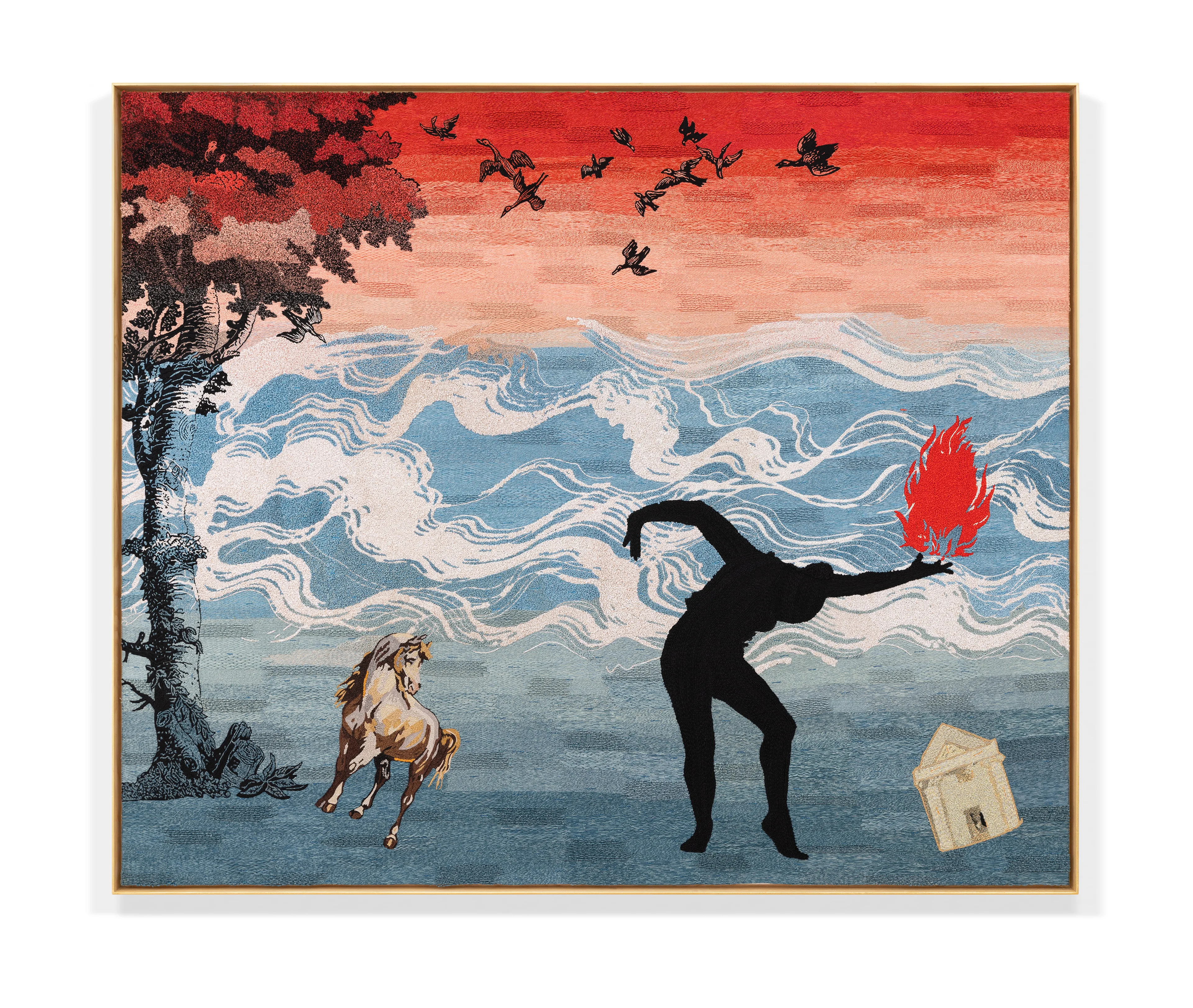
Marinella Senatore 1977, The Theatre of Commons, 2026. Embroidered tapestry 150 x 180 cm. Courtesy of the Artist, Mazzoleni.
“The Theatre of Commons”: Embroidery as a Practice of Emancipation
The participatory nature of Senatore’s research is expressed differently in the tapestries presented by Mazzoleni at Art Basel Miami Beach from December 4 to 6, with preview days on December 2 and 3. The gallery is participating in the fair with “The Threshold of the Visible,” an exhibition that features works by Alighiero Boetti, Agostino Bonalumi, Lucio Fontana, Iran do Espírito Santo, Wifredo Lam, Salvo, and Senatore. This presentation brings together different generations and visual languages to explore visibility as a territory in constant transformation rather than a fixed condition of representation. In this context, Senatore presents a hand-embroidered tapestry from the 2026 series titled “The Theatre of Commons.” The piece features a complex narrative composition in which human figures, symbolic elements, and diverse visual references coexist within a single landscape. The work originates from the collage technique that is dear to the artist. It is then translated into a textile surface through a collaboration with the Chanakya School of Craft in Mumbai. The institution was founded to preserve traditional Indian craft techniques and carry them into the future. The school enables women to develop their creative skills and achieve economic independence through craftsmanship. Historically, knowledge in this field has been transmitted in India through family lineages, often from father to son, rather than through formal institutions.
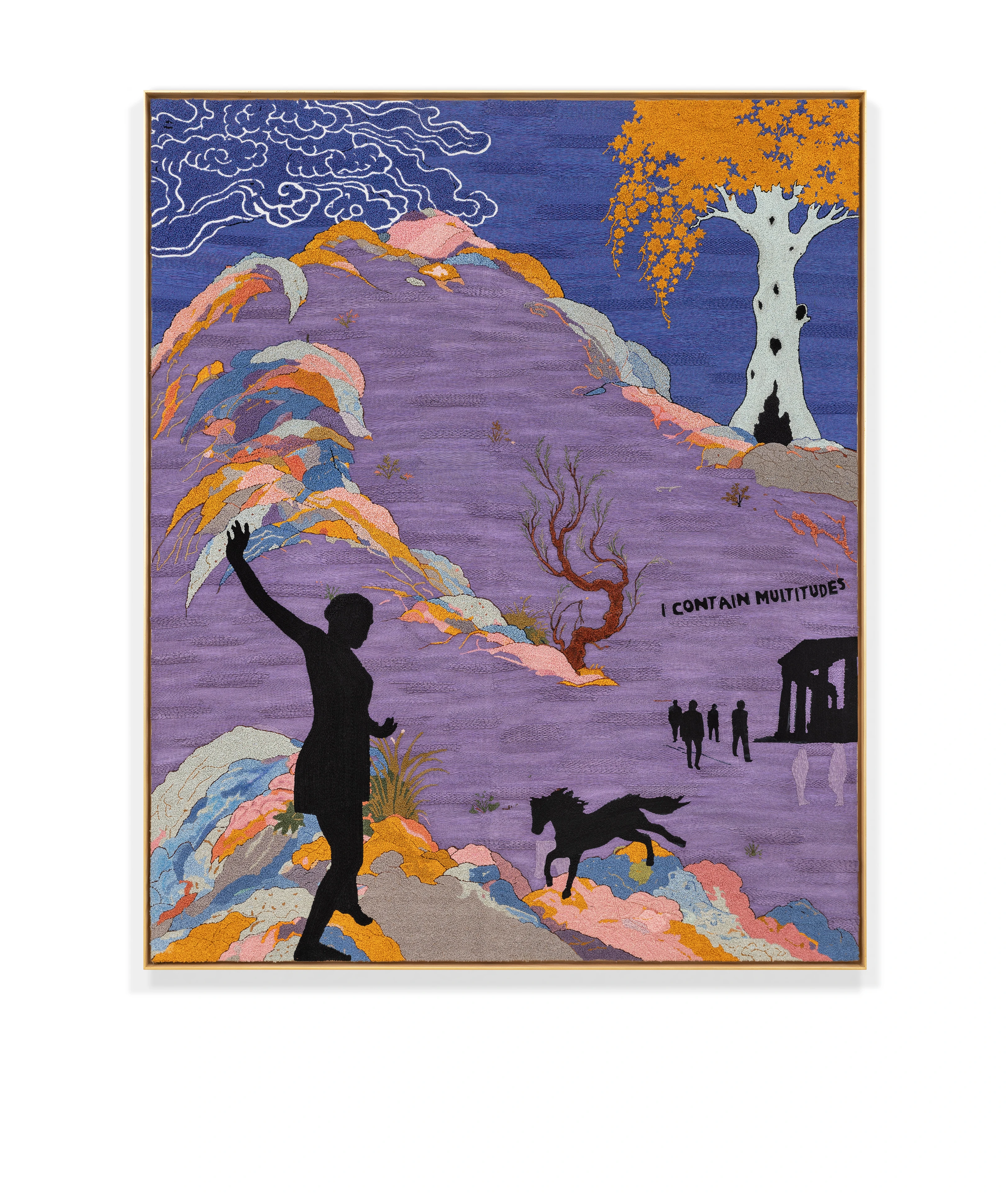
Marinella Senatore 1977, The Theatre of Commons, 2026. Embroidered tapestry 180 x 150 cm. Courtesy of the Artist, Mazzoleni.
“I have worked with textiles throughout my entire career. This is connected to my activist side and my desire to engage with social issues. For example, I created ceremonial banners, and other banners that I created with women who had experienced domestic violence. I also set up social tailoring workshops in Lampedusa. In these community sewing workshops, people brought their own skills and learned from one another. When we made banners together, we chose the words that would be carried into the streets.” Encountering the Indian school, facilitated by designer and creative director Maria Grazia Chiuri, who has supported its development since its inception and with whom Senatore has collaborated on several occasions, introduces another layer of reflection on the relationship between tradition, gender, and the transmission of knowledge. Historically, artisanal skills have been organized according to hierarchical structures that restricted women’s access to certain forms of training and professional recognition. “Female empowerment occupies a central position in my research,” the artist emphasizes, noting that her work has long addressed broader issues of social inequality and exclusion. The tapestries presented by Mazzoleni reveal a dialogue between various textile traditions by blending Mediterranean and Indian embroidery techniques. This fusion showcases the intricacy of a process that encompasses diverse skills and cultural heritages. “This is not an act of cultural appropriation,” Senatore clarifies. “For me, traditions are tools that draw people into the present. It is extraordinary to realize how deeply we belong to one another and to our own history when we engage with traditions that are centuries old.”