If there is one realm where the world’s complex disunity, the tension between the empirical and the ideal, can coexist, it is certainly the realm of art. This is especially true in reference to the work of Anselm Kiefer (b. 1945, Donaueschingen, Germany), whose practice has always involved wandering and division, generating a ceaseless fluctuation between unity and rupture. After all, when Kiefer emerged on the German art scene in 1969, he did so with a disruptive gesture: a series of works dedicated to the memory of World War II, forcing Germany to confront its repressed past. It was not merely a provocative act but also a critical intervention that cracked the collective amnesia of the postwar era and brought to light what had been buried under the weight of reconstruction. He certainly did not escape criticism, especially from the American press, when he and Georg Baselitz represented the German Pavilion at the 1980 Venice Biennale. His colleague presented a tempera-painted wooden work titled “Model for a Sculpture” that bore too close a resemblance to a depiction of Adolf Hitler. This did nothing to dispel the prejudices of those who viewed Kiefer’s work with suspicion, particularly its references to Martin Heidegger’s controversial philosophy. “I don’t identify with Nero or Hitler, but I have to recreate some of what they did to understand their madness. That’s why I make these attempts to become a fascist,” read an article that same year titled “Venice 1980: Contemporary Art Made in Germany,” written by Axel Hecht and Werner Krüger and published in the magazine “Art: Das Kunstmagazin.”
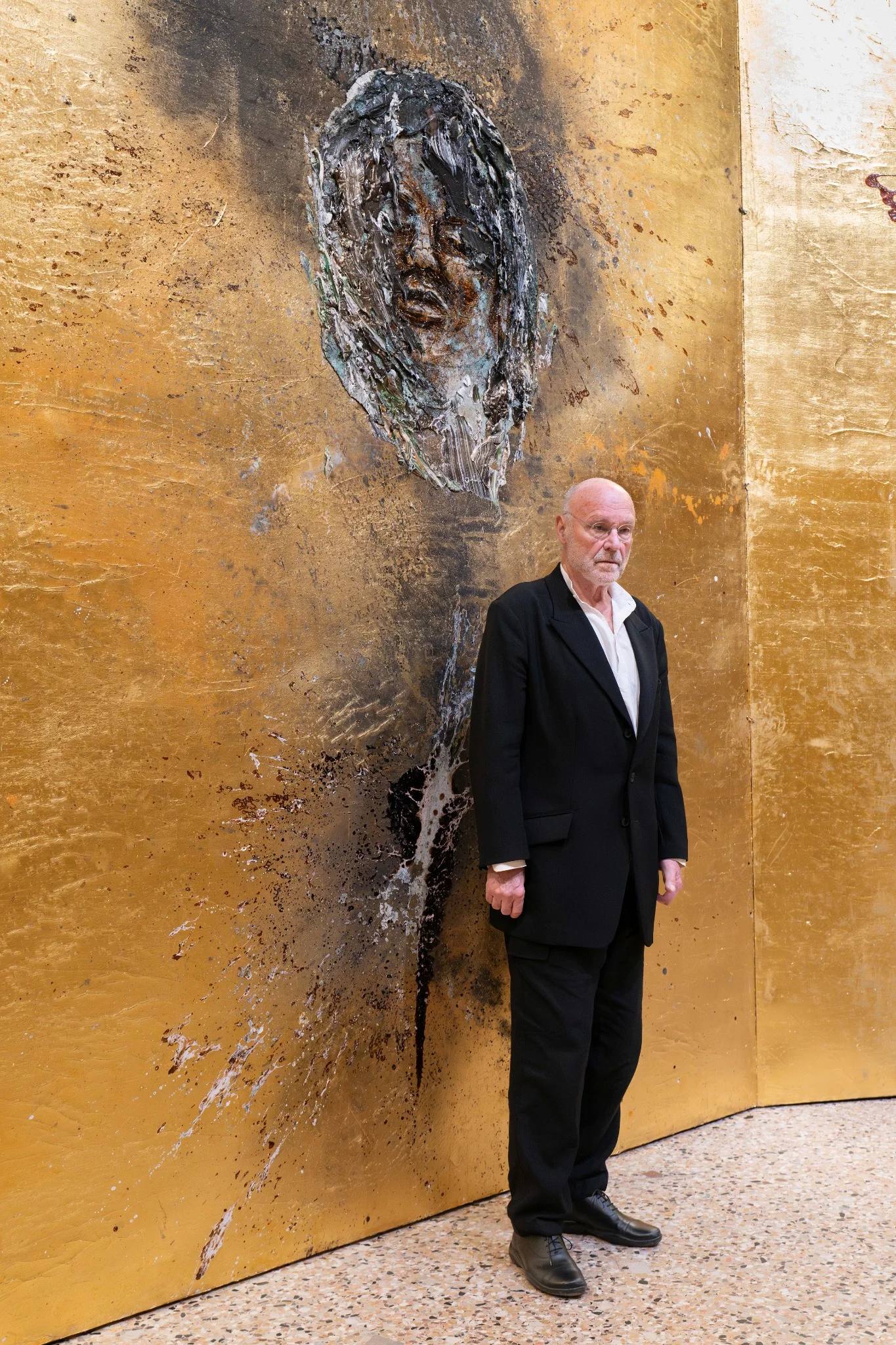
Anselm Kiefer © photo Ela Bialkowska OKNO studio
Monumentality, Materiality, and the Legacy of Joseph Beuys
This boldness is not unusual for Kiefer; it permeates his entire body of work. One might call it a rejection of historical, formal, and perceptual limits. The monumentality and density of his paintings, achieved through the use of unconventional materials such as lead, ash, straw, and earth, are never mere cosmetic effects. Rather, they are devices through which the artist explores the depths of time and memory. Kiefer is more drawn to the shamanic side of his mentor, Joseph Beuys, than the strictly conceptual one. From the outset, it has been the energetic potential rather than formal innovation that has fascinated him, leading him to navigate contemporary artistic experiences with ease and confront the anguish of drama and memory. His ability to engage with history and confront taboos merges personal and collective memories, thanks to the space offered by the canvas. The picture plane is continually interwoven with textural elements of strong symbolic significance. His characters, blended with sand, seeds, and sunflowers, draw from German literature and mythology. They range from Rumpelstiltskin, the small, goblin-like being with cunning and deceitful intelligence who turns straw into gold, to Margarete and Sulamith. These figures embody two opposing historical and spiritual universes and are the protagonists of the poetic transfiguration of the Holocaust in Paul Celan’s 1945 masterpiece, “Todesfuge”. They all evoke the power of fire as a demiurgic force, a metaphor for the manipulation and transfiguration that takes place in the artist’s work.
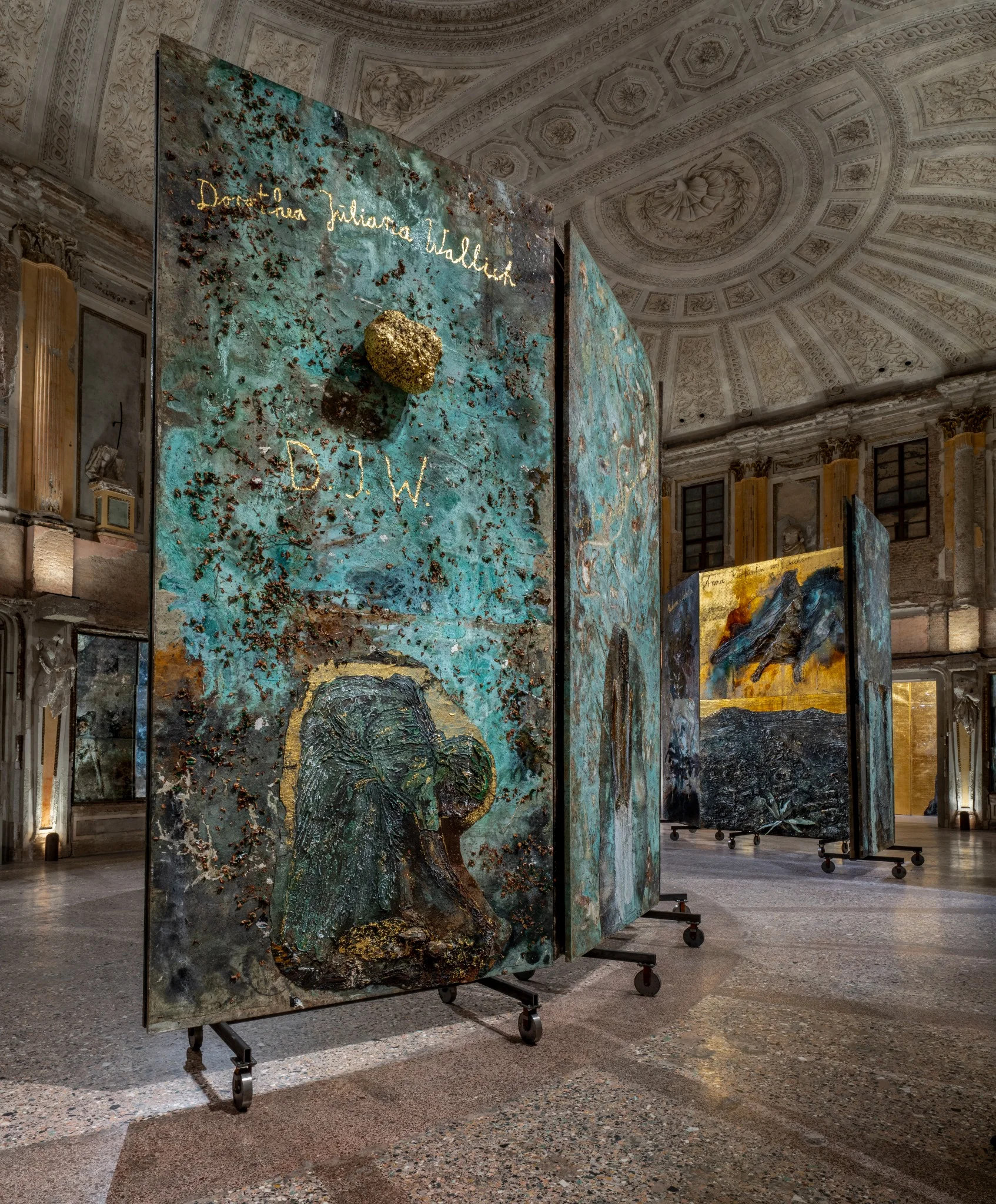
Anselm Kiefer. The women alchemist. Milan, Palazzo Reale, Sala delle Cariatidi. Installation view. Photo © Ela Bialkowska, OKNO Studio
Art Will Survive Its Ruins: Kiefer’s Lectures and the Philosophy of Artistic Survival
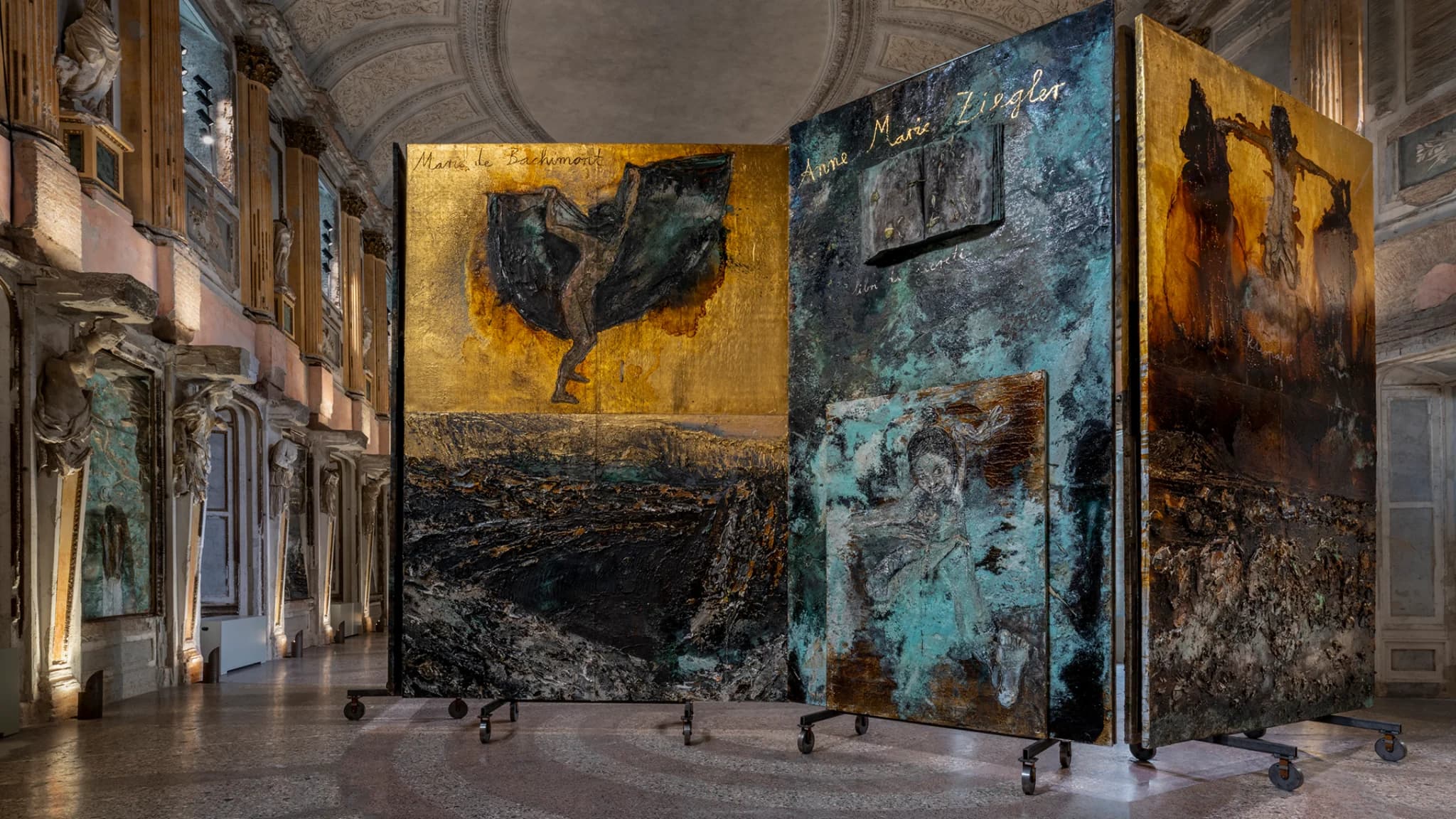
But there is more to it than that. Art’s power lies in its remarkable ability to reinvent itself in other places and times despite adversity, trauma, and decay. Not by chance, the title of the book compiling Kiefer’s lectures at the Collège de France (2010–2011) is Art Will Survive Its Ruins. The complex nature of art, which cannot be fully understood through definitions or aesthetic theories, emerges in all its disruptive force in the major exhibition “The women alchemist,” dedicated to the German artist at Palazzo Reale in Milan. Curated by art historian Gabriella Belli and promoted by the Municipality of Milano-Cultura, the exhibition project consists of a new site-specific work specifically conceived for the Sala delle Cariatidi. This is a significant venue because it was devastated by the 1943 bombings and was never fully restored. It is a space that bears the dialectic between destruction and rebirth inscribed in its very architecture.
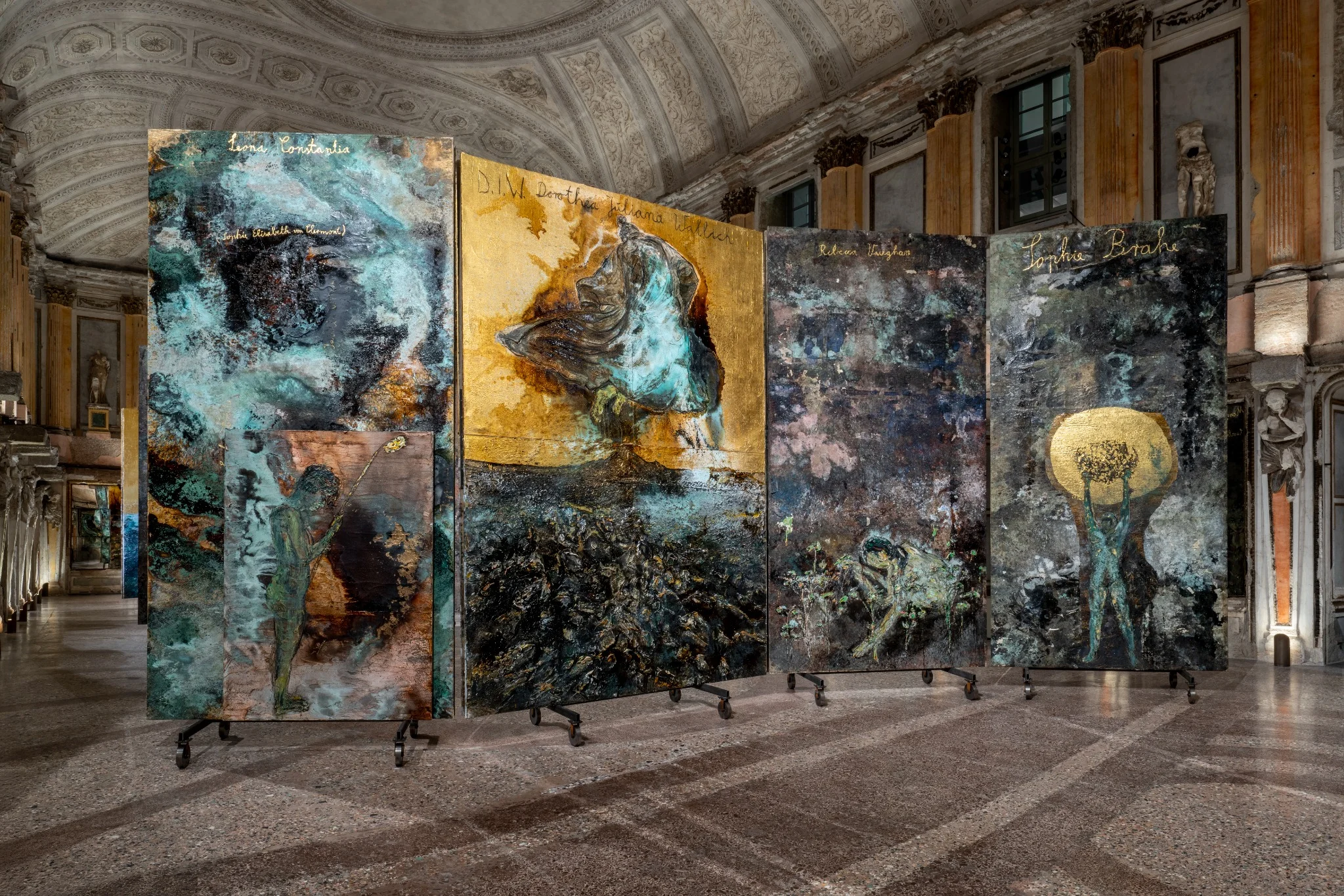
Anselm Kiefer. The women alchemist. Milan, Palazzo Reale, Sala delle Cariatidi. Installation view. Photo © Ela Bialkowska, OKNO Studio
The Female Alchemists: Forgotten Figures of Science, Knowledge, and Transformation
The exhibition consists of 42 monumental canvases envisioned as a single piece. These works explore Kiefer’s central themes of collective memory, identity, destruction, regeneration, myth, and history. At the center is the figure of the female alchemist. The artist creates a female pantheon that highlights figures often excluded from the official narrative: Caterina Sforza, daughter of Galeazzo Maria Sforza, Duke of Milan; Isabella Cortese, credited with one of the most famous books of secrets of the Renaissance; Kleopatra, one of the very few women to whom Greek sources attribute an authorial role in the alchemical tradition; and Cristina di Svezia, daughter of Gustavo II Adolfo Vasa and Maria Eleonora di Brandeburgo, who transformed Stockholm into a center of European patronage; Margaret Cavendish, one of the few 17th-century female philosophers whose works intertwined metaphysics, poetry, and science; Mary Anne Atwood, a key figure in the 19th-century English ‘spiritual’ reception of alchemy; Perenelle Flamel, a wealthy benefactor, collaborator, and wife of the alchemist Nicolas Flamel; Marie Meurdrac, a self-taught chemist and pioneer of female scientific outreach; Anne Marie Ziegler, a court alchemist in Reformation Germany who was burned at the stake in 1575 for theories deemed wicked and arrogant; and Sophie Brahe, a bridge between courtly culture and the laboratory. The result is an imaginary field in which these figures reemerge as archetypes: pioneering scientists and custodians of empirical knowledge, bodily practices, and hybrid knowledge spanning medicine, cosmetics, and spirituality. Their stories also speak of exclusion, persecution, disguise, and recantation. For this reason, they become symbols of alternative, marginal yet fundamental knowledge.
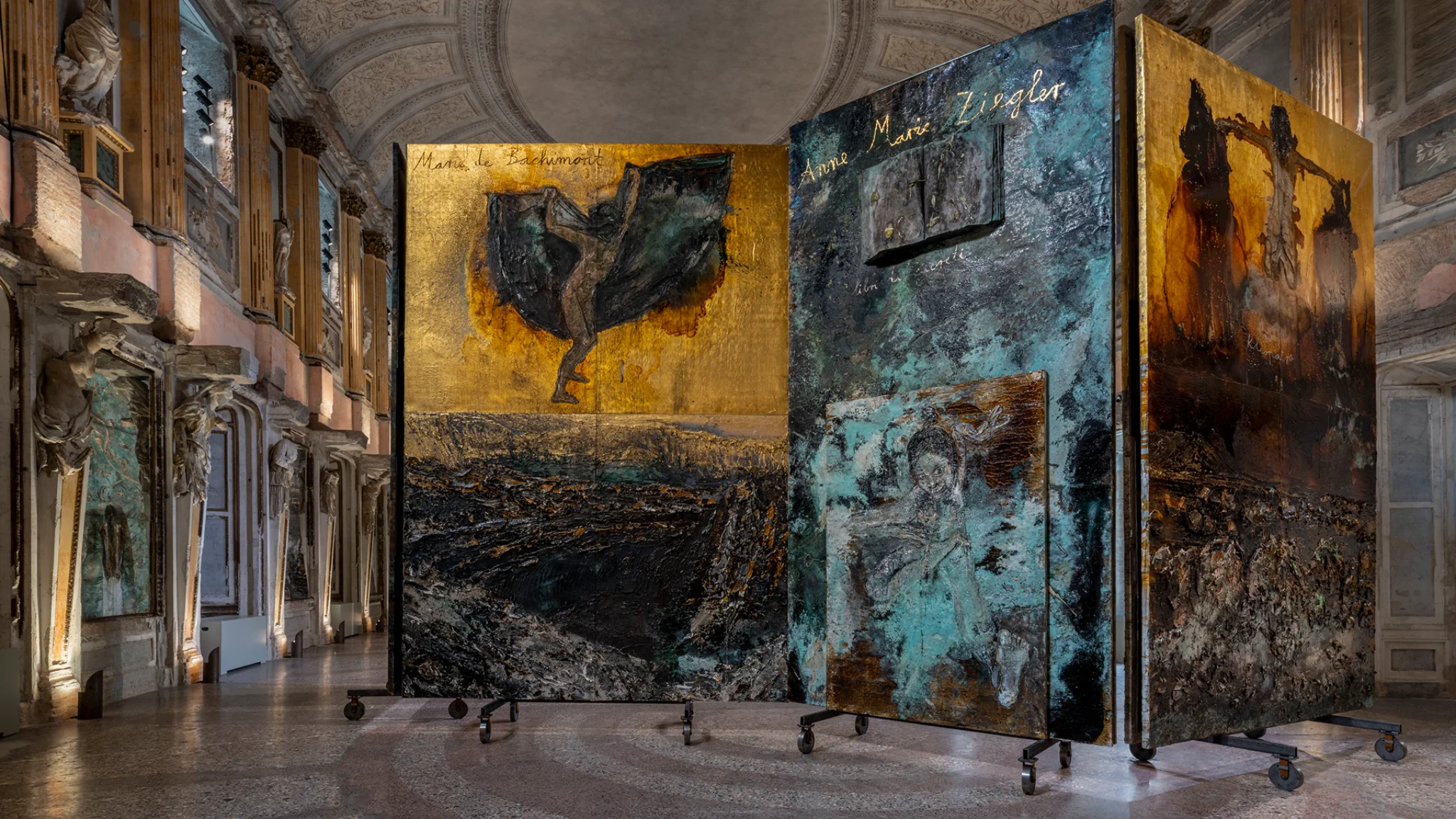
Anselm Kiefer. The women alchemist. Milan, Palazzo Reale, Sala delle Cariatidi. Installation view. Photo © Ela Bialkowska, OKNO Studio
Alchemy, Matter, and the Transformation of Materials in Kiefer’s Painting
In keeping with Kiefer’s modus operandi, which can be interpreted as a contemporary form of alchemy, each canvas is an act of re-emergence, with faces and bodies rising from the magmatic chaos of elements piled on the surface. The alchemical motto, “Obscurum per obscurius, ignotum per ignotius” (the obscure through the more obscure; the unknown through the even more unknown), is not just a reference but a key to understanding the project as a whole. Like an alchemist, the artist transforms matter. However, while alchemy aspires to transmuting metals into gold and regenerating matter, Kiefer’s ultimate goal coincides with art itself. In other words, the “gold” is the artwork, yet it always remains beyond perception and understanding. This exploration yields visible fragments of an invisible, boundless reality. These fragments do not seek to represent, but rather to evoke, layer, and conceal. After all, for the artist, the creation of a painting is a constant back-and-forth between nothingness and something. It is an incessant oscillation between one state and another. It is an uncontrolled process that follows no rules and relies on moments of transition. In this context, materials become of crucial importance. Faced with certain substances, Kiefer recounts finding himself viewing them differently, as if seeking to transcend or spiritualize the elements. Such was the case with lead, the discovery of which in the pipes of an old house was a veritable shock, an attraction impossible to put into words because it seemed to move beyond the insurmountable limits of our reality. Lead contains a spark of light that seems to belong to an inaccessible world.
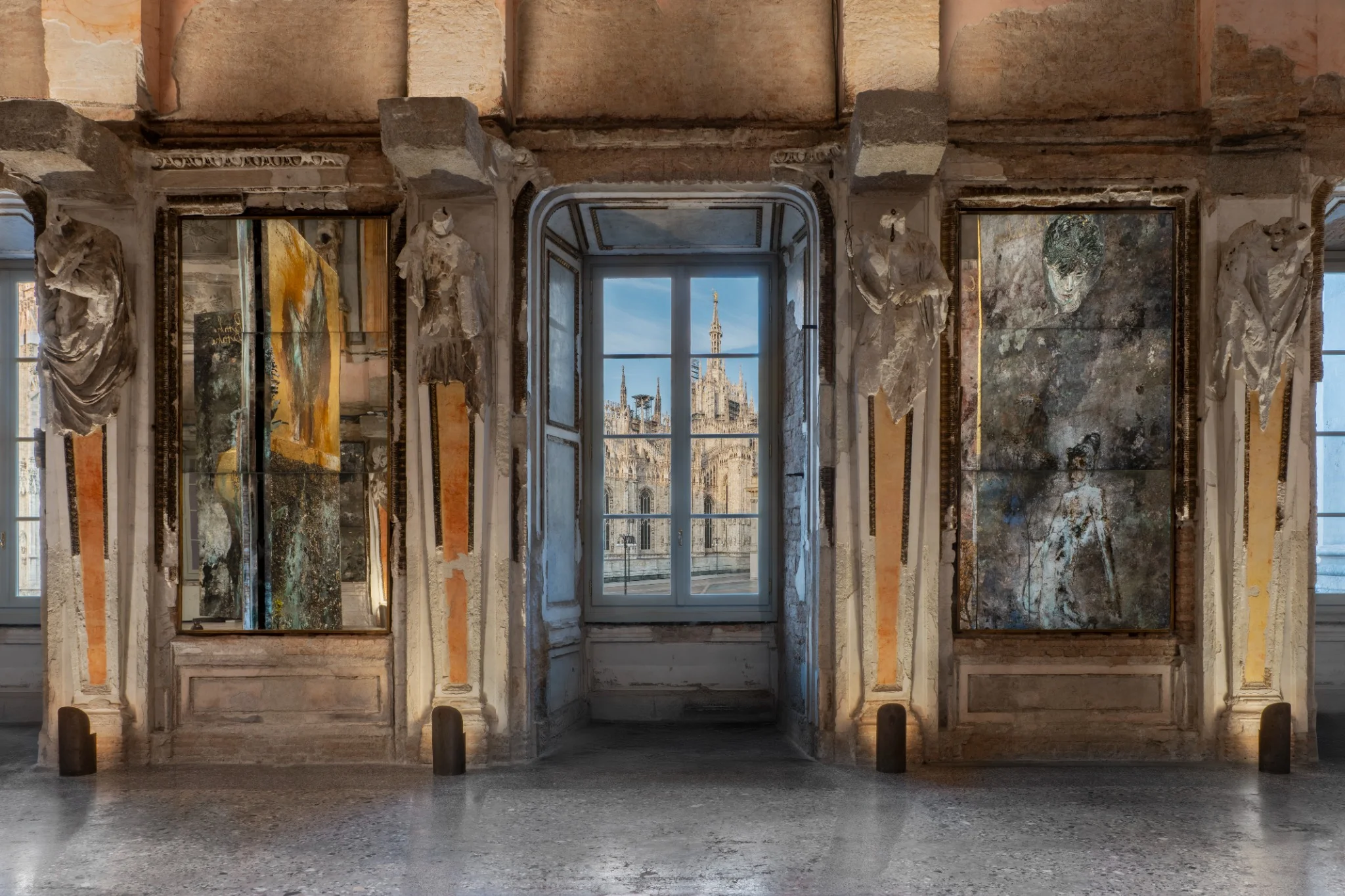
Anselm Kiefer. The women alchemist. Milan, Palazzo Reale, Sala delle Cariatidi. Installation view. Photo © Ela Bialkowska, OKNO Studio
If we were to name that inaccessible world, we might call it “totality,” which is the sense of infinity that reconnects humanity with the deepest meaning of artistic creation. This meaning coincides with the sphere of being itself. “I have faith only in art, and without it, I am lost,” he argues. “I could not live without poetry or paintings, not only because I don’t know how to do anything else, but for almost ontological reasons. I distrust reality, even though I know that works of art are also an illusion in their own way.” Paintings and poems coexist within the same symbiotic dimension. This dimension does not imprison existence and its multiplicity within a single, complete whole. Far from it. Kiefer offers a promise of the absolute with an uncertain outcome. Yet, as it unfolds, it reveals signs of transformation. The artist exposes his works to the open air and elements, allowing natural forces to take precedence over human creation. This makes the contradiction, the constant oscillation between process and result, all the more evident.
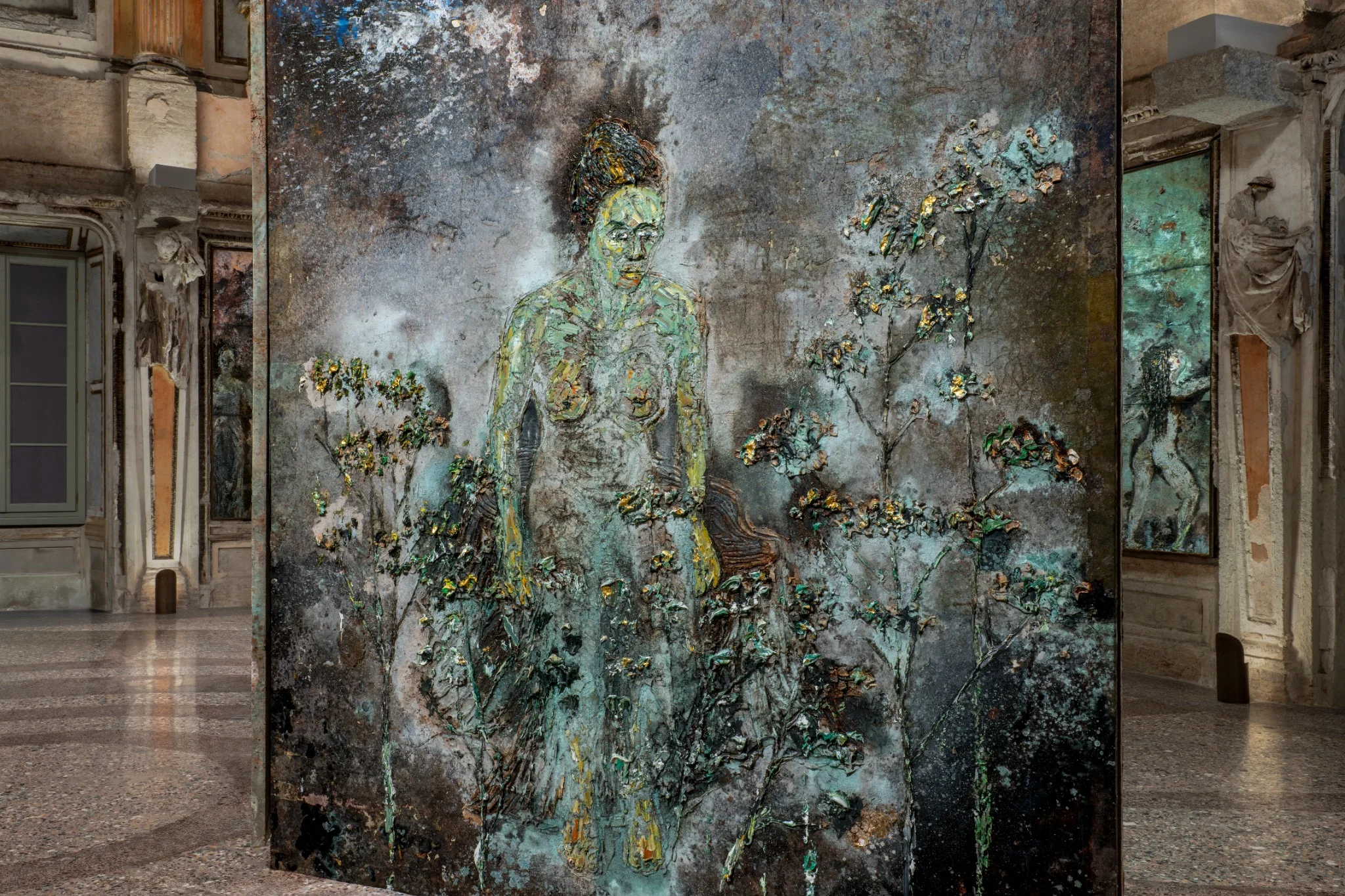
Anselm Kiefer. The women alchemist. Milan, Palazzo Reale, Sala delle Cariatidi. Installation view. Photo © Ela Bialkowska, OKNO Studio
Art as Ontological Resistance: Rilke and the Poetics of Transformation
There is a deeply lyrical passage by Rainer Maria Rilke that Kiefer mentions in his lectures and that captures this sense of transformation well. A few lines from Sonnets to Orpheus (Sonnet II, 13) read:
And if the world has forgotten you,
say to the silent earth. I flow.
To the rushing water speak: I am.
Perhaps there is no better way to end a reflection on Kiefer than with these lines. Like the exhibition itself, they are an invitation to experience a form of ontological resistance through art. They are a tenacious affirmation of life in opposition to its annihilation.
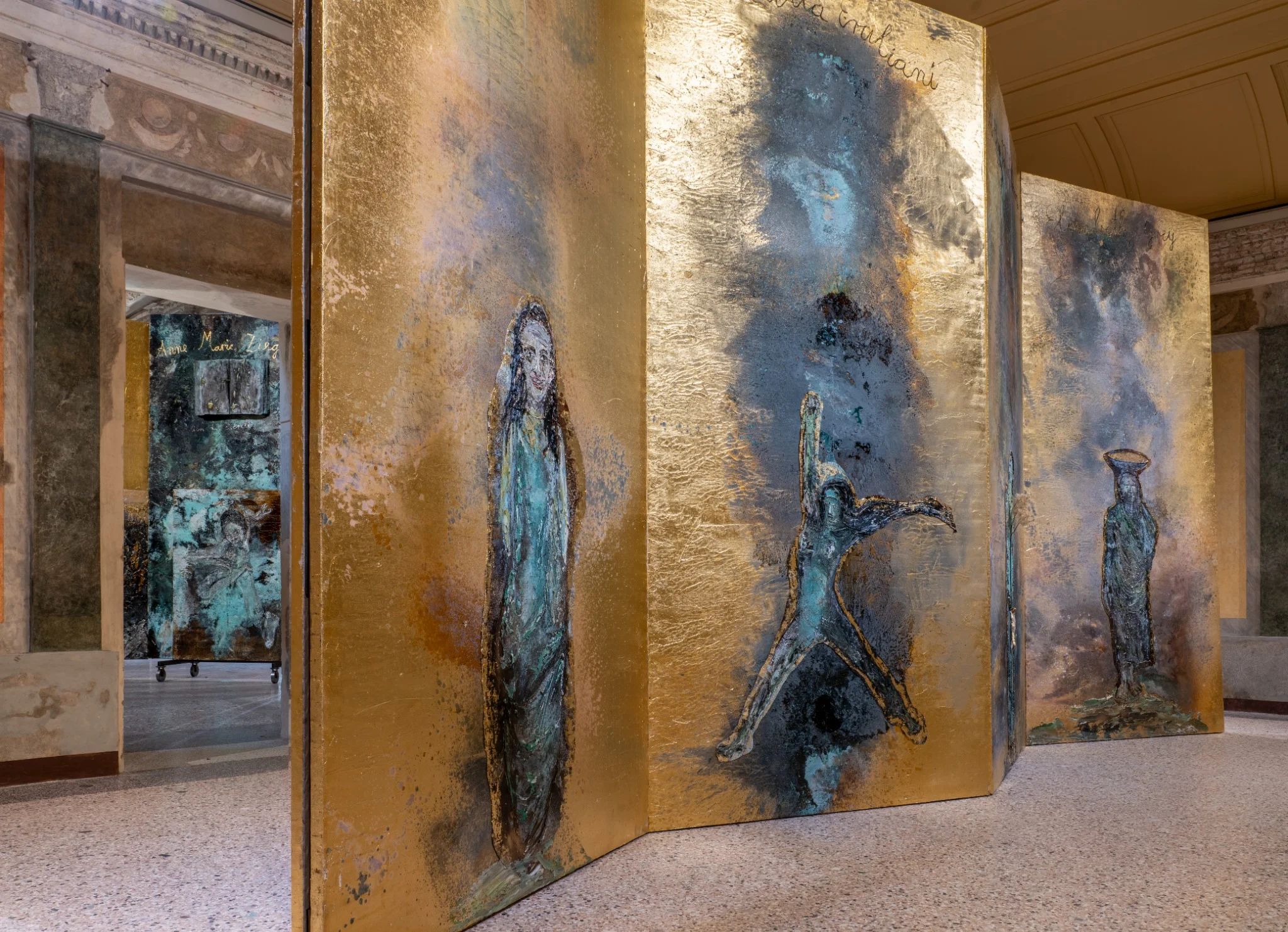
Anselm Kiefer. The women alchemist. Milan, Palazzo Reale, Sala delle Cariatidi. Installation view. Photo © Ela Bialkowska, OKNO Studio
Milan, Palazzo Reale – Sala delle Cariatidi
From February 7th to September 27th, 2026
Curated by art historian Gabriella Belli, promoted by the Municipality of Milano-Cultura and produced by Palazzo Reale and Marsilio Arte, with the contribution of Gagosian and Galleria Lia Rumma and supported by Main Sponsors Unipol and Banca Ifis,
The exhibition is part of the cultural program for the Milano Cortina 2026 Winter Olympics.