Irina Dzhus in sculptural black turtleneck and structured cap, portrait by Lukas Klimek
9 min

24.08.2026

Irina Dzhus on Fashion as Transformation, Identity, and Survival

By Francesca Interlenghi

Ukrainian designer Irina Dzhus discusses her transformable clothing, war's impact on her work, the psychological cost of fashion, and poetry's growing role in her creative process.

Ukrainian designer Irina Dzhus founded her brand DZHUS in 2010. The brand has built its identity around a design-oriented approach to clothing. DZHUS’ collections are distinguished by their architectural silhouettes, modular constructions, and multipurpose garments that can be configured in different ways through folds, openings, overlays, and assembly systems. With an austere, almost industrial aesthetic, DZHUS intertwines fashion, design, and conceptual experimentation in its creative process. After Russia invaded Ukraine, Irina sought refuge in the EU and began creating clothing that served as a metaphor for her personal, political, and psychological experiences.
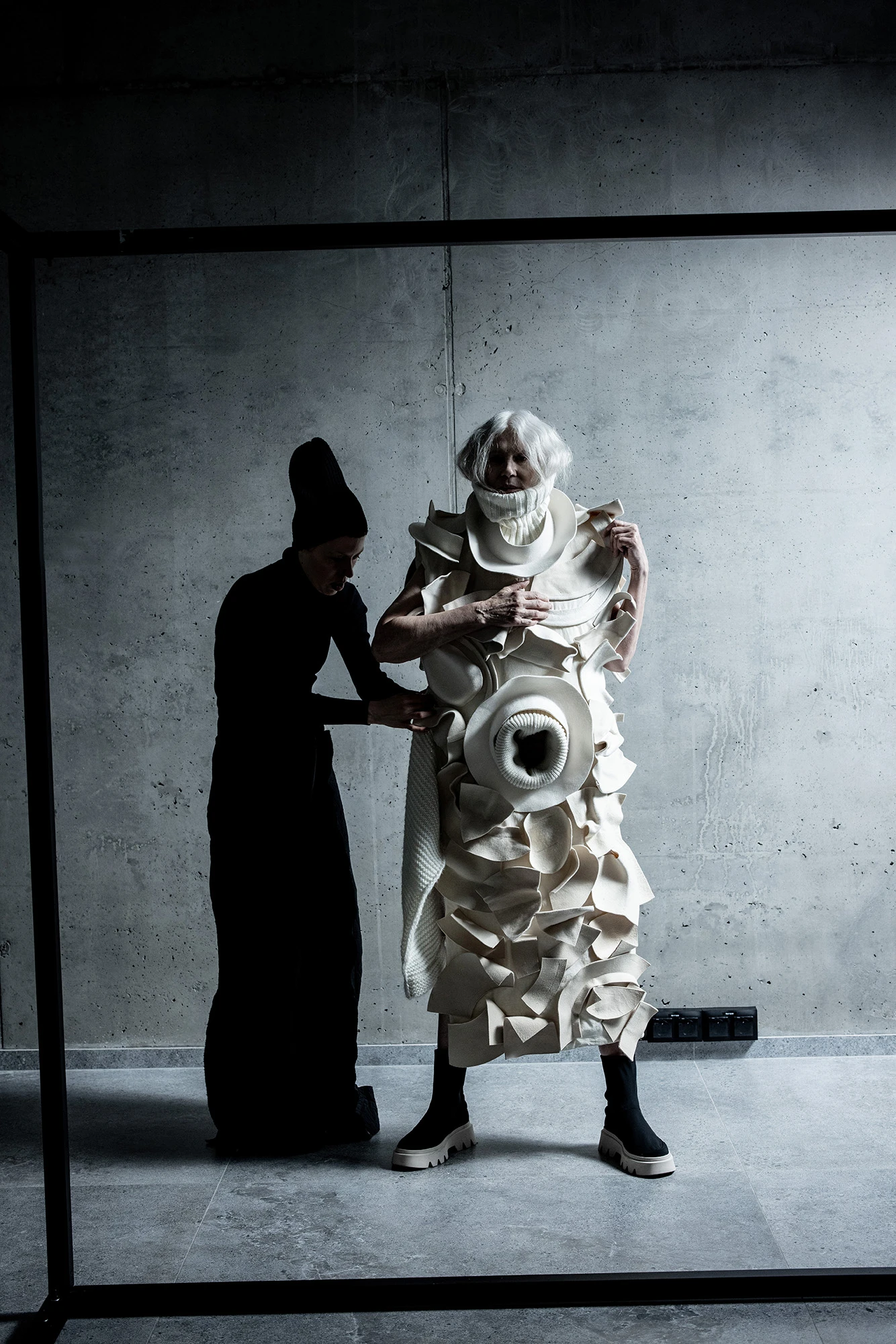
DZHUS ABSOLUTE collection: model in sculptural white ruffled coat assisted by dresser in black, concrete studio setting

DZHUS, ABSOLUTE collection. Photo by Julia Jaracz @ Konewka Studio. Location and beauty partner: Jaga Hupało Space of Creation


Your work challenges the conventional idea of fashion. You see clothing as more than just something to wear. To you, it's also a design practice and a field of research. What does fashion mean to you? How do you transform an initial intuition or concept into a garment and then into a collection?

From the age of five, I was fascinated by fashion as a phenomenon. I learned nonstop in the hope of one day joining the industry. However, after discovering my unique vision in my late teens, designing became a mission rather than a passion. I’ve never lacked inspiration. I download ideas from various spheres, filter them through my professional expertise, and deliver authentic products to my target audience. I choose not to pollute the market with unnecessary releases and only bring innovative concepts to life. This pioneering ambition requires extensive research and exhaustive experimentation. Before the war, DZHUS’ designs were inspired by cultural and scientific sources, ranging from paleontology to socialist modernism. After my evacuation, I faced a dilemma while preparing for my first Berlin Fashion Week in January 2023, as one of the selected Ukrainian designers: whether to deliver a commonly expected eloquent “wartime POV” or commemorate the real-time tragedy quietly and modestly. Selecting an alienated subject would have confused both the Ukrainian cultural front and the sophisticated European audience, no matter how genuine the concept. It was in this tension that the TRANSIT collection was conceived. Inspired by all types of travel cases, from luggage to pockets, it featured multipurpose, gender-fluid silhouettes. Embracing a personality metamorphosis under the impact of extreme circumstances, the collection celebrated functionalism as an escape.
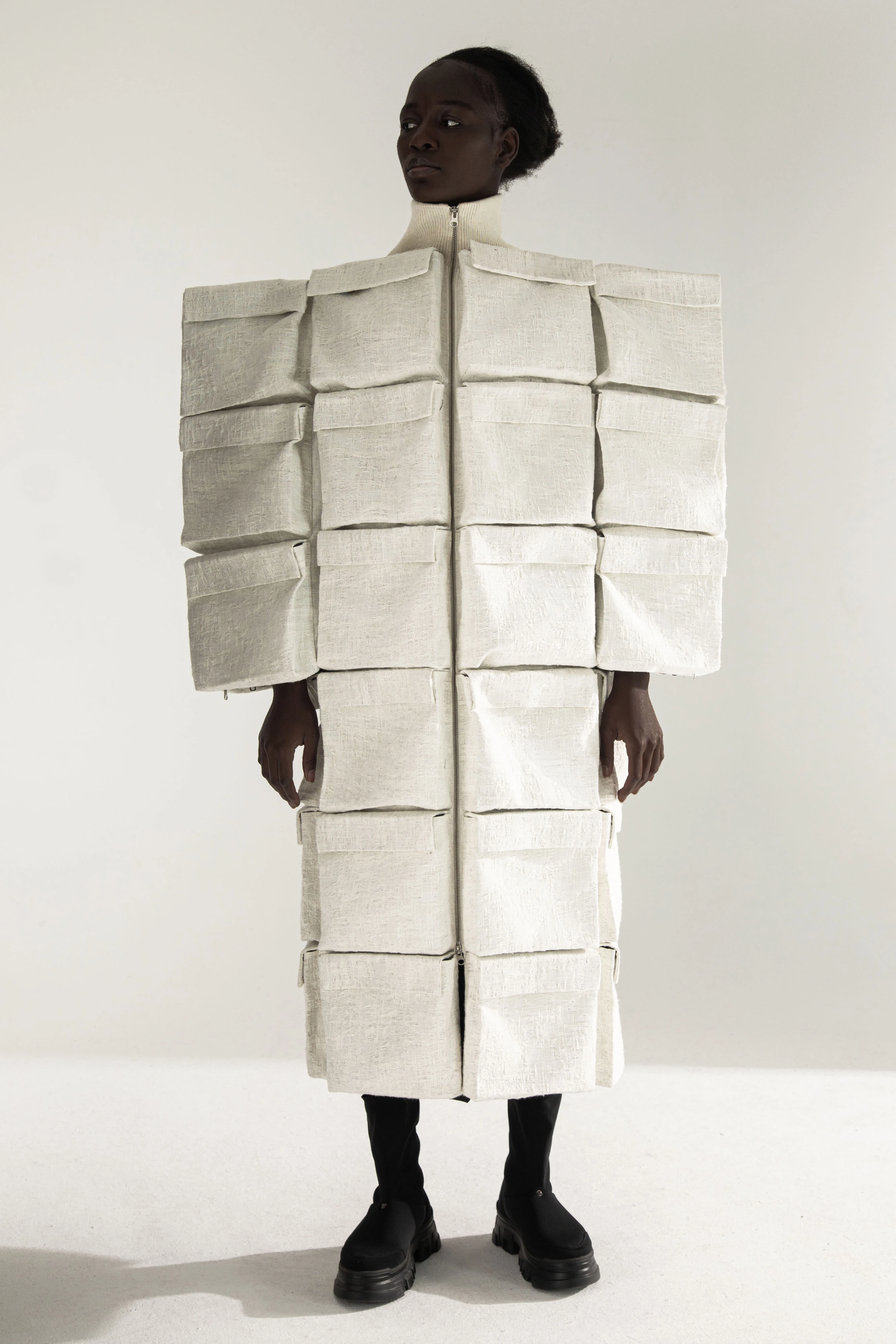
DZHUS TRANSIT AW23 sculptural linen coat with geometric padded squares, modular avant-garde fashion by Ganna Goncharova

DZHUS AW23 collection, TRANSIT. Photo: Ganna Goncharova


Berlin was a turning point in your life, both personally and professionally. Could you elaborate on that?

Ironically, DZHUS’s Berlin debut triggered a drastic personal situation that turned into a major trauma, my private war. While I was unable to adjust to the social agenda due to a critical emotional state, I stopped working within the system. I sold my grief for three more BFW budgets, which forced me to perform shows regardless of my mental state. At that point, my creativity became entirely cathartic. It was autobiographical wearable art, oversaturated with grotesque metaphors. Needless to say, fashion culture, in all its attributes, remained in my distant past. I was abandoned, face-to-face with distilled relevance to communicate for the sake of practical survival, using the only familiar language...or was it? In this way, my poetry gained publicity. I had always rhymed and eventually grew into a “word engineer,” generating multilayered interlingual structures. Finally, after merging avant-garde apparel with poetic commentary in the ANTICON performance, I made the difficult decision to pause the development of new styles to achieve personal well-being, as the two processes were mutually exclusive. Still, the last two ranges needed finalization, from sample repairs and pattern improvement to visual campaigns and PR, which took an additional two and a half years. No one believed I could do it, but I did. Until further notice, I have kept poetry writing as my sole creative outlet: genuine, timeless, and free of commerce.
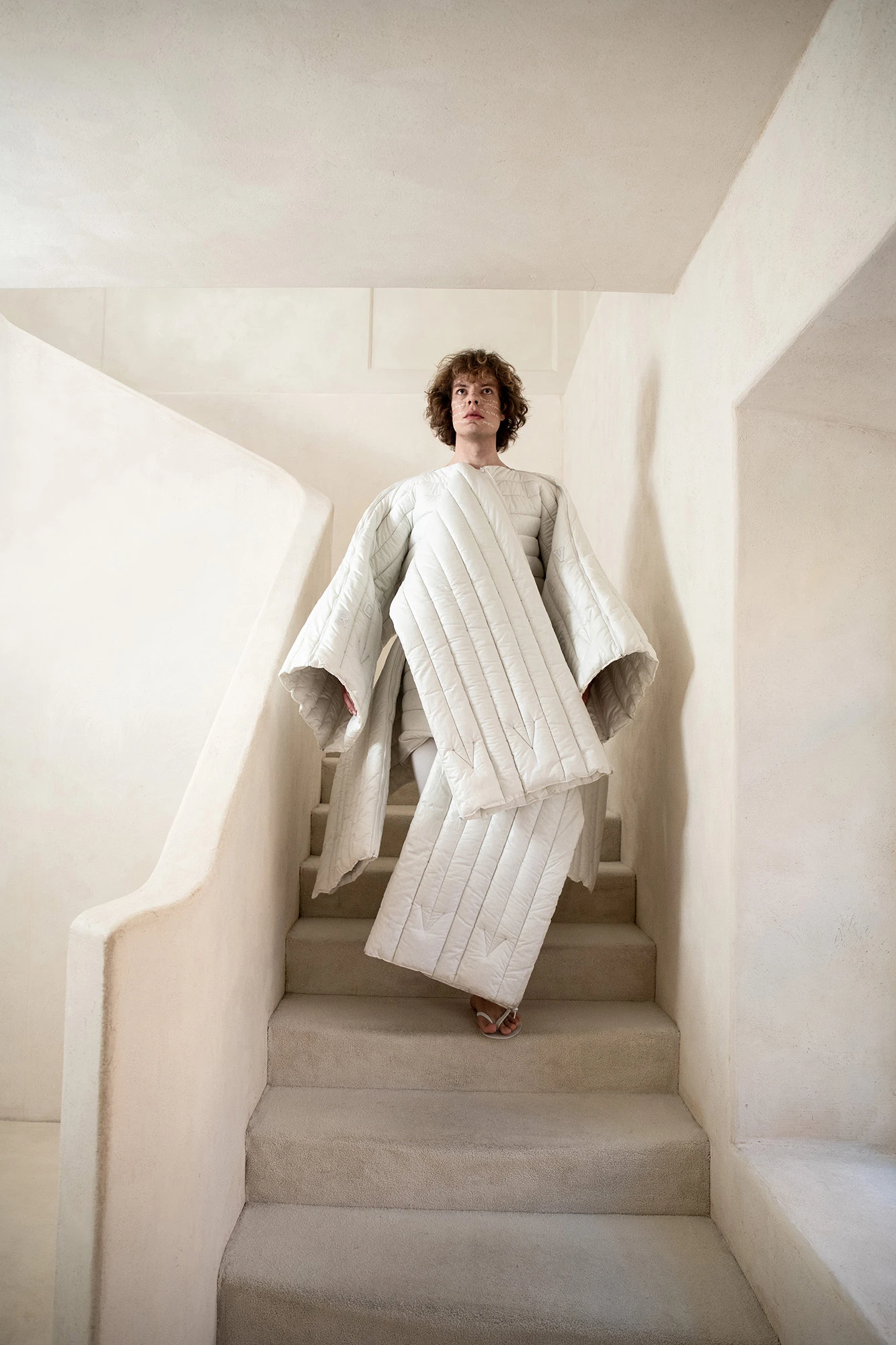
DZHUS ANTICON collection quilted white sculptural coat on model descending stairs at CONCEPT 11 Warsaw

DZHUS, ANTICON collection. Photos by Marta Chudek and Maria Salivonova. Location: CONCEPT 11 Warsaw
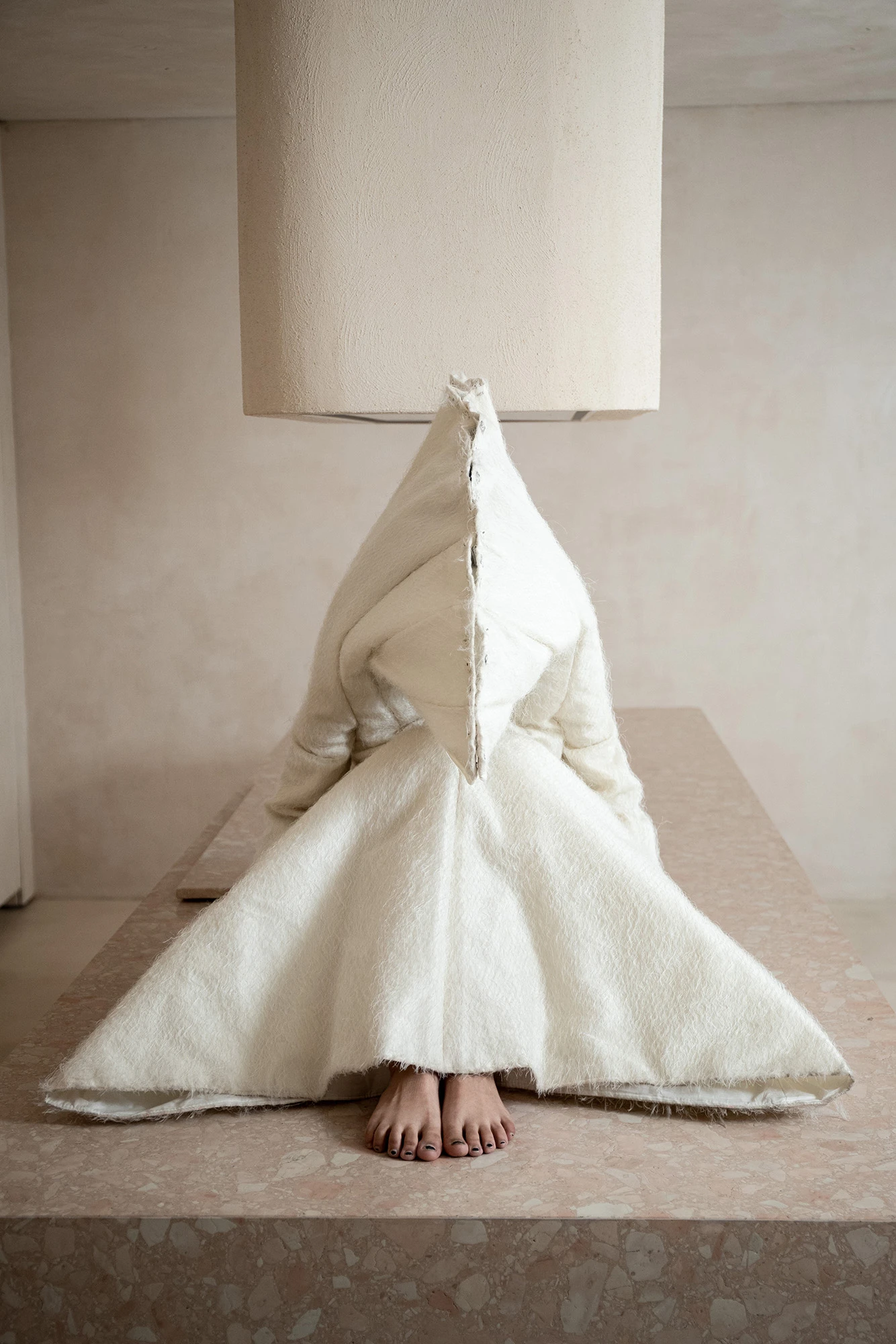
DZHUS ANTICON collection sculptural white textile ensemble with pointed hood, bare feet, at CONCEPT 11 Warsaw

DZHUS, ANTICON collection. Photos by Marta Chudek and Maria Salivonova. Location: CONCEPT 11 Warsaw


Transformability has become a kind of grammar for DZHUS. What interests you about the concept of an object with multiple identities and functions? Is this primarily a design-oriented exploration, or does it also involve broader reflections on contemporary identity?

At its core, DZHUS design is metamodernist. It comments on relevant issues via life-affirming rhetoric. It is dialectical, raising questions and suggesting cooperation. Despite stereotypes, multifaceted identity is not a new concept. Even a brief historical overview features amusing examples of intercategorical authenticity and fluidity that challenge contemporary binary perceptions. My creations aim to transcend purpose and redefine it. What began as a self-challenge in pattern making at the dawn of DZHUS has quickly revealed an astonishing potential for conscious fashion in both planet-oriented and art-therapeutic vectors. The transformability of my designs prolongs their existential cycle. Playfulness expands styling horizons and carries a healing outcome for those initiated.
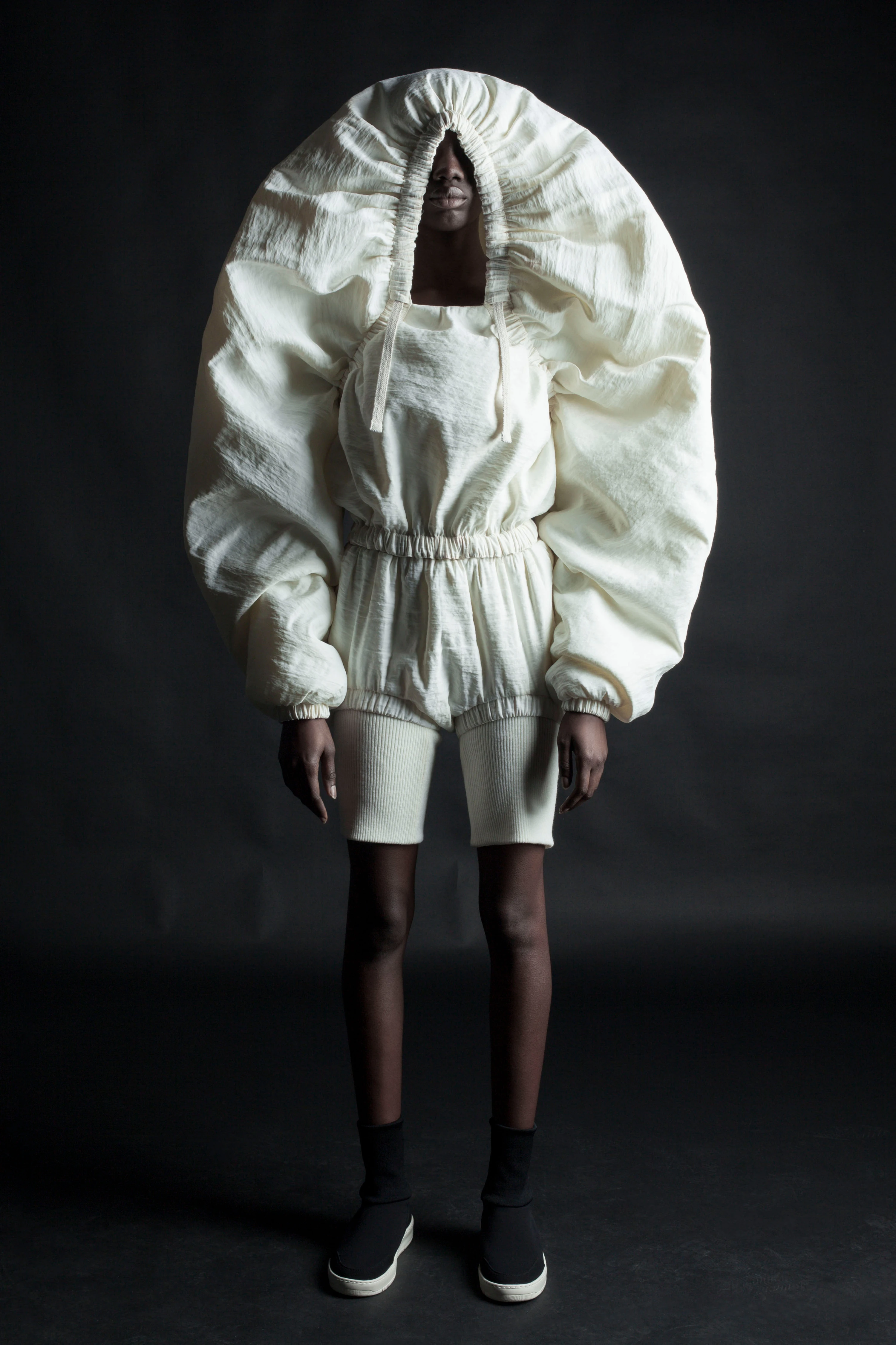
DZHUS AW 2020 Misconcept collection: sculptural ivory puffer ensemble with oversized oval hood, shorts, and black sneakers

DZHUS AW 2020 collection, MISCONCEPT. Photo: Alexey Ponomarev


Transformation has been central to your artistic language since before the Russian invasion of Ukraine. Since 2022, however, adaptability, precariousness, and change have become part of your personal experience. Has your perception of transformation changed?

Although my own transformation was due to personal circumstances, the migrant paradigm has broadened my perspective. Accompanying my countrymen in their multilayered integration process has given me an understanding of timeless adaptation mechanisms. Consequently, the meaning of deconstruction and transformation in my practice has taken on new dimensions. I aim to assist in self-discovery and self-acceptance. DZHUS provides its wearers with tools for insight and self-reflection, as well as social attributes.
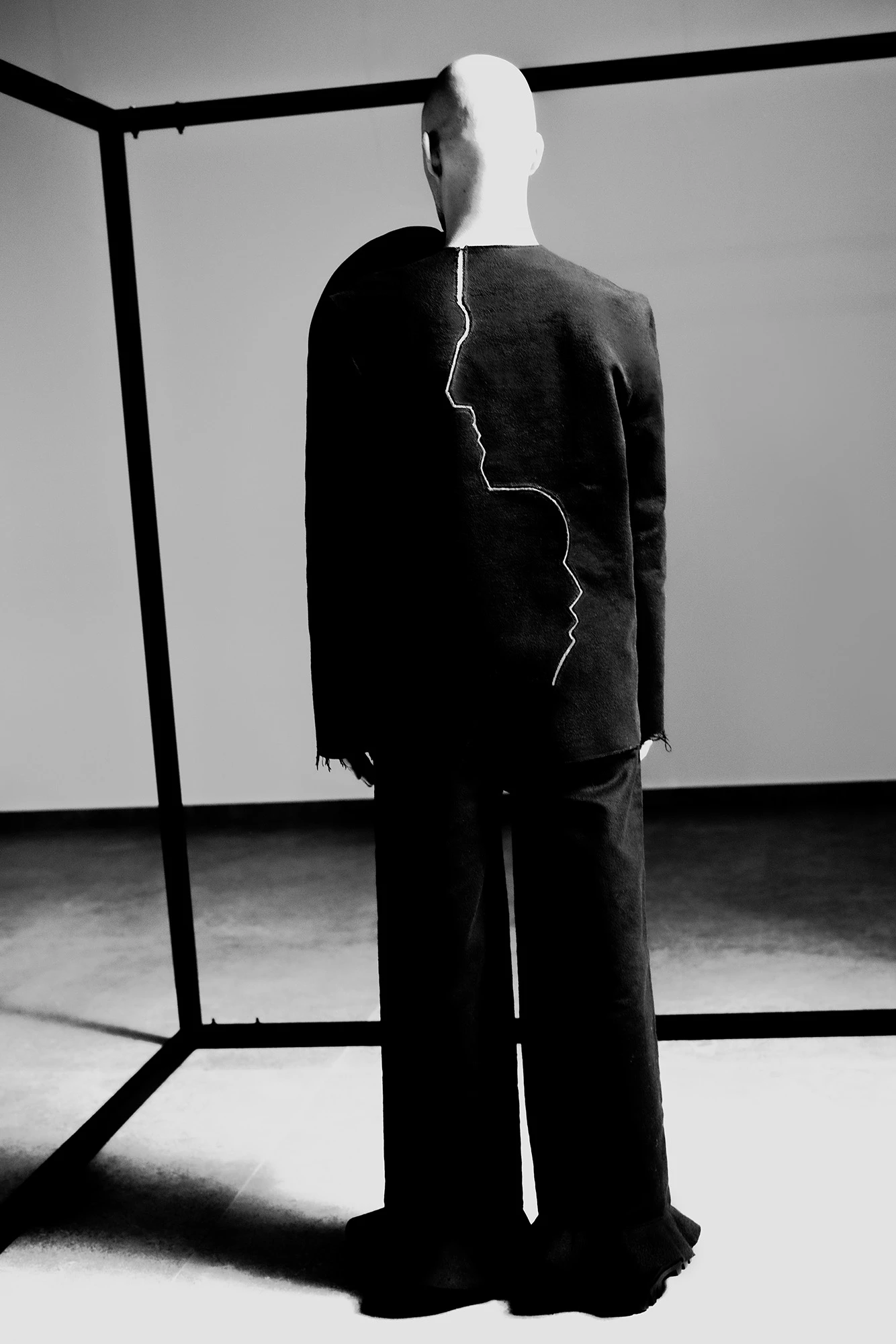
DZHUS ABSOLUTE collection dark suit with white face silhouette seam detail on mannequin, rear view

DZHUS, ABSOLUTE collection. Photo by Julia Jaracz @ Konewka Studio. Location and beauty partner: Jaga Hupało Space of Creation


You had to leave Ukraine and rebuild part of your practice while displaced. How has this experience changed your approach to designing, producing, and conceptualizing DZHUS?

I fled the invasion with as much of our material heritage as a large bag could fit, prioritizing the evacuation of three cats on behalf of my family. Within moments, half of DZHUS’ SS22 line was packed and would soon be raising funds for the brand’s survival and a Ukrainian charity. The rest of the outfits and materials were transported to me from Kyiv once logistics resumed. The forced relocation and subsequent travels caused anxiety due to the burden of possession. This led to a firm understanding of my minimalist and wanderlust nature. Since then, I’ve prioritized independence, mobility, and practicality in my work. Currently, I place orders with freelance Ukrainian seamstresses in Poland and sell samples and don’t purchase fabrics upfront. The key leitmotif of the ANTICON line is “inter-refuge,” which navigates to “self-settlement.” The concept explores whether finding "where you belong" can replace the instinct of homecoming and suggests using civilization's semantic database for obtaining identity.
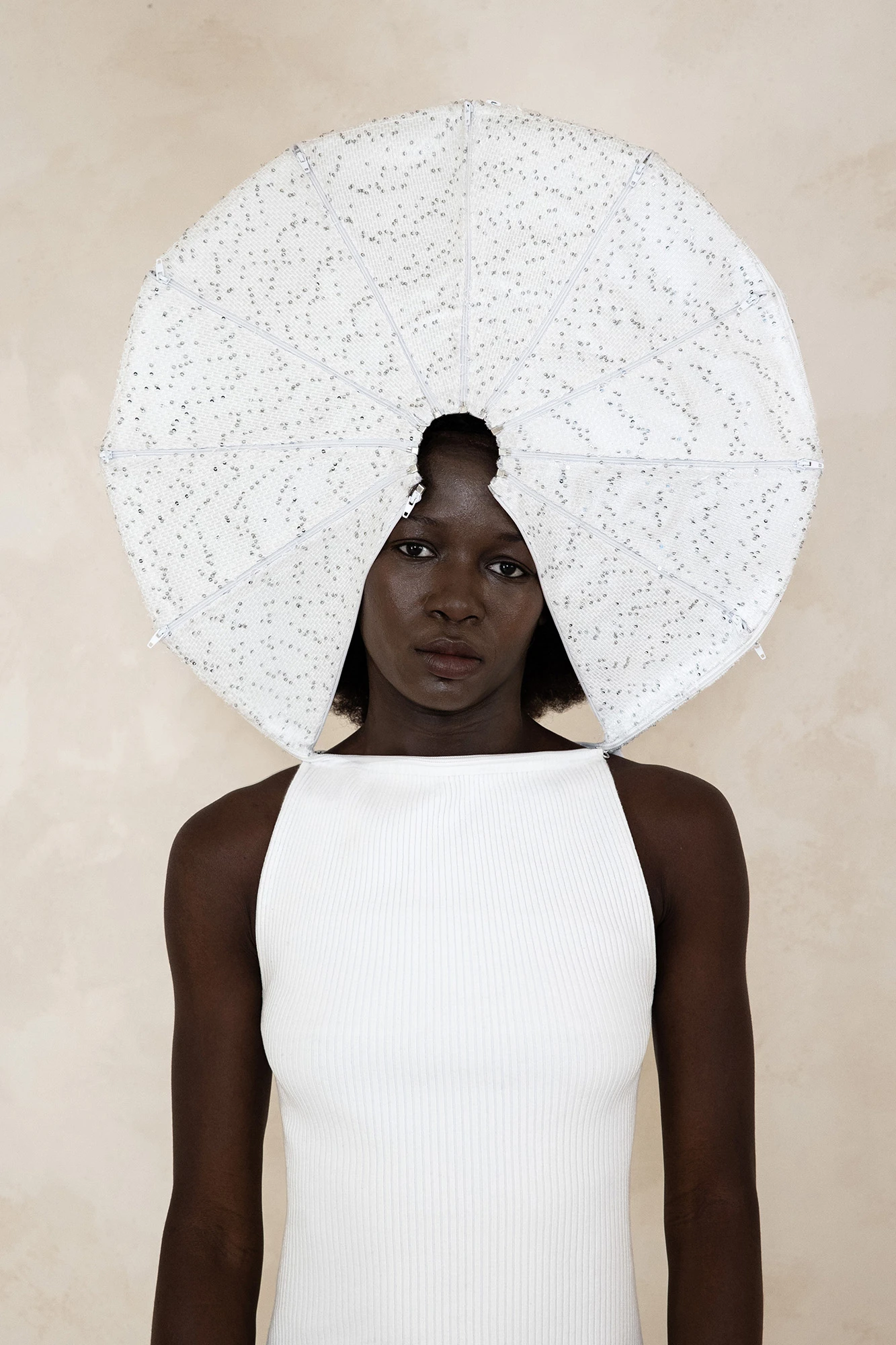
DZHUS ANTICON collection model wearing white ribbed top and sculptural circular headpiece, shot at CONCEPT 11 Warsaw

DZHUS, ANTICON collection. Photos by Marta Chudek and Maria Salivonova. Location: CONCEPT 11 Warsaw
The fashion industry imposes specific standards, such as consistent production, public visibility, financial performance, speed, and continual reinvention. How sustainable is this model psychologically for an independent designer?

I once found myself in a dead end, trapped by circumstances that forced me to create in order to survive. Struggling with an emotional state that disabled my ability to socialize, I found that my artistic potential was my only asset to make ends meet. Thus, I used grants, sentencing myself to compulsory creativity with no option to stop. This "masochistic" regimen resulted in dissociation and gradually revealed PTSD. As an autonomous avant-garde designer, I experienced frustration and anxiety due to the poor quality of my products, caused by unrealistic deadlines and a lack of assistance.

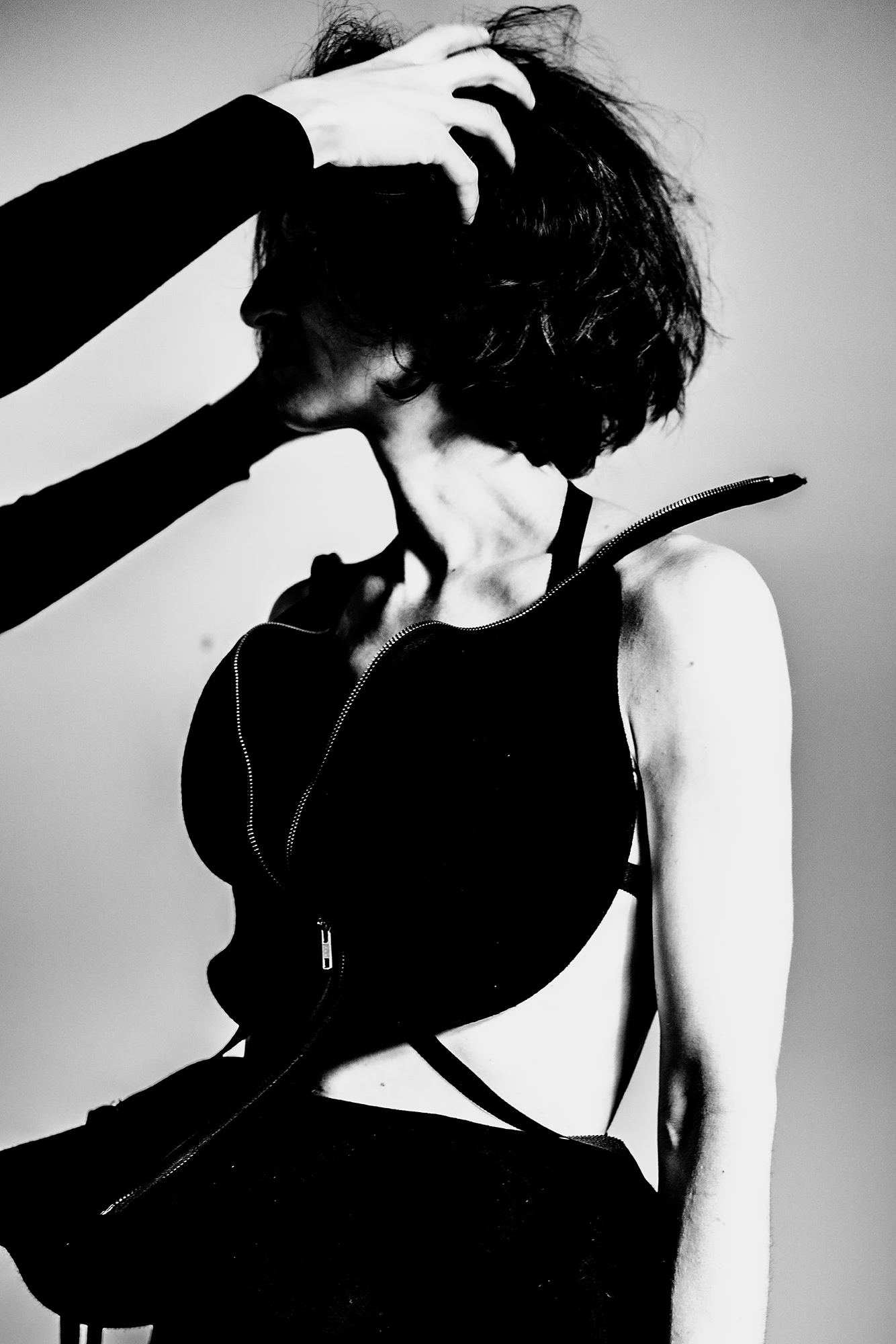
DZHUS ABSOLUTE-124 black architectural harness top editorial fashion monochrome portrait with dramatic shadows

DZHUS, ABSOLUTE collection. Photo by Julia Jaracz @ Konewka Studio. Location and beauty partner: Jaga Hupało Space of Creation


Don’t you see the contradiction between the demand for authenticity placed on designers today and the fact that they must conform to the system's rules just to survive?

Hypocrisy lies at the foundation of today's fashion dystopia. There is a demand for authenticity, but there are also deadlines and seasons. Craftsmanship is valued, but the price point must be competitive. There is a celebration of individuality, but there are also gestalts and quotas.

There’s a lot of talk about environmental sustainability in fashion, but not as much about “mental sustainability.” Do you think the industry underestimates the psychological toll of constant creative production? Have you had to develop strategies to protect yourself?

After delivering four seasonal showcases in a row under the sobering grant conditions, it took me a couple more years to finalize the projects in terms of quality and presentation until they met my own rigid standards of sincerity and transparency. At that point, I took a long-awaited break from creativity for the sake of my personal well-being, with the exception of poetry writing.

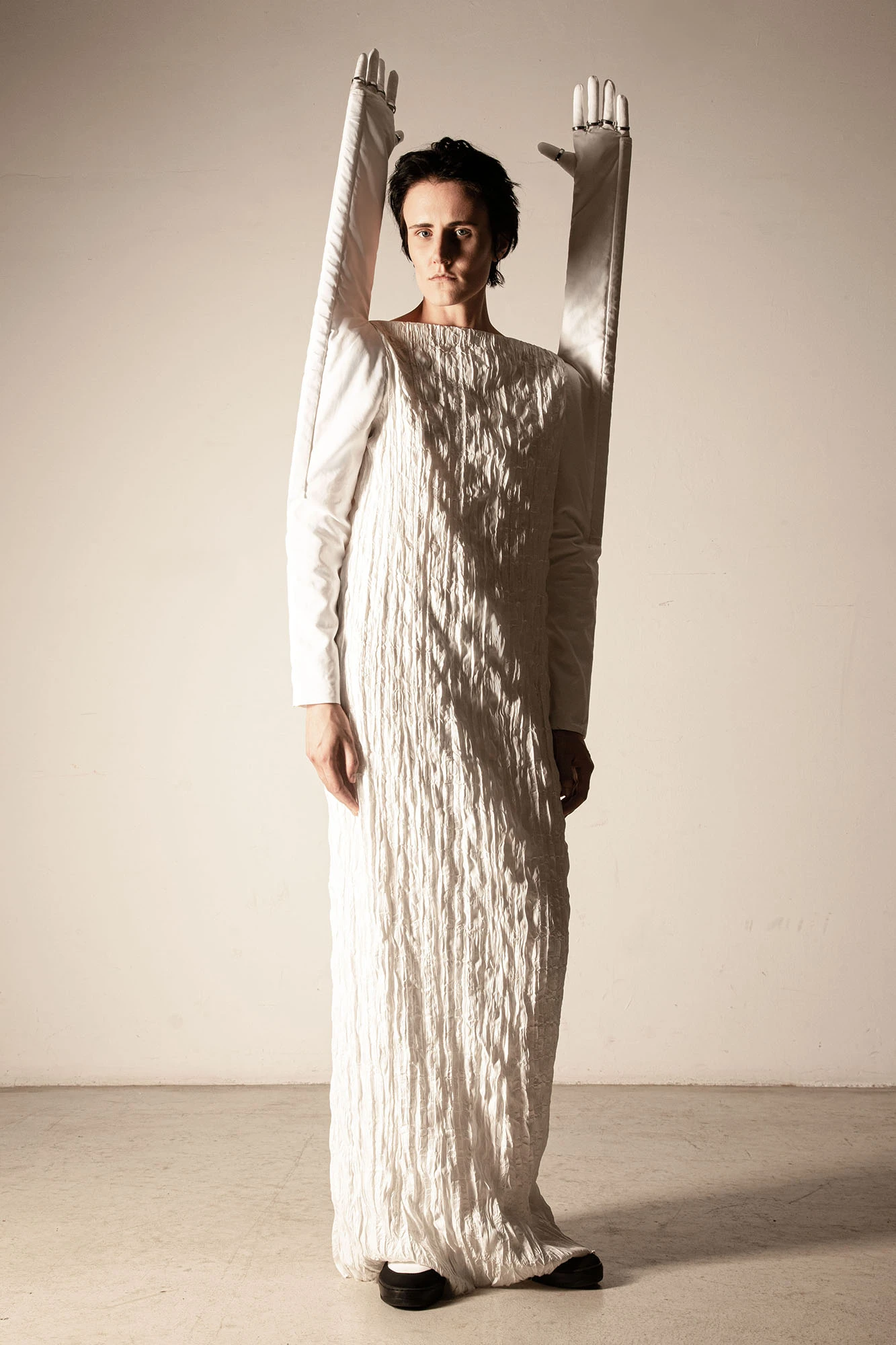
DZHUS SS24 THESAURUS collection white crinkled maxi dress with long opera gloves raised overhead, editorial fashion

DZHUS SS24 collection, THESAURUS. Photo by Ganna Goncharova


Which type of support do you think young designers need the most? Financial? Production-related? Distribution-related? Institutional? Or more time for authentic research?

An ingenious vision requires education, which starts far away from institutions. The environment in which the next generation is raised shapes the future of the industry and, therefore, the horizons of sustainability and ethics throughout the entire consumerist continuum. A wannabe designer should be embraced by a curated range of opportunities, from social media content and role models to representation and funded residencies and independent mentorship. This would provide a balanced variety of stimuli and a fruitful perspective for both the creative individual and the entire industry in their following professional integration. Further on, contests and scholarships are a lifeline for those taking their first steps. Emerging business insiders face tougher challenges: tax systems are devastating, and the market reality leaves little room for artistic experimentation. Additionally, full-time employment in a sole proprietorship does not allow for self-education, which is necessary for a brand's technological and legal sustainability. This could be addressed at the state level by subsidizing micro entrepreneurship, providing grants to creative professionals with low or no profit, and covering the cost of ongoing business education. Furthermore, the mental well-being of the creative sector should be an integral part of cultural development strategies at the global and local levels. If this seems essential and commonplace, congratulations! You are blessed to be in the bubble of the privileged.

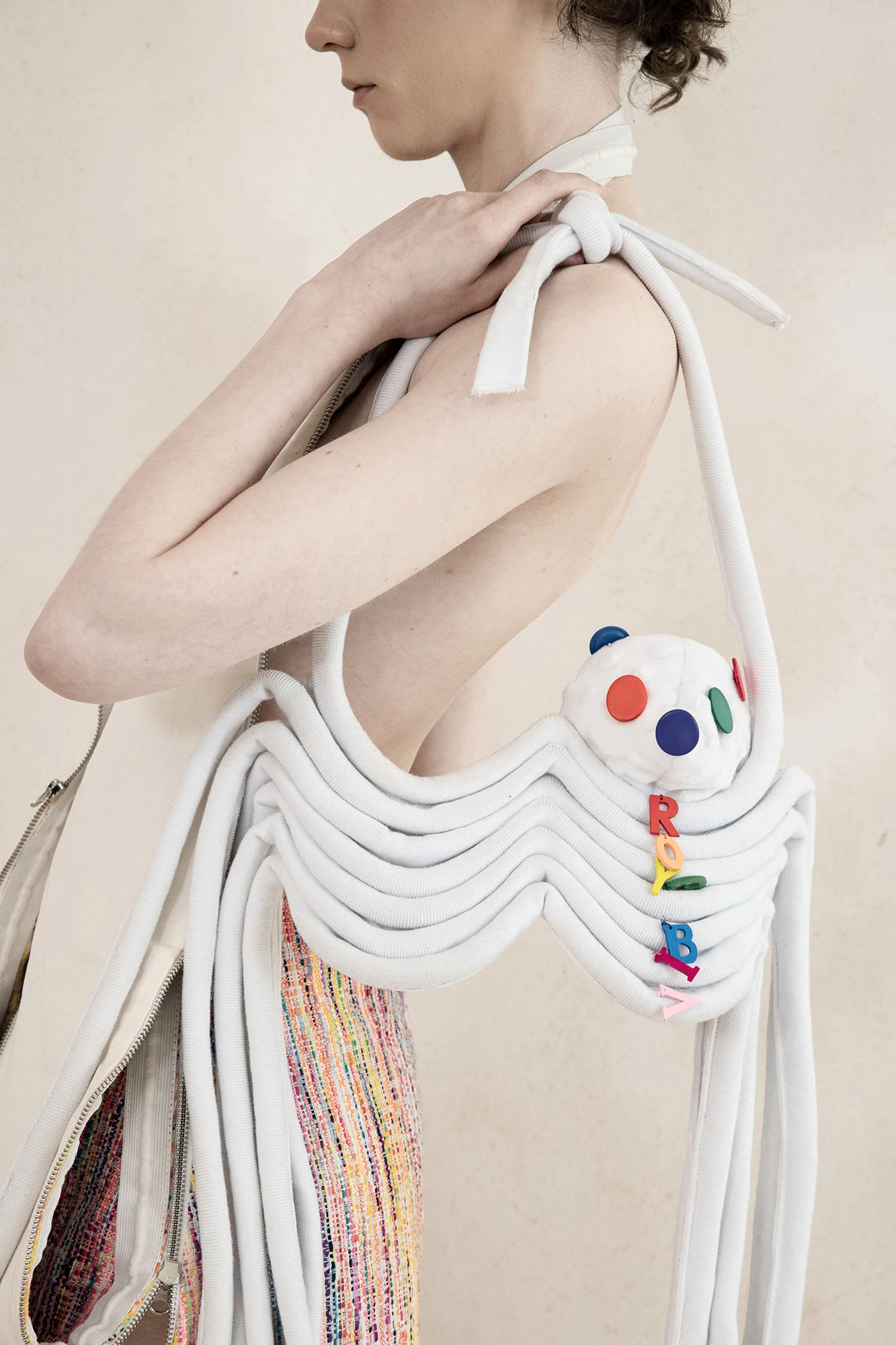
DZHUS ANTICON collection white rope sculptural bag with colorful clay accents worn as body harness

DZHUS, ANTICON collection. Photos by Marta Chudek and Maria Salivonova. Location: CONCEPT 11 Warsaw

DZHUS’ presentations are performances in which garments transform right before viewers' eyes. This interactive approach allows viewers to move beyond the one-way nature of traditional fashion shows. It creates an interactive space where the body, garment, and audience engage in a reciprocal dynamic. Why isn't the traditional runway enough to showcase your work?

The classic catwalk once ignited my passion for fashion. These days, participating in collective shows with a fixed format feels like a blessing. There’s something particularly tempting about fashion surrogacy that drives my aspiration to return to the défilé again when the opportunity arises. As DZHUS’s narratives accumulated multi-story contexts, a conceptual presentation became the obvious choice. However, our shows only embraced their now-signature performative nature in 2020 due to pandemic-driven phygitality. Previously, I would transform the models' outfits backstage and only present the final product. The Ukrainian Fashion Week show marked a major shift in approach by introducing the audience to the mystery of transformation. This turning point brought the “exhibitionism” of a garment’s ins and outs to the forefront of the DZHUS statement.

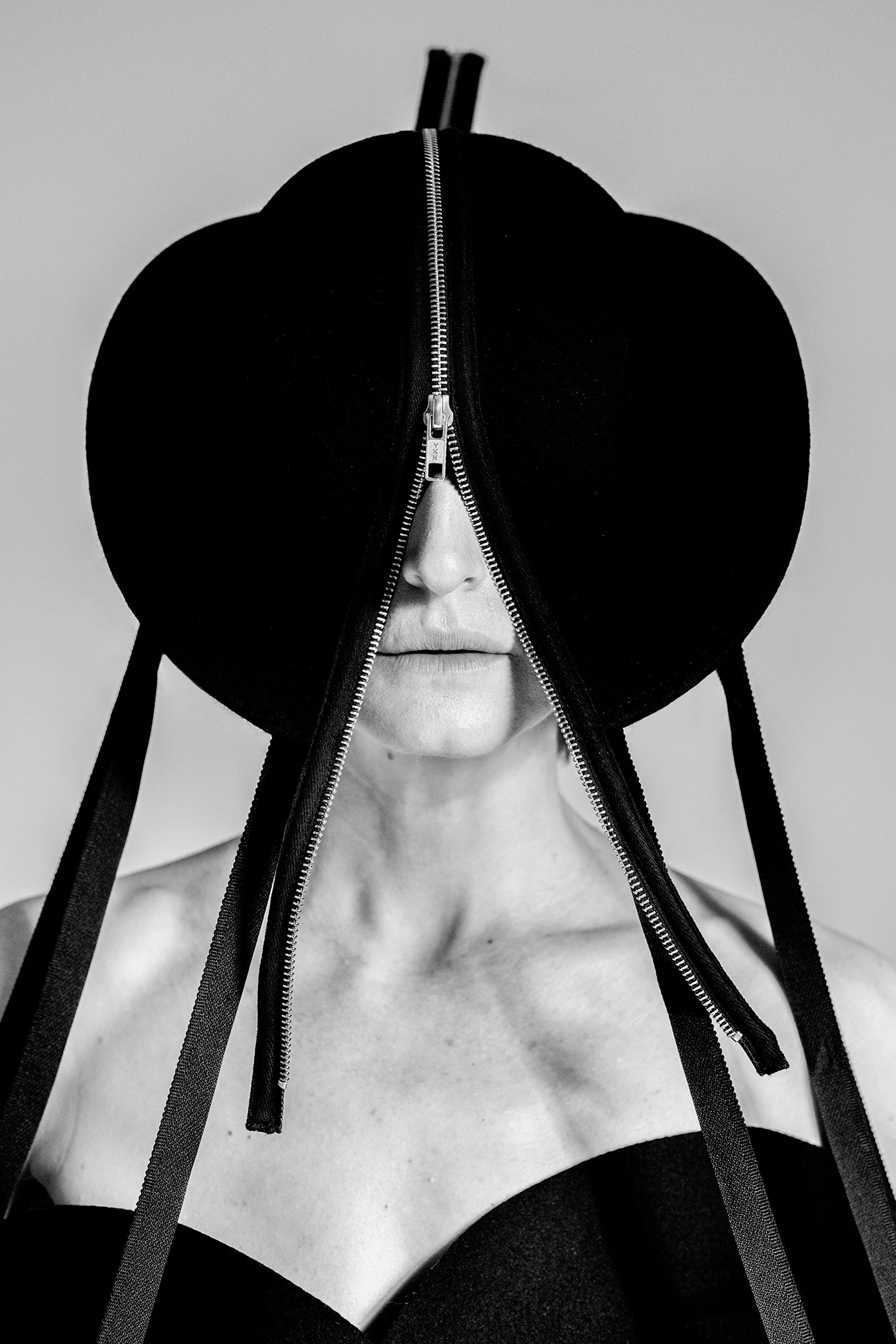
DZHUS ABSOLUTE collection avant-garde black hat with zipper detail, fashion editorial by Julia Jaracz

DZHUS, ABSOLUTE collection. Photo by Julia Jaracz @ Konewka Studio. Location and beauty partner: Jaga Hupało Space of Creation


Writing, particularly poetry, plays an increasingly significant role in your creative process. It serves as a vehicle for your inner world, offering others a reflection in which they can see themselves. At the same time, writing conveys individual and universal messages. Is there something you can express through words that you cannot express through clothing, no matter how complex it is?

Words themselves have metaphysical power and often dominate the narrative. So does their shape, which frames and molds their meaning. I refrain from prose or fine arts due to their vague starting points. Like design, poetry aims to fit ideas within rigid technical requirements. My poems are architectonic, multi-layered, and cathartic, much like my garments. The principle of converting “patterns into patterns” migrates from one medium to another. I play with morphology and semantics, confronting phonetics with pictography and exploiting typographic solutions. I code senses with numbers and eclectically choose vocabulary, among other things.

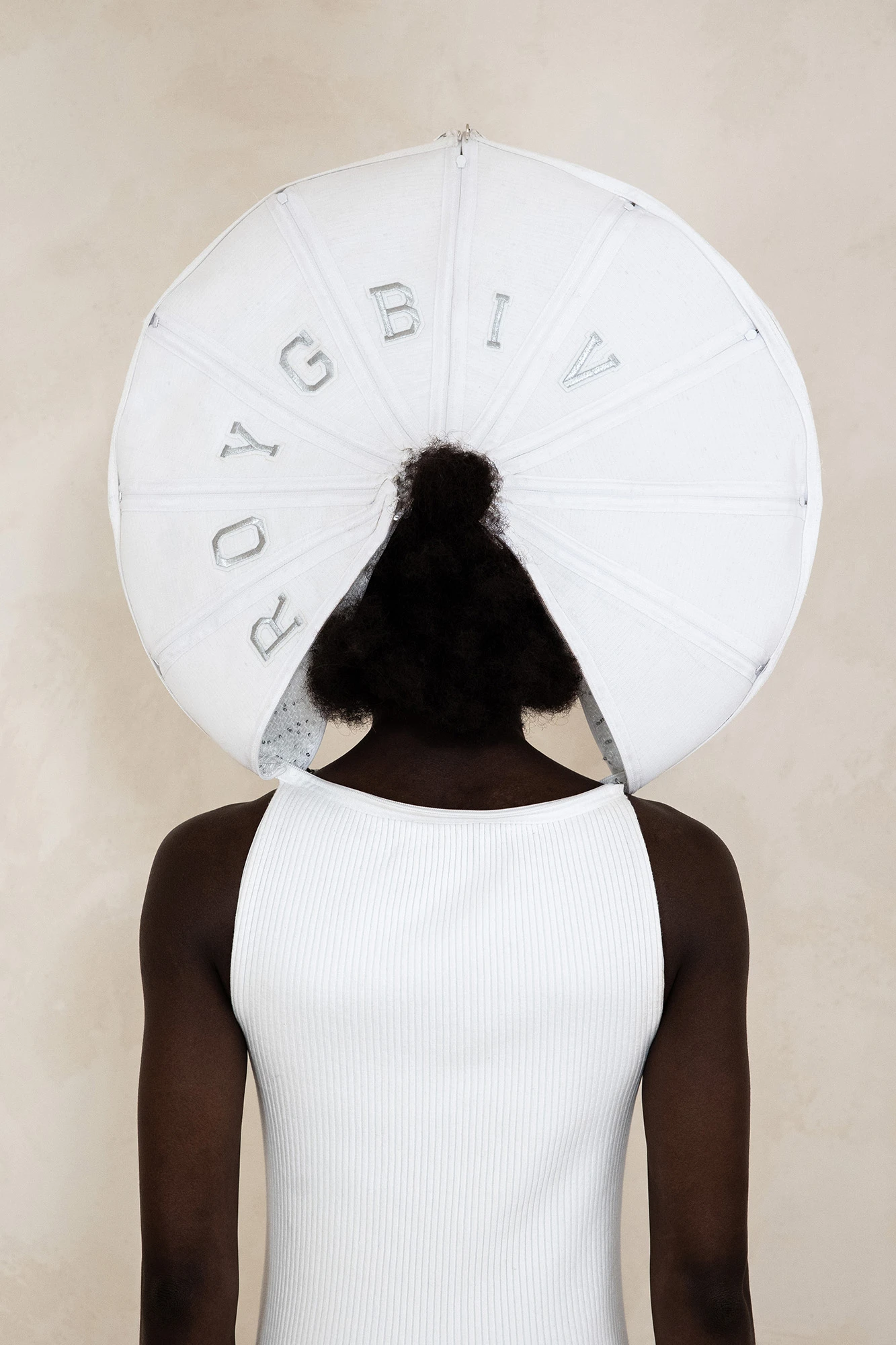
DZHUS ANTICON collection model wearing oversized white circular headpiece with ROYGBIV lettering, photographed by Marta Chudek

DZHUS, ANTICON collection. Photos by Marta Chudek and Maria Salivonova. Location: CONCEPT 11 Warsaw
DZHUS, ANTICON collection. Photos by Marta Chudek and Maria Salivonova. Location: CONCEPT 11 Warsaw
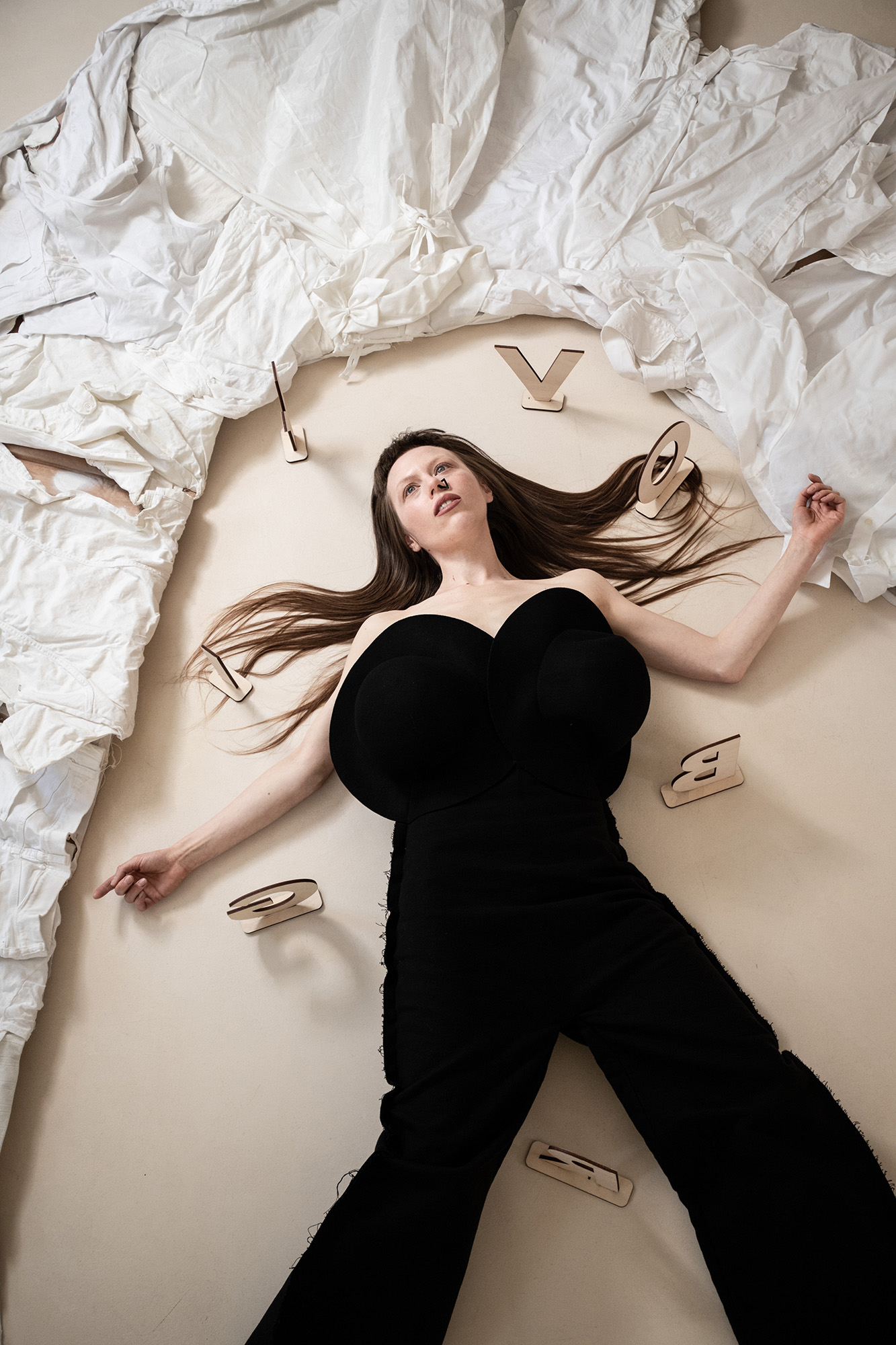
DZHUS, ANTICON collection. Photos by Marta Chudek and Maria Salivonova. Location: CONCEPT 11 Warsaw

_
On the cover: Irina Dzhus portrait by Lukas Klimek

Date

24.08.2026

Tags
Fashion & Textiletransformable fashionDZHUSIrina DzhusUkrainian designeravant-garde designfashion interviewidentity and clothingsustainable fashiondisplacement and designpoetry in fashionindependent designerperformative fashionmodular garmentsfashion industry critique