The MAK - Museum of Applied Arts in Vienna presents “Helmut Lang. SÉANCE DE TRAVAIL 1986–2005,” the first comprehensive retrospective dedicated to the visionary designer. The exhibition is based on the largest official public archive of Lang’s work, which was donated to the museum in 2011. The project offers a new interpretation of Lang’s creative process from 1986 to 2005 and his radical vision of fashion as a field of continuous experimentation capable of overcoming conventions. The works on display are site-specific multimedia installations that transcend the traditional format of fashion exhibitions. They highlight the pioneering role of the Austrian polymath in the dialogue between art, communication, and design.
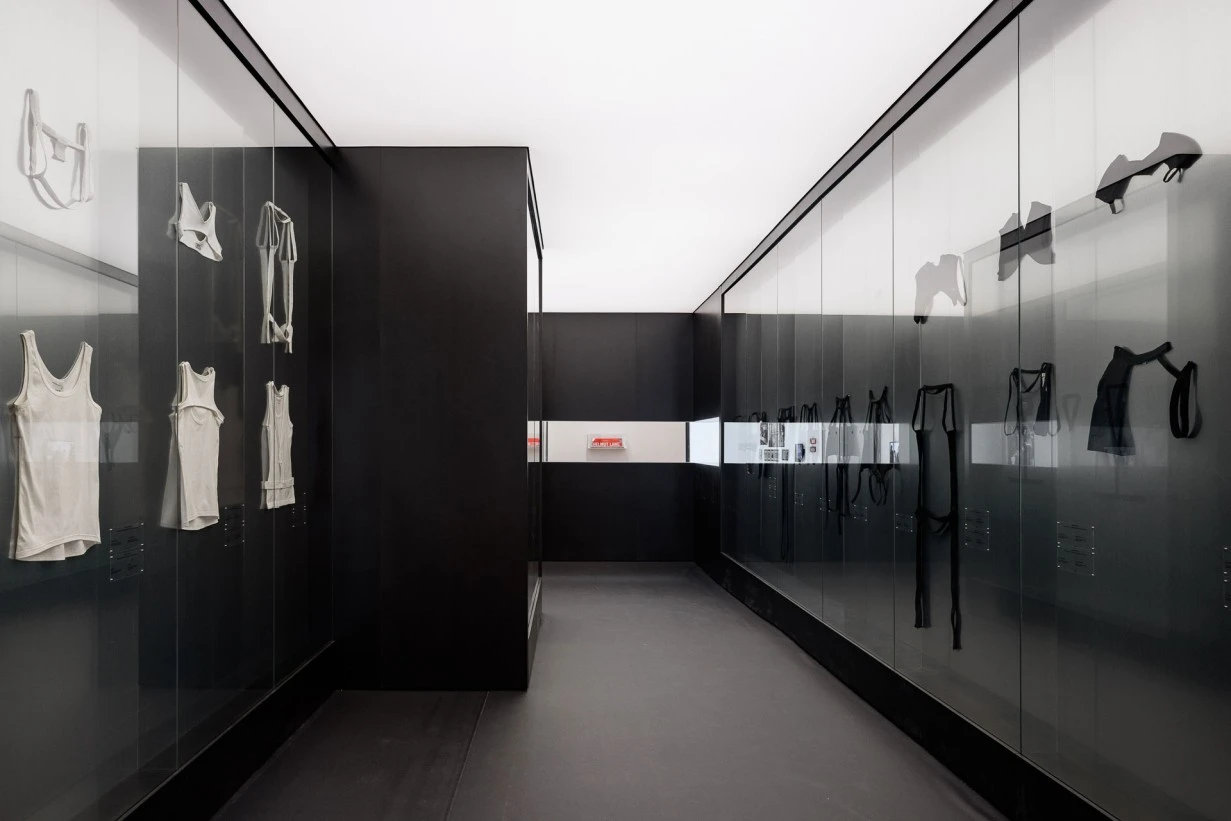
Exhibition view, Helmut Lang. SÉANCE DE TRAVAIL 1986–2005, MAK Vienna. © kunst-dokumentation.com/MAK
Helmut Lang Between Vienna, Paris, and New York
Lang, active in Vienna, Paris, and New York, redefined dressing codes through an essential, functional aesthetic with a strong conceptual accent. Through artistic collaborations, visual campaigns, and an emphasis on the emotional aspect of fashion, he has transcended disciplinary boundaries, prioritizing experience over consumption. His intermedia approach, similar to the experimental practices of the Fluxus art movement, makes his work difficult to classify and open to interpretation. Rather than a production system, his framework could be defined as an interdisciplinary method of relentless innovation.
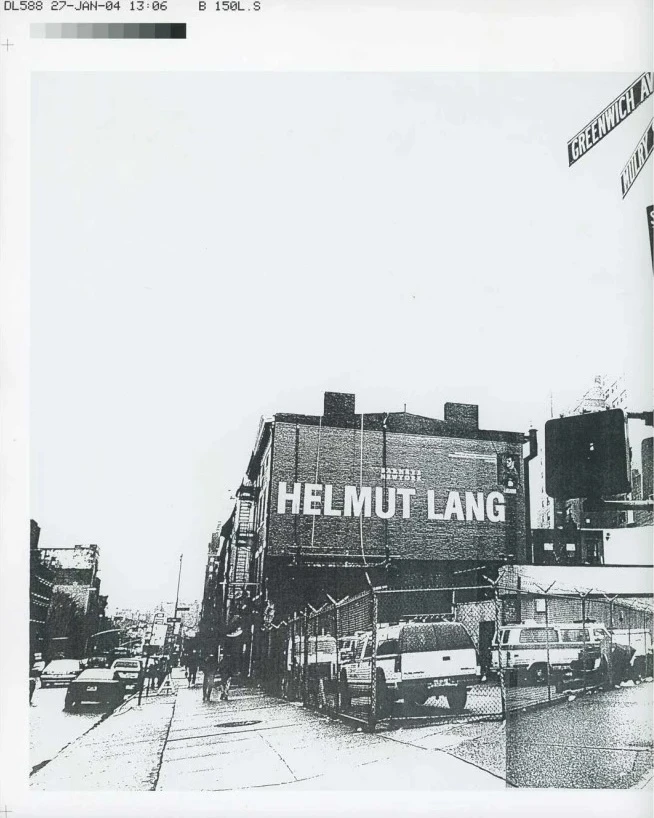
Test print of Helmut Lang’s Barneys New York wall advertising. © MAK Helmut Lang Archive. Courtesy of hl-art.
Avant-Garde Fashion and the Apocalypse Joyeuse Collection
After launching his first collections and bespoke service in Vienna in 1986, he was invited to present his Apocalypse Joyeuse collection at the “Vienne, Naissance d’un siècle, 1880–1938” exhibition at the Centre Pompidou in Paris. This established him as a leading avant-garde figure, in stark contrast to the prevailing climate in the Western world at the end of the 1980s. Decorativism, glitz, and frills gave way to a reduction in the structure of clothing: sheath dresses made from unusual materials, such as nylon, that followed the body’s contours; fitted jackets; tight, flat-fronted trousers; and color palettes without vibrant accents. This vocabulary would crystallize in the years to come, clearly defining his stylistic signature. Lang’s approach dampened the sexual implications of the thin rubber latex used with lace for the iconic rubber dress. The design drew energy from the juxtaposition of materials that seemed perfectly matched yet irreconcilably foreign. It was simultaneously demure and erotic.
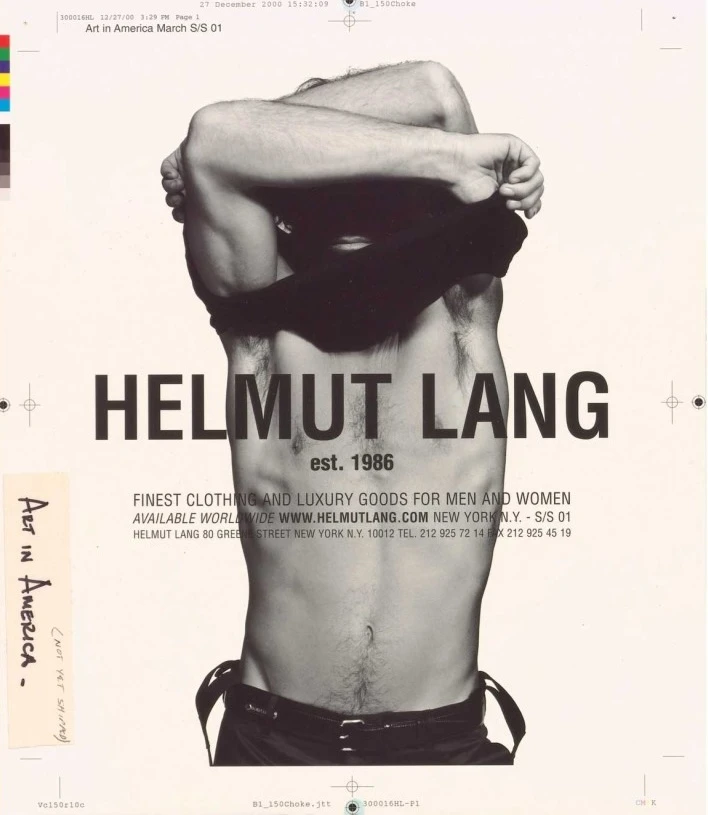
Helmut Lang, Art in America advertisement, Spring Summer 2001. © MAK Helmut Lang Archive. Courtesy of hl-art.
Minimalism, Adolf Loos, and Viennese Modernism
He embraced simplicity and formal rigor, which the press at the time labeled “anti-design” and “anti-fashion.” There is an obvious connection between the clean lines of his intellectual fashion and Viennese modernism, particularly the ideas of Adolf Loos, one of the leading theorists and architects of the early 20th century. Known for his nonconformity, Loos’s work and thinking marked a clear break with Art Nouveau aesthetics and 19th-century historicism. In his famous 1908 book, “Ornament and Crime,” he defined excessive ornamentation as a manifestation of cultural decadence. Proportion, quality of materials, and clarity of construction are elements Lang embraced and translated from architecture to fashion. His functional essentialism should not be considered a cosmetic exercise for its own sake. Rather, it is the ability of a creative visionary to interpret or anticipate the zeitgeist. When they saw the first collections, buyers commented, “There’s nothing revolutionary about it,” without realizing that the revolution had already begun and that Lang had sensed it well in advance.
Fashion, Globalization, and Cultural Shifts
To understand his story, however, we must take a step back in time and recall a series of events. On November 9, 1989, the Berlin Wall fell. Six months earlier, on May 18, the exhibition “Magiciens de la Terre,” subtitled “First World Exhibition of Contemporary Art,” opened in Paris. It brought together artists from all continents at the height of postcolonialist research. This controversial exhibition aimed to showcase contemporary artistic practices from the Western and non-Western worlds. These two seemingly unrelated events are indicative of the birth of the era of integral capitalism that we would call globalization twenty years later. When the economic recession began to affect fashion in 1991, bringing with it a vocabulary of deconstruction and minimalism, Lang began to gain popularity. He became the most eloquent spokesperson for this new scenario.
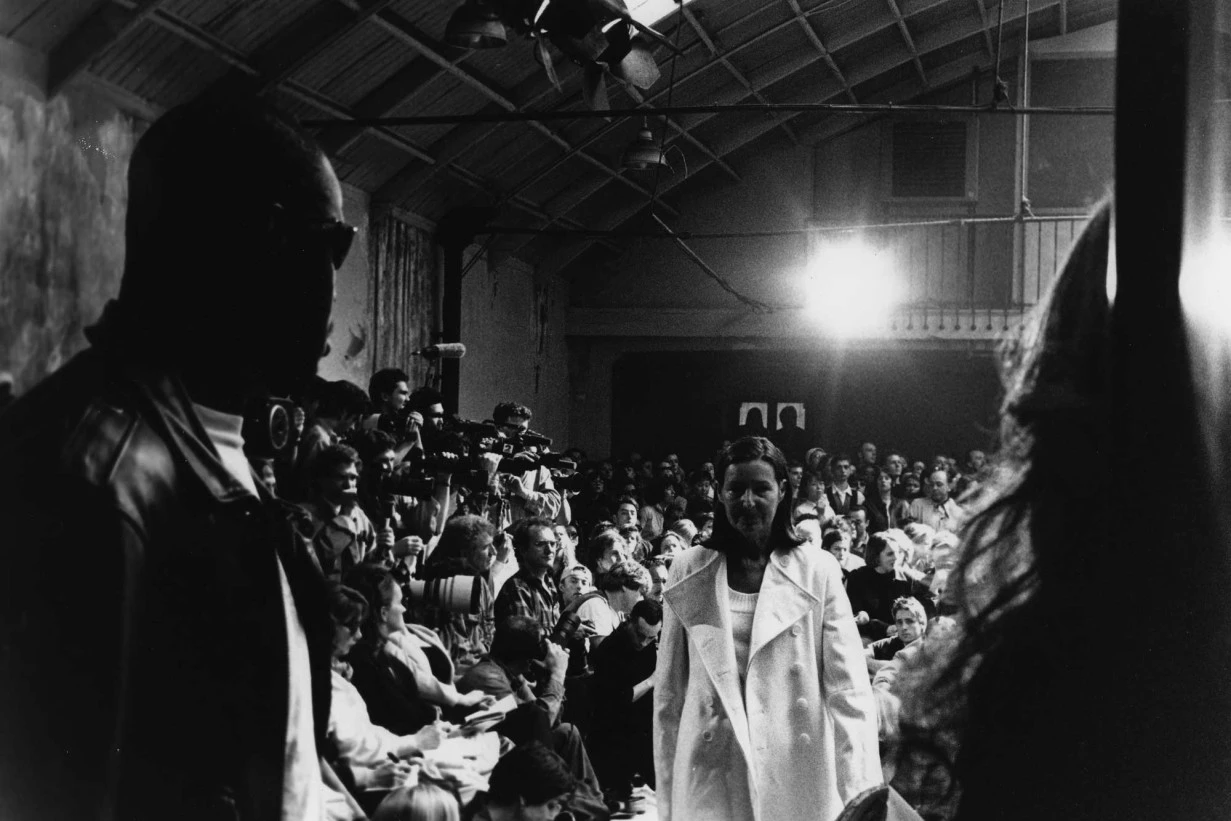
Helmut Lang, photograph of Helmut Lang Collection Hommes Femmes Séance de Travail Défilé, Winter 1993–94. Depicted person: Elfie Semotan. © MAK Helmut Lang Archive. Courtesy of hl-art.
Workwear, Uniforms, and Painted Jeans
The expressive tools through which Lang articulated his research became an integral part of a coherent and conscious narrative fully embedded in the present moment. His interest in workwear and uniforms, as well as the principles of function, form, and social coding they embody, served as the foundation for his work. He reinterpreted these principles as open and adaptable systems in which functional elements, such as pockets, fastenings, and padding, became aesthetic devices. Streetwear references were integrated with more culturally elevated ones, such as the legendary painted jeans, inspired by the classic five-pocket Levi’s 501 model. Lang translated the strength and durability concepts of denim, originally a work fabric, by repositioning the garment in the contexts of fashion and art. He reworked its meaning through playful staining reminiscent of a painter in his studio.
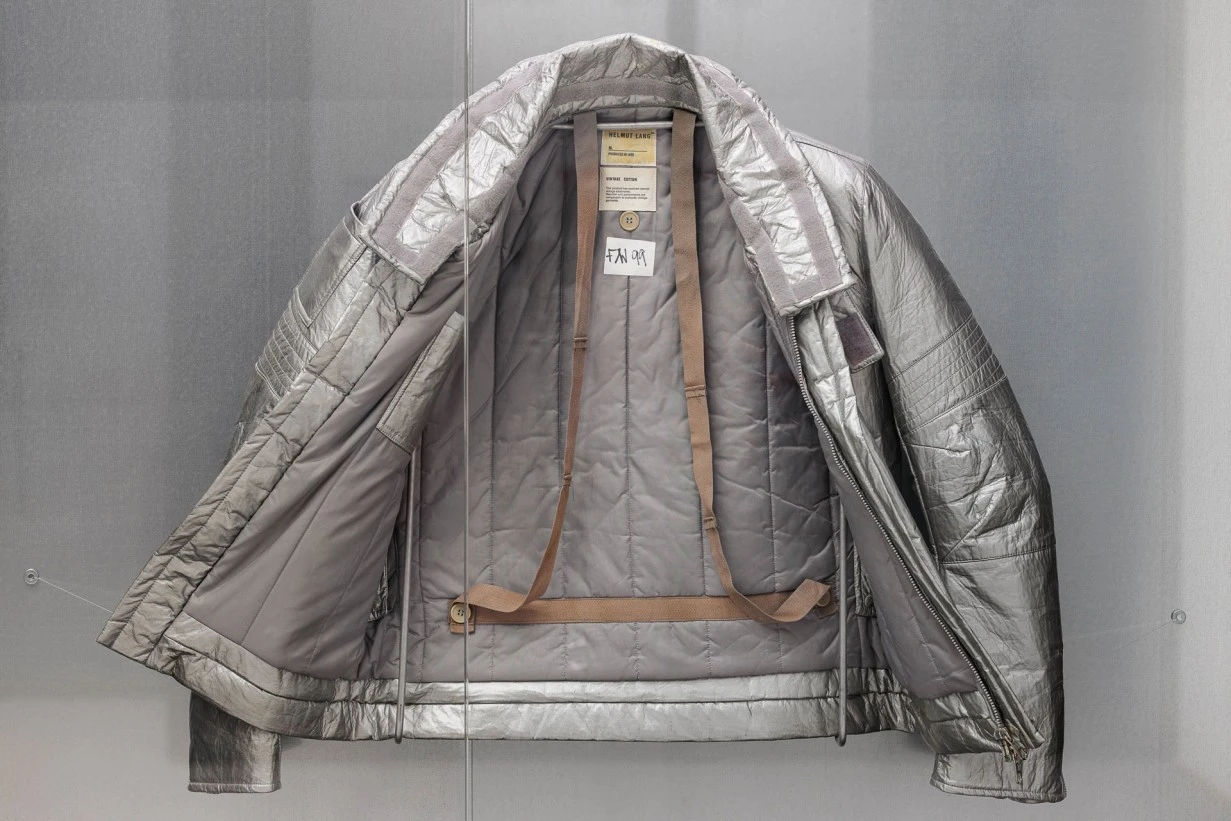
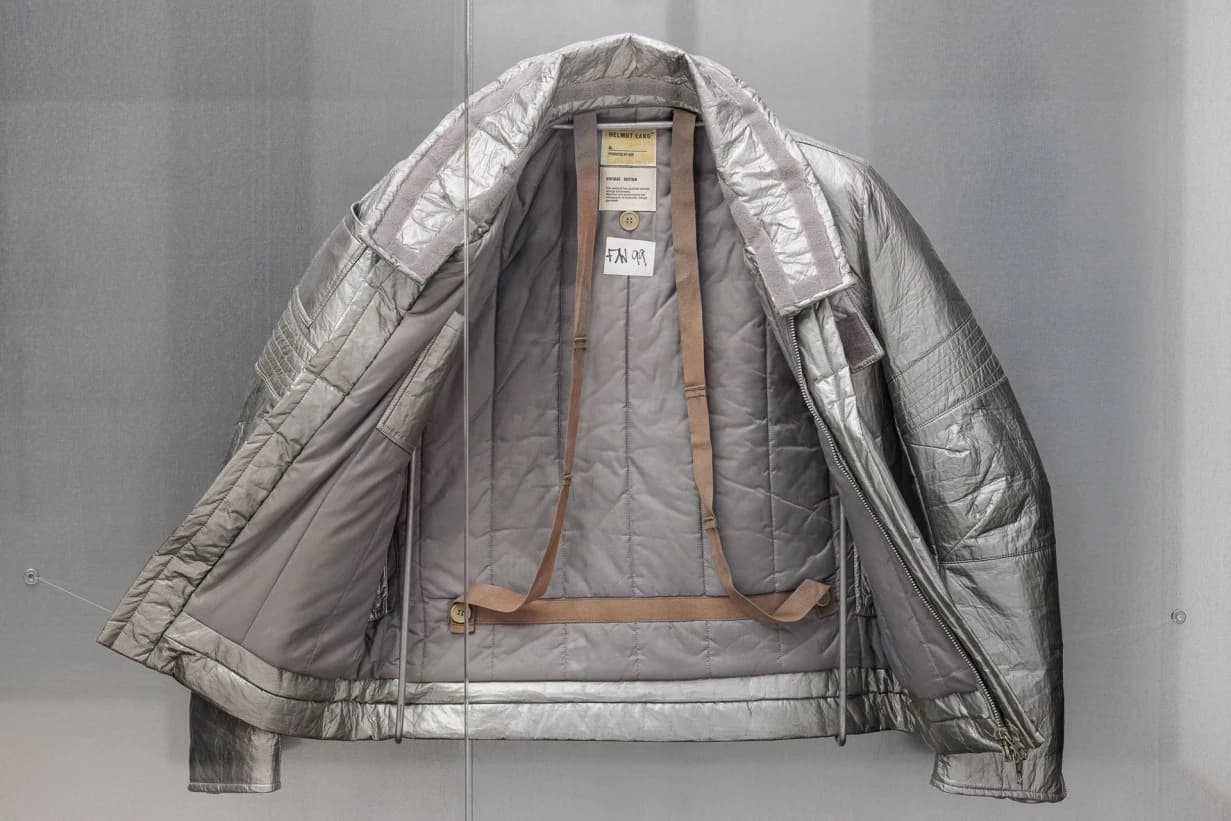
Helmut Lang, Astro Biker Jacket, 1998. MAK Helmut Lang Archive. © kunst-dokumentation.com/MAK
Séance de Travail and Digital Innovation
Starting in 1988, he replaced the classic elevated catwalk with the performative séance de travail (work session or work in progress), creating a dialogue between fashion, architecture, sound, and the public in industrial and informal settings that blended with everyday life. In 1998, when he relocated his fashion house to New York City, he became the first designer to present a collection online, embracing the democratizing potential of the emerging internet. He promoted the campaign on taxi signs, which became a symbol of Manhattan. He developed an essential aesthetic for his flagship stores together with architect Richard Gluckman, enriching it with installations by Jenny Holzer and Louise Bourgeois to reinforce the synergy between different media.
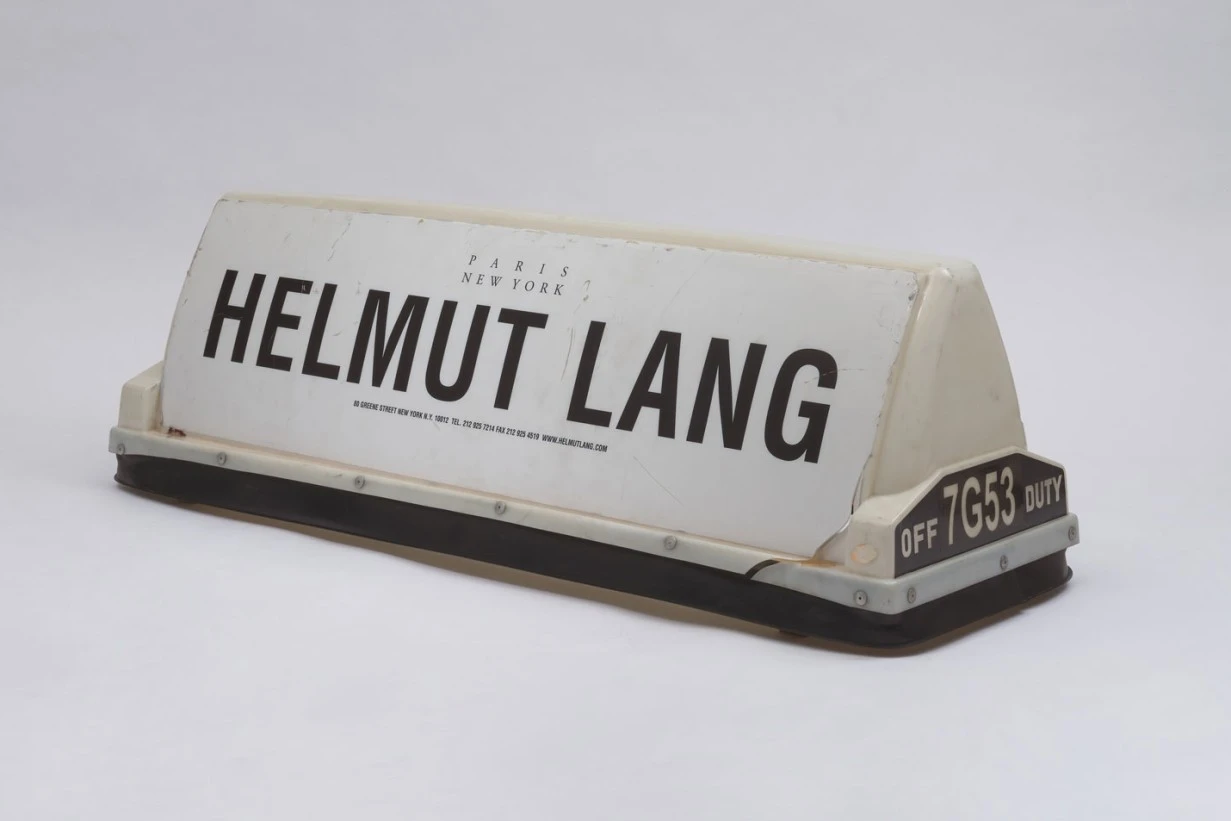
Helmut Lang, New York City Taxi Top, 2002. © MAK / Christian Mendez
Photography, Backstage, and Visual Communication
He transformed the backstage area into a fundamental element of his visual communication by merging the high and the low without establishing hierarchies. In doing so, he turned it into a symbol of authenticity, spontaneity, collective work, and transparency. Thanks to his collaboration with Juergen Teller since 1994, photographs, Polaroids, and process materials replaced glossy images with an immediate aesthetic that deliberately renounced the usual theatricality of fashion shows. One might call it an aesthetic of reality that was well suited to the desire to focus on the human element without idealizing the body. This aesthetic has profoundly influenced contemporary photography. The 2000 perfume campaign with Jenny Holzer, which used only text, was also emblematic: “I SMELL YOU ON MY SKIN…” Transformed into a conceptual work disseminated in print, radio, and video, the fragrance advertising redefined perfume as a sensory and cultural experience rather than a mere product. Not to mention his contribution to redefining the international fashion calendar by ensuring that New York fashion shows were held before their European counterparts.
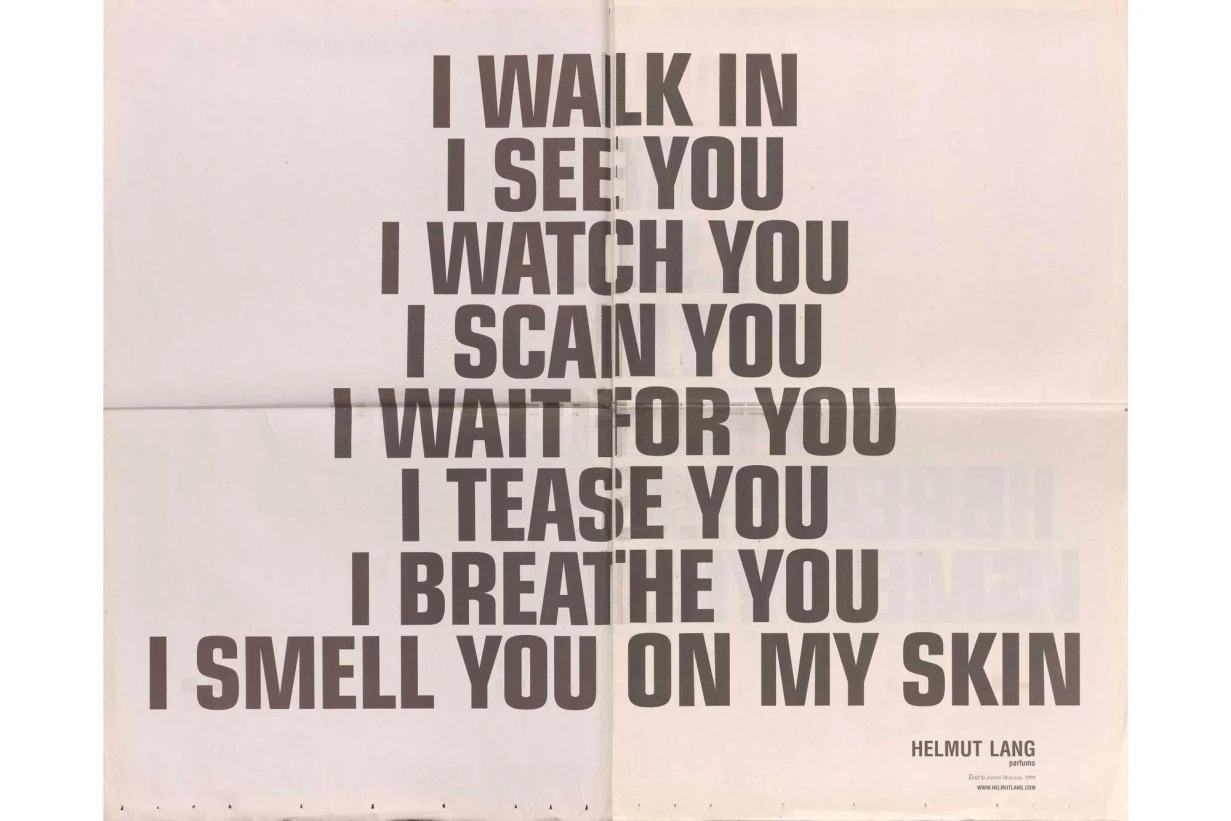
Helmut Lang, Helmut Lang Parfums supplement from The New York Times, text by Jenny Holzer, 2001. © MAK Helmut Lang Archive. Courtesy of hl-art.
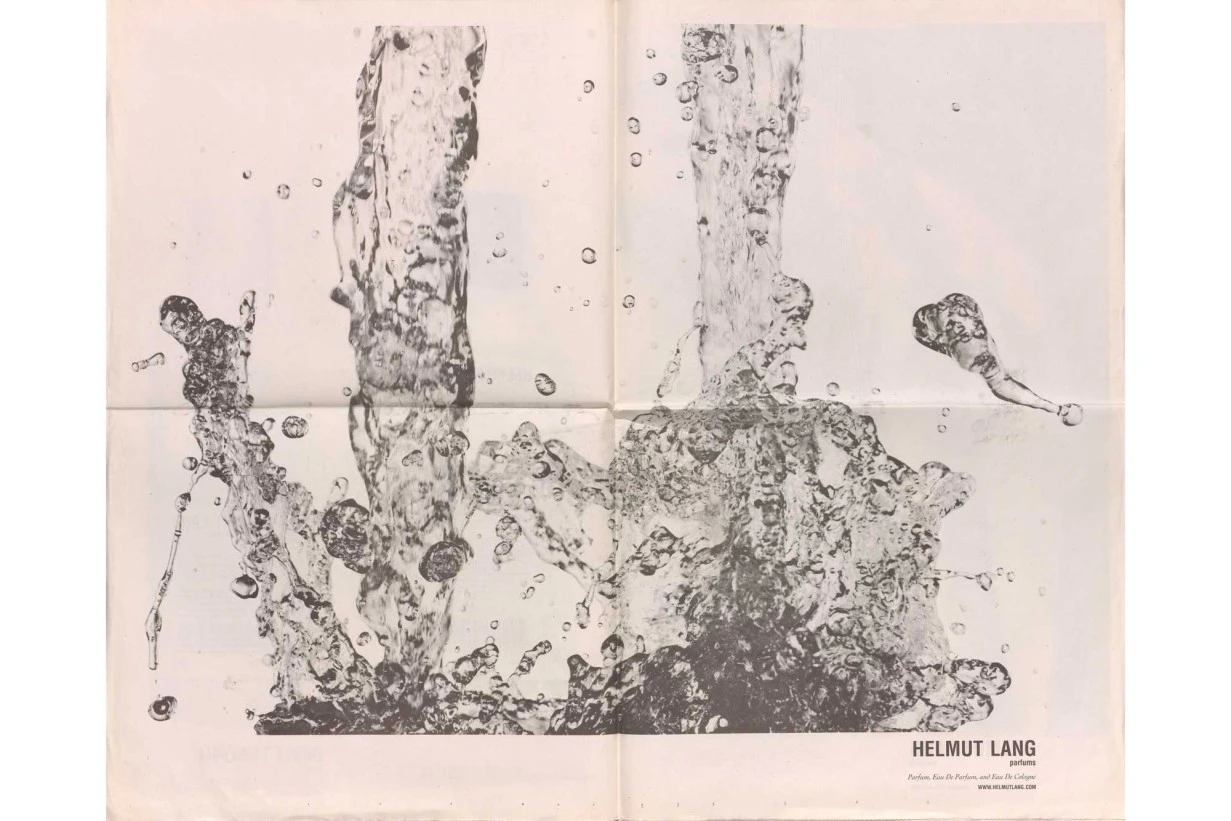
Helmut Lang, Helmut Lang Parfums supplement from The New York Times, photography by Larry Larimer, 2001. © MAK Helmut Lang Archive. Courtesy of hl-art.
Exhibition Curation and the Helmut Lang Archive
Marlies Wirth, Curator of Digital Culture and Design Collection at MAK, beautifully curated the exhibition setting to reflect Lang’s concept of the séance de travail as a process of continuous experimentation, refinement, and renewal. Through the themes Identity, Space, Séance de Travail, Media and Cultural Presence, Collaborations with Artists, and Backstage, his work is presented as an interconnected system and as part of a broader cultural narrative. For this exhibition, the Helmut Lang Archive, containing over 10,000 documents, has been thoroughly updated. Previously unseen materials, videos of the séance de travail, and a selection of experimental clothing and accessories are now accessible. Life-size installations recreate the performative nature of the fashion shows, transforming the exhibition space into an immersive environment.
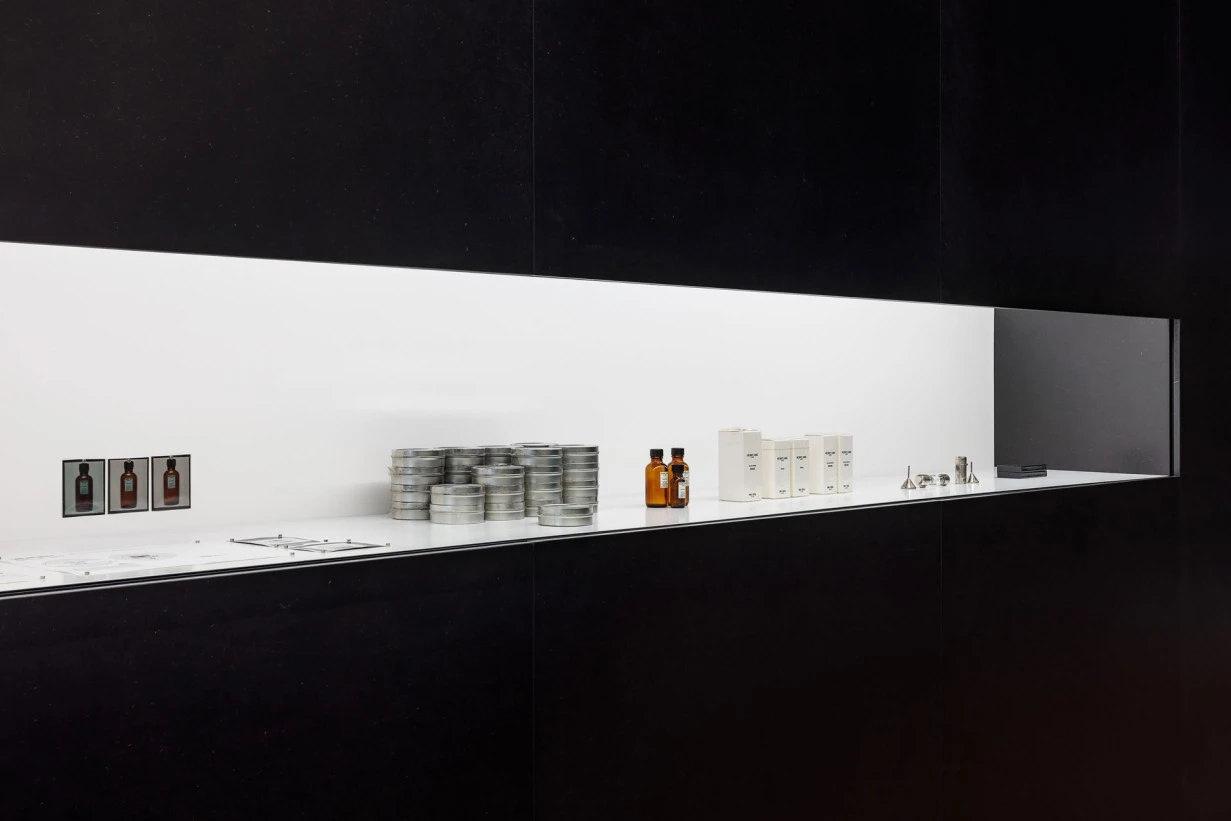
Exhibition view, Helmut Lang. SÉANCE DE TRAVAIL 1986–2005, MAK Vienna. © kunst-dokumentation.com/MAK
A Living Archive for Contemporary Culture
The multiplicity and heterogeneity of the materials on display reveal a collective vitality and a sense of shared participation involving everyone who collaborated with Lang to bring his ideas and vision to life. This reinterpretation of the archive is fascinating because it does not treat the documents as fossils. Instead, it shows us that they live on in the present through those who observe and interpret them, not only from a philological point of view. In this complex exhibition project, Lang’s story is reconstructed not through a sterile, chronological approach, but rather through a critical reinterpretation. SÉANCE DE TRAVAIL allows the designer’s research to reveal itself anew through a critical reinterpretation, enabling younger generations to see something vital. The exhibition transforms the viewing experience into a highly personal and collective endeavor, approached with great seriousness, as it is a significant social responsibility to document the journey of an icon who redefined the relationship between fashion, art, and society, establishing himself as a pivotal figure in contemporary culture.
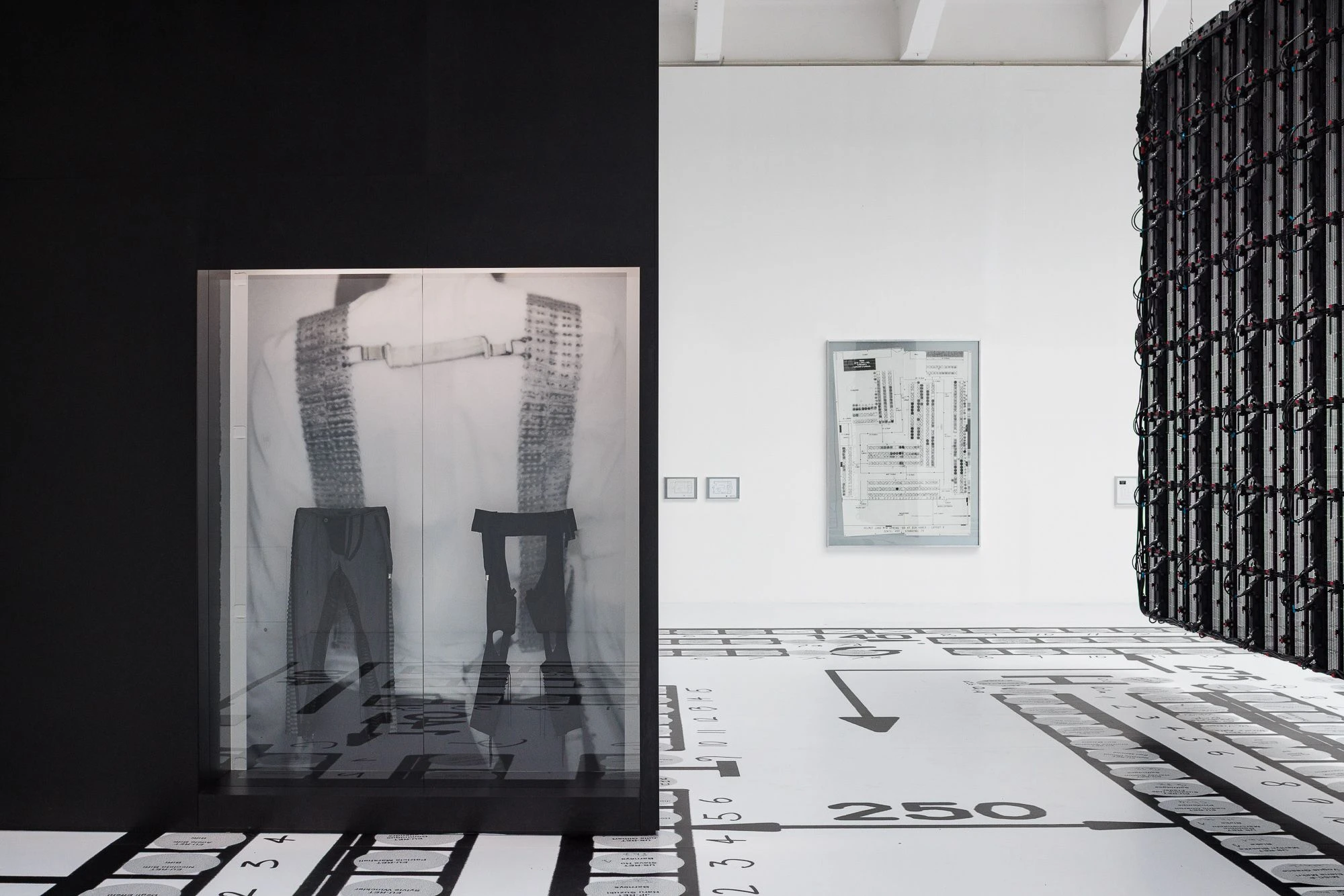
Exhibition view, Helmut Lang. SÉANCE DE TRAVAIL 1986–2005, MAK Vienna. © kunst-dokumentation.com/MAK
Helmut Lang. SÉANCE DE TRAVAIL 1986–2005. Excerpts from the MAK Helmut Lang Archive
MAK Exhibition Hall (ground floor)
MAK, Stubenring 5, 1010 Vienna
December 10, 2025 – May 3, 2026