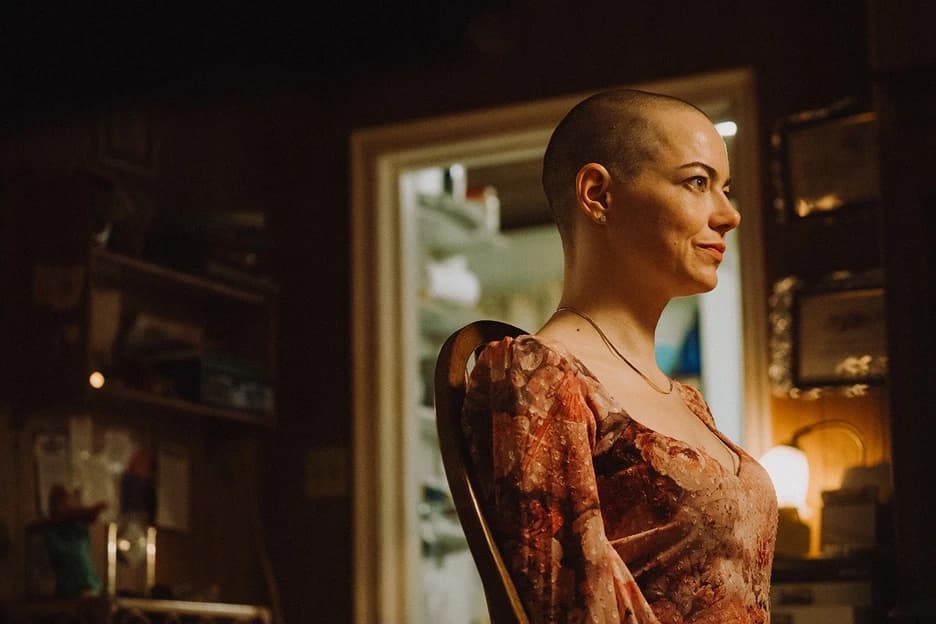
Emma Stones character with a shaved head sits in profile on a wooden chair, softly lit in a warm, cluttered interior, wearing a patterned dress.
8 min

Bugonia (2025): Corporations, Conspiracy and Chaos

By Rania Reihanah

A cultural film analysis of Yorgos Lanthimos' Bugonia (2025), exploring conspiracy culture, corporate power, Michelle Fuller's alien ambiguity and the psychology behind believing alternative

Introduction: conspiracy culture and corporate media

The age of Conspiracy is around us! Prepare your tinfoil hats!

From flat earthers to anti-vaxxers, there will always be a dedicated community of people with alternative beliefs that go against what is mainstream. In the age of hypercapitalism, highly globalized corporations and media channels control the narrative that controls modern society. The illusion of choice is granted through subsidiaries, as we often forget that the media are not entirely independent; many large corporations have a stake in different media outlets, usually controlling the narrative for their audiences. In the age of corporate media, we as audiences demand more from the media we consume, and some even turn to alternative news sites to fully experience independence from mass-controlled ideologies. Truth serves as global currency traded amongst the conglomerates that control the narrative, and many are sick of it.

But what are the repercussions of embracing conspiracy and contrarianism? Are there any dangers in trusting alternative beliefs and facts?

Myth, bees and climate: what “Bugonia” really means

Yorgos Lanthimos’s Bugonia explores this idea, showcasing how an intricate web of conspiracy develops from one’s distrust of the world. Through Teddy, Don and their questionably innocent victim Michelle, we explore a story where beliefs in alternative facts based on conspiracy theories form and develop into a haywire mess of torture, murder and aliens. Sort of. Through Bugonia, Lanthimos explores humanity’s current sense of hopelessness in the state of the world and how it leads to a psychological connection to conspiracy theories. In an age of hypercapitalist global economies, it is hard not to wonder if maybe the age of destruction is not caused by us as a society, but the big corporations’ poisonous methods in forcing us into submitting to capitalism.

Bugonia’s exploration of conspiracy comes in layers. The etymology of Bugonia refers to the Greek Myth of the same name, derived from the ancient Greek words βοῦς (boûs), for “cattle”, and γονή (gonḗ), for “progeny”. Bugonia stands as an enduring symbol of death and renewal, a ritualistic phenomenon used to revive agriculture as recorded in Virgil’s Georgics. The core belief of Bugionia is that Death and Sacrifice are essential to maintaining the health of the earth. The story within Lanthimos’s Bugonia also follows the same fundamental belief: that, to save the Earth’s environment, sacrifices are necessary to reset the climate.
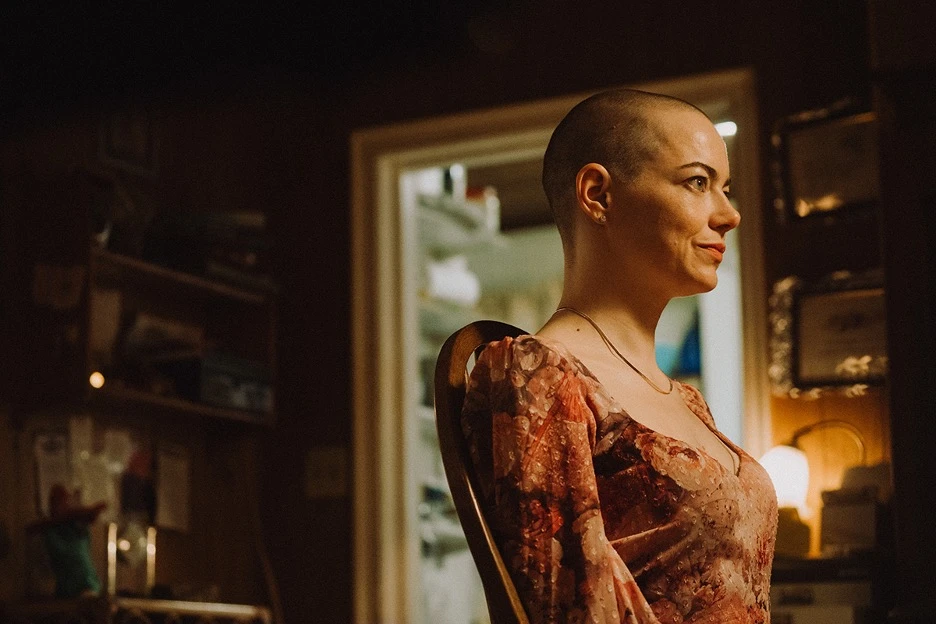
Emma Stones character with a shaved head sits in profile on a wooden chair, softly lit in a warm, cluttered interior, wearing a patterned dress.

Emma Stone in Bugonia (2025), directed by Yorgos Lanthimos. Cinematography by Robbie Ryan. © Focus Features. Image courtesy of Universal Pictures.

Lanthimos’s Bugonia follows the story of the kidnapping of a Pharmaceutical Corporation CEO by two conspiracy theorists who believe that she is an alien using extraterrestrial technology to destroy humanity by polluting the Earth and decimating the population of bees. The film, unlike most sci-fi alien films, is gruesome in its exploration of extraterrestrial life and, in a way, creates an ambiguous perspective on the truth. Is Michelle Fuller really an alien? Or are Teddy and Don physically and mentally torturing a not-so-innocent human CEO? Lanthimos plays with the idea of beliefs in the film by never truly revealing the canonical truth until the film’s rather absurd yet comical twist ending. Lanthimos’s exploration of perceptual truth encourages the audience to reflect on what is real and what is myth, examining how perceptions of truth shape those who consume it.
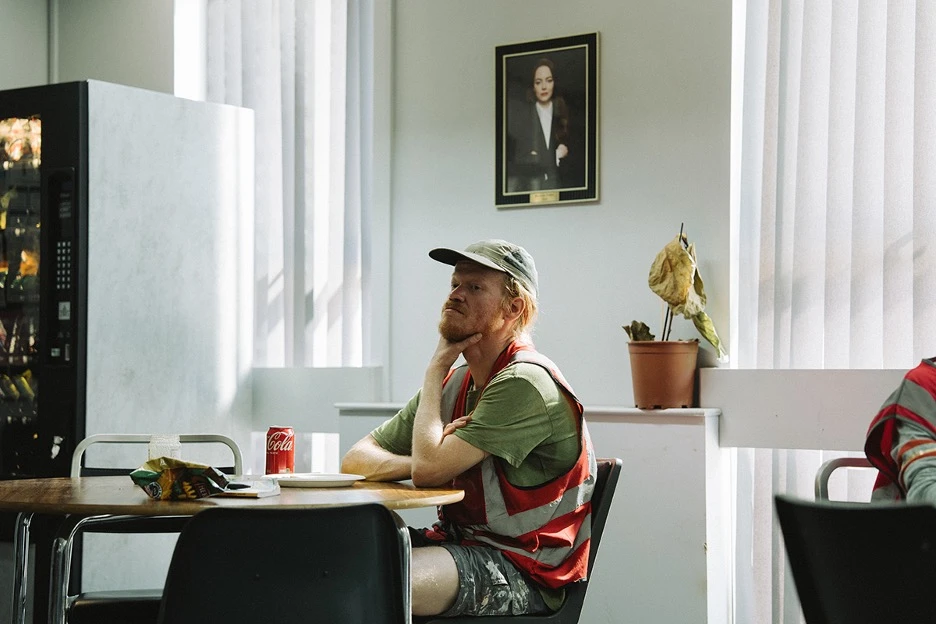
Jesse Plemons character in a high-visibility vest sits alone at a break-room table with snacks and a soda, staring thoughtfully ahead beneath a framed portrait on the wall.

Jesse Plemons in Bugonia (2025), directed by Yorgos Lanthimos. Cinematography by Robbie Ryan. © Focus Features. Image courtesy of Universal Pictures.

Plot, ambiguity and the psychology of belief

Bugonia guides the audience through Teddy’s conspiracies, only revealing their reality to them at the end of the movie. The conspiracies in themselves seem ridiculous: there was no way the Aliens who are apparently among us would plan to eliminate humanity by eliminating the bees. Through Teddy, Lanthimos showcases how the ordinary person can succumb to alternative beliefs, driven by feelings of disappointment in the world and a desire to find answers to causes that feel beyond one’s control. Researchers note that the broad scope of conspiracy theories offers consistent explanations that allow people to preserve their beliefs in the face of uncertainty and contradiction. It’s difficult to accept reality, and believing in an alternative often helps one process one's grievances. However, it doesn’t mean that believing in conspiracy theories is a healthy way to cope. Conspiracy beliefs increase deprivation of social needs. However, despite this, the believers are not just simple-minded, mentally unwell people, but also people who turn to said theories “to fulfill deprived motivational needs and make sense of distress and impairment.”

While conspiracy theories help people contextualize their beliefs, they will still feel forms of anxiety, as conspiracies in themselves are unlikely to make one feel safe or confident. Belief in conspiracy theories also often leads to social stigma, increasing the risk of social rejection. Despite the ‘comforting’ nature of denialist conspiracy theories, they serve only to explain the causation of current issues. For example, the belief that “Big Corporations are responsible for creating global issues.” However, it in turn can lead to beliefs that overexplain the causations of said anxiety of the global problems, like how “Michelle Fuller is responsible for humanity’s imminent demise because she is an alien overlord whose species wants to kill all of humanity by killing the bees.”
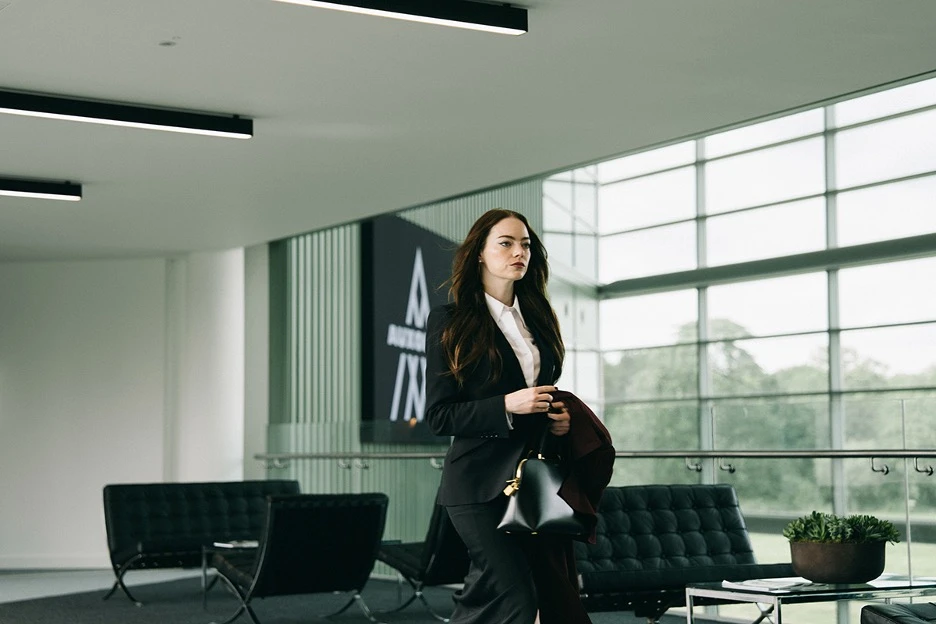
Emma Stones character in a dark business suit walks confidently through a modern glass-walled office lobby, carrying a handbag and coat.

Emma Stone in Bugonia (2025), directed by Yorgos Lanthimos. Cinematography by Robbie Ryan. © Focus Features. Image courtesy of Universal Pictures.

Media, McLuhan and the echo chamber

As media conglomerates control the general public's point of view, we must consider big media’s role in funnelling folks into conspiracy theories. As Marshall McLuhan writes, “the effects of technology do not occur at the level of opinions or concepts, but alter sense ratios or patterns of perception steadily and without any resistance.” The more one consumes media that promotes certain ideologies, the more likely one is to believe them. Passive consumption of media, including mainstream and alternative media, can lead to the development of certain ideologies that shape one’s core beliefs, which explains why conspiracy theorists continue to consume theories and remain within their echo chamber of alternative truths. Added to their general distrust of controlled media, becomes the catalyst for their behaviour as a whole.

Michelle Fuller: performative humanism and corporate alienation

But is Michelle Fuller an Alien?

Spoiler alert, yes and no. The ending reveals Michelle is an alien, yes, but that the Andromedons are the earliest model for the current evolution of what we know as the ‘human’.

So, what is the truth?

The ‘truth’ behind Michelle Fuller’s human identity lies in perception. Emma Stone’s characterization of Michelle exemplifies performative humanism and corporate narrative control. Michelle controls the narrative around her, serving as a metaphorical ‘Queen Bee’ of her colony, wielding matriarchal-esque power over her employees who work tirelessly to aid her corporate ambitions without question. The consequences of her company’s endless ambitions are showcased through the suffering of Teddy’s mother, Sandy Gantz, lying in a vegetative state, thanks to Auxolith Corp’s miracle drug to cure Opioid Addiction. Her speech regarding Sandy Gantz’s condition is an excellent example of this human performance aided by corporate greed, as, according to Michelle, sacrifice is necessary to achieve success, delivered through a polished yet empty corporate PR apology that condescendingly thanks the Gantz family for their sacrifice.

The answer to the question of Michelle’s alien status, however, is up to manipulation as opposed to interpretation. Even in a state of grave danger, Michelle consistently ragebaits her captors, as she grows to see them as liabilities and unstable idiots who are wasting her time rather than the threat she initially saw them to be. Michelle’s shift in attitude shows how her status within the corporate power structure alienates her from the people she sees as beneath her. She perceives Teddy as an illogical, immoral and borderline idiotic man, so she uses his belief in conspiracy to guarantee her freedom. Michelle takes advantage of Teddy’s preposterous belief that she is an Andromedon Alien and manipulates him for her freedom by planting hints that the anti-freeze in her car will cure his mother. And Teddy, so deep in his echochamber of conspiracy, believes her, ultimately killing his mother in hospice care.

Cruelty, victims and the absurd ending

Bugonia’s showcase of human cruelty, presented through absurdist yet realistic storytelling, explores the extremes, examining human dread and misery and what they can lead to. In the end, the actual victims are neither Michelle, who was tortured and kidnapped, nor Teddy, whose beliefs in conspiracy led to his ultimate demise, but Sandy and Don, whose only grave sin is their optimistic beliefs that led to their respective downfalls. Lanthimos explores human cruelty in a similar film he did with Emma Stone, where Emma’s character, Bella Baxter, finds clarity after experiencing the true cruelties of class difference — you can read the whole piece at: Poor Things (2023): Exploring Human Nature, Feminine Agency and the Obsession with Power and Control.

The absurdity of the reveal that she is, in fact, an alien, and that all of Teddy’s conspiracies turned out to be true, is also, in a way, ambiguously true. The Audience is led to believe in Michelle’s human performance and understand that Teddy is crazy. But that is not the case, as the ending is absurd enough that audiences can either read it as the fact that they have been gaslit the entire time by Michelle and the Andromedons, or that the tonal shift is a metaphorical representation of how Michelle will never understand the struggles of the people she has hurt through her corporate experimentations even after experiencing one of her victims emotional and physical torture, making her the actual alien to society.

Bugonia’s service as a study of the relationship between corporations, conspiracy, and community offers a new, albeit dark, perspective on humanity. How existential dread can lead to dangerous extremities, how corporate irresponsibility in the name of development can facilitate conspiracy, and how one places importance on things that are often not worth fighting for. Lanthimos guides his audience to seek the truths hidden behind ideological conspiracies and narrative controls, perceiving the humanistic aspect of reality as a whole. Bugonia showcases truths in the eyes of its beholders, the narrative perceptions that lead to destruction and how everyone is vulnerable to the clutches of conspiracy, especially in an environment that values the strong.

Works Cited

American Psychological Association. (2023, June 26). Why some people are willing to believe conspiracy theories [Press release].

Bennington-Castro, J. (2025, November 4). What is the ancient ritual of Bugonia? HISTORY.

Douglas, K. M., Sutton, R. M., & Cichocka, A. (2017). The Psychology of Conspiracy Theories. Current Directions in Psychological Science, 26(6), 538–542.

Fadel, L. (2025, October 24). Conspiracy theorists fuel “Bugonia” climate horror. NPR.

Index of US Mainstream Media Ownership | The Future of Media Project. (n.d.).

Li, S. (2025, November 10). ‘Bugonia’: An Intimate Portrait of Humanity at Its Worst. The Atlantic.

Logo IMPERIUM ROMANUM. (2001, November 25). IMPERIUM ROMANUM.

McCluskey, M. (2025, October 31). Breaking down the comically bleak ending of Yorgos Lanthimos’ Bugonia. TIME.

McLuhan, M. (1964). Understanding Media: The Extensions of Man. McGraw-Hill Companies.

‘The Bees (Virgil’s Georgics: Book IV)’ | TLS. (2016, September 6). TLS.

Van Prooijen, J. (2022). Psychological benefits of believing conspiracy theories. Current Opinion in Psychology, 47, 101352.

Yorgos Lanthimos’ Bugonia and the absurdity of the modern world. (2025, November 16). To Be Magazine.

Date

06.12.2025

Tags
Film & MediaBugonia filmBugonia (2025)Yorgos Lanthimos BugoniaBugonia film analysisBugonia film reviewBugonia conspiracyEmma Stone BugoniaMichelle Fuller Bugoniacorporations and conspiracy theoriesconspiracy cultureconspiracy psychologyclimate horror filmBugonia mythsacrifice
Bright industrial studio interior at Studio Albatros with high factory windows, minimalist furniture, photographic works on the wall, and a large framed installation wrapped in plastic.
8 min

Paris third-spaces: artists, curators and the importance of community

By Victoria Gandraman-Schwartz

From white cubes to tiers-lieux, this essay explores how artists and curators in Paris use third places like Studio Albatros to build community, share journals and rethink exhibition spaces.

From the white cube to third places in Paris

A Parisian-based, academy-trained artist’s first exhibition will often be their diploma show. As a rule, the show – set in the academy gallery or in the artist’s studio – will follow a set of prerequisites that are well-engrained in the contemporary art ecosystem, established throughout the past century: the space will be clean, the walls will be white and there will be enough room around the art pieces in order for them to breathe. The goal is for the pieces to be observed individually, even if the exhibition itself is collective and brings together multiple artists’ artworks through curatorial choices. Following this initial show, the ideal next step for the artist would be to start being represented by a commercial gallery. Their works would then be shown in a similar space to the one aforementioned, commonly known as a white cube. Generally speaking these spaces are ground-level, small and in the city center, with owners wary of their proximity to people’s homes thus often quiet and with early closing hours. In this ideal scenario, gallery representation would consolidate the artists’ path towards exhibitions in institutional spaces such as museums and art centers, which tend to have a similar frame of reference in terms of scenography and curation to the ones described above. All of this is, of course, a schematic and simplified view of things that rarely translates into reality. Parallel to the orthodox, sometimes puritan white cube, emerging contemporary artists and curators will work in associative, community-based and artist-run spaces. Because of how far they can be from institutions, both physically and symbolically, these third-places can feel liminal and in-between; it is, however, common ground that these are the places where artistic freedom and expression have the most room to flourish. But where exactly are these spaces ? How are the art pieces shown, by whom and for whom?

Street view of Studio Albatros in Montreuil, with colorful murals covering the walls and a blue-and-white geometric pattern painted along a fence beneath a leafy tree.

Studio Albatros, Montreuil. 

Pushing beyond the périphérique: why third places matter

This article will focus on contemporary art exhibitions by emerging artists, curators and their practice in the city of Paris, France… or rather around it. The capital of France is quite insular, surrounded not by water but by the “périphérique”, a 4-lane highway separating what is referred to as intramuros and extramuros of the capital – literally “inside the walls” and “outside the walls” – that operates as a border between the two. While throughout the 20th century the more important part of the artistic emulation happened inside of the walls, Paris-based artists and curators are now pushing these borders farther and farther out into the Ile-de-France region, with Paris at its heart. A myriad of reasons for this are at play, the more obvious ones being culture workers lacking money, needing space and working towards the building and consolidation of community.

Across the world, cities that used to be epicenters of arts and culture are known to be changing, and radically so. Public museums lose funding with every passing year, entire areas are rented out to create passive income and third-places risk destruction in the face of real estate developers. The picture may be dire, but not without it being fuel for action. Being pushed away from the center, art spaces are blooming in peripheral areas. Naturally, they are active participants in various forms of gentrification. Gentrification is an essential issue of the 21st century, broadly researched by urbanists and sociologists, namely in terms of what it means today to be a “digital nomad” or an “expat” but also in the ways in which artists can be unintentional initiators of the phenomenon. While an element that is essential to take into account, the present article focuses on what exactly happens inside of these decentred third-places rather than outside of them, even if the two are undissociable by definition. Without denying the role these spaces play in the cityscapes that they exist in, it is undeniable that their mere existence crystallizes a desire for community and coming together that is much harder to obtain in metropolitan hearts.

What is a third place (tiers-lieu) for artists?

“Third-place” is a term coined by American sociologist Ray Oldenburg, defining what comes after one’s home and one’s workplace. It is, in essence, a space of and for community. It can take the shape of a café, of a bar, of a store; central to it are the people coming together to be together with no other prerequisite. The usage of this term in French has come to be almost independent of its initial and historical meaning, a “tiers-lieu” (French for third-place) commonly being perceived as a space of culture and art of all kinds. Throughout the second part of the 20th century, the third-place has become the only place for lots of people, often artists, operating as a synthesis of the three places theorized by Oldenburg. It only makes sense : the artist’s work and life are intertwined, one resulting from the other and vice versa in an endless loop. Arguably, community is intrinsic to that because one makes art, if not with others, for others.

Studio Albatros, Montreuil: a living third place

One such space was invested by young Parisian curatorial duo Minot and Marius. This September, they put together a 5-day exhibition in a space known as the Studio Albatros in Montreuil, on the East side of Paris. Historically a cinema studio used for the production of silent films, it has slowly and throughout the 20th century become its own entity, connected to the vast web of similar entities around and across the city. An active part of the community of Montreuil, it hosts several artist’s studios ranging from painters to musicians to sculptors, a large courtyard that doubles as a playground and, in the back, two gallery spaces. The vast area has existed for more than a hundred years and has been through numerous changes, each one leaving a trace. Physical elements of the initial building are minimal yet bricks, concrete and metal panels come together to create an eclectic structure gracefully revealing the passage of time. Of time but also of people, many of whom have literally marked their presence – decades of graffiti stand one upon another, creating a patchwork of styles. Regularly, Studio Albatros rents out the bigger gallery space of the two for a symbolic price to emerging curators and artists. It is an opportunity for them to work not against but rather with the history of the space. A 20-minute metro ride from the city center, it also provides the possibility of making full-fleshed events that come alive with music, performances, and giant sitting areas.

Bright industrial studio interior at Studio Albatros with high factory windows, minimalist furniture, photographic works on the wall, and a large framed installation wrapped in plastic.

Exhibition space

“Surexposer l’intime”: journals, scenography and shared authorship

At the heart of Minot and Marius’ curatorial project was exhibiting something that is profoundly intimate: their peers’ journals. Surexposer l’intime, which can be roughly translated to “Overexposing the intimate” was conceived as an invitation. On one hand, it was an invitation to the people willing to share their journals. The journalers’ role didn’t stop there: they were encouraged to create small scenographies around the objects, questioning authorship and what exactly is a piece of art, who decides that it is one and the place legitimacy holds. In that sense, it is worth noting that the members of the duo intentionallydiscard their last names, placing themselves in the background, taking on the roles of mediators rather than that of authors themselves. On the other hand, it was an invitation for the public to not only observe and maybe admire the art, but to interact with it. Interactive art has been at the forefront of the contemporary art world’s preoccupations for quite some time now – in this case, the reasoning is taken one step further since the public not only interacts with the pieces but spends extensive time with them. Three little islands were created where people could comfortably sit and read, one area was dedicated to a short-film projection by Marion Le Taillandier and in the middle of it all was an installation hanging from the ceiling, signed by Marcelle Germaine. The walls were covered in drawings by Chloé Charrois and in the corner of the space was a functioning kitchen used by the resident artists of the space. Far from sterile, the gallery space was alive. Alive with the aforementioned decades of graffiti on the walls, with the draft coming through the door swaying the central installation left and right and with the constant presence of people reading pages and pages of Juliette, Laure and Anaïs’ thoughts. Music played until late in the adjacent space and about 200 people came together for the opening evening, making the event an undeniable success.

Overhead view of a small round table covered with a white crochet cloth on a red fabric, arranged with handwritten notebooks, candles, cards, and small ritual objects.

Juliette’ s journal and her chosen scenography

Why third places stay essential for artists and curators

When talking to Minot and Marius, we were wondering if the exhibition could have taken place in a central white cube. The answer is, of course, yes. Were some pragmatic elements attained, namely putting together enough money to rent a gallery space, the duo would have found a way to show and honor the artists’ works and their peers’ generously borrowed journals. But that would have taken so much away from what they managed to put together; what comes first to mind is, of course, the space for community. In a place like Studio Albatros, people come to stay. The distractions of the city are secondary and the focus is the art, which in and of itself takes so many shapes, from the studio pieces to the film to the journals to the music. Gallery representation and institutional recognition remain essential to the career of an artist and that of a curator. They allow for a more clear separation between work and life, too, although that is a subject of its own. We can only hope that in the interstices of the contemporary art worker’s career path there will always be room for community, freedom and expression, perceiving the exhibition less as a temple and more as an organism.

Date

06.12.2025

Tags
Culture ResearchParis third placesthird spacestiers-lieux in ParisStudio Albatros Montreuilartist-run spacesassociative art spacesemerging artists and curatorscommunity-based art spacesalternative exhibition spacesParis contemporary art scene