Art has always had the capacity to analyze, absorb and reinterpret the great technological changes of our time. From the invention of the renaissance perspective to photography and the internet, each new tool has modified the ways of seeing, creating and thinking about the world. Today, more than ever, art presents itself as an essential tool to help us navigate the deep cultural changes followed by the arrival of Artificial Intelligence (AI) in our daily lives.
However, even if art has the capacity to reflect on technology, it does not necessarily mean that every use is either ethical or moral, especially when the effects of AI on cultural industries are far from neutral. As someone who works closely with artists, cultural projects and their audiences, it is not unusual for me to encounter reactions that range from fascination to outright rejection. It is undeniable that the impact of this technology has drawn us into intense debates about authority, intellectual property rights, transparency, training biases and economic sustainability, all within a context where legislation often advances more slowly than technical innovation.
In this article, we will analyze some of these debates to understand in which forms Artificial Intelligence is challenging creative industries.
The emergence of artificial intelligence in artistic creation
In order to understand this change, it is useful to ask us how Artificial Intelligence has arrived into the artistic ground. The democratization of these tools happened in 2022, when platforms like DALL·E 2 (OpenAI), Midjourney, Stable Diffusion (Stability AI) or ChatGPT had general access. This moment, transformed transversely the creative practices in all the cultural environments.
That was the very same year of one of the most viralized controversy: Jason Allen’s
AI-generated artwork Théâtre D’opéra Spatial (2022) won first prize in the digital category at the Colorado State Fair, sparking a global debate about authorship, artistic merit and the boundaries between human creation and automation. After that, the AI has been welcomed into big artistic institutions such as MoMA (New York), Ars Electronica (Linz) and Barbican Centre (London), just as a few examples. More importantly, AI has been incorporated not only as an exhibition theme, but also as a means of creation and curatorship.
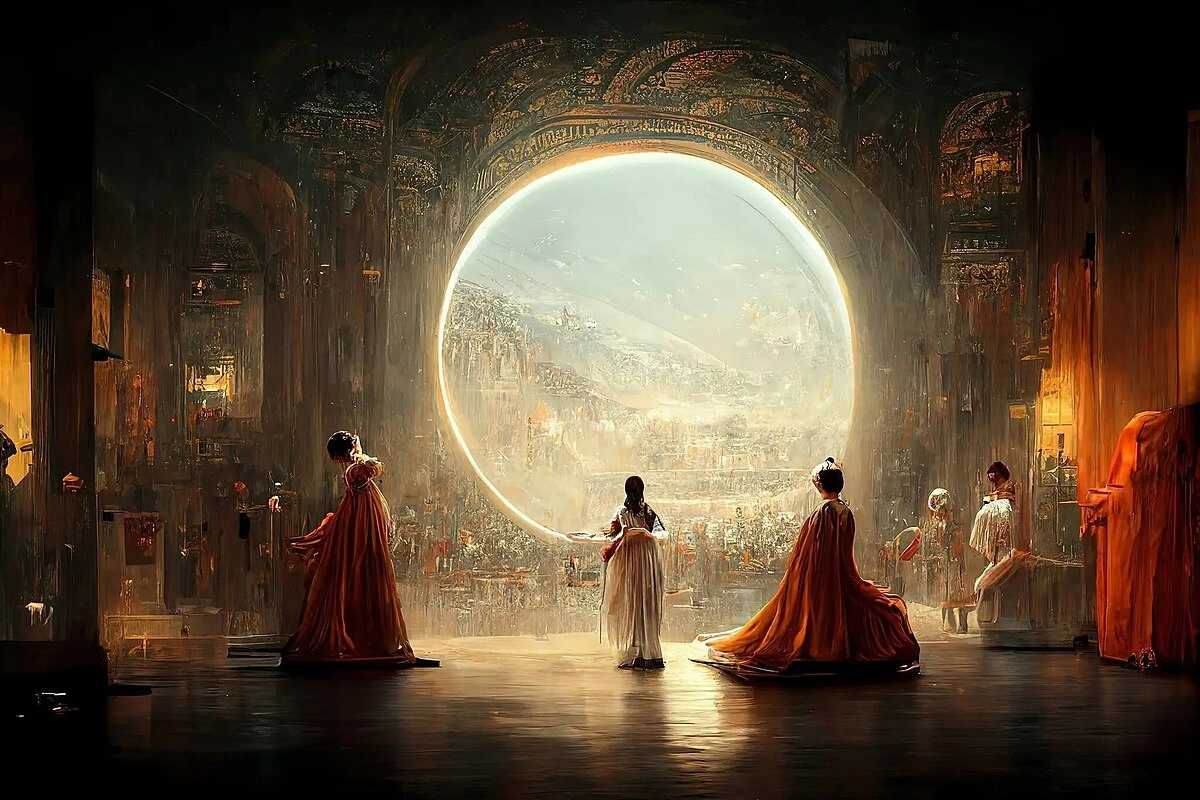
Jason Allen’s AI-generated artwork, Théâtre D’opéra Spatial, 2022. Via Wikimedia, open domain
Refik Anadol’s Unsupervised (2023) at MoMA is an emblematic case. The artist used machine learning models trained on the museum’s collection to generate constant-changing visualizations. Eventually, the artwork reshaped MoMA’s archive into an alive being able to dream about its own data. This event can be understood as the definitive emergence of AI into the contemporary art canon. Beyond its visual impact, this installation raises questions about authorship, mediation and legitimation by delegating part of the curation to a machine.
However, the reception of this piece, as expected, was rather ambivalent. From within the institution itself, Joan Kee and Michelle Kuo (MoMA Magazine, 2023) have emphasized that Unsupervised should not be understood merely as a technological spectacle, but rather as a continuation of the abstract tradition which, like machine learning, challenges the notion of the artwork as a symbol or human expression. In this sense, Anadol would turn artificial intelligence into a poetic material: he neither celebrates nor rejects it, but instead reappropriates and diverts it, transforming it into a medium through which to rethink the relationship between history, emotion and technology.
Other critics, such as Ben Davis (Artnet News, 2023), have argued that Anadol’s work represents a new kind of “technological formalism,” in which the museum embraces a spectacular, decorative aesthetic (“an extremely intelligent lava lamp,” he writes with irony) that, while hypnotic, leaves little room for critical reflection. This is an argument that undoubtedly points to an increasingly evident tension between art, technology and the market.
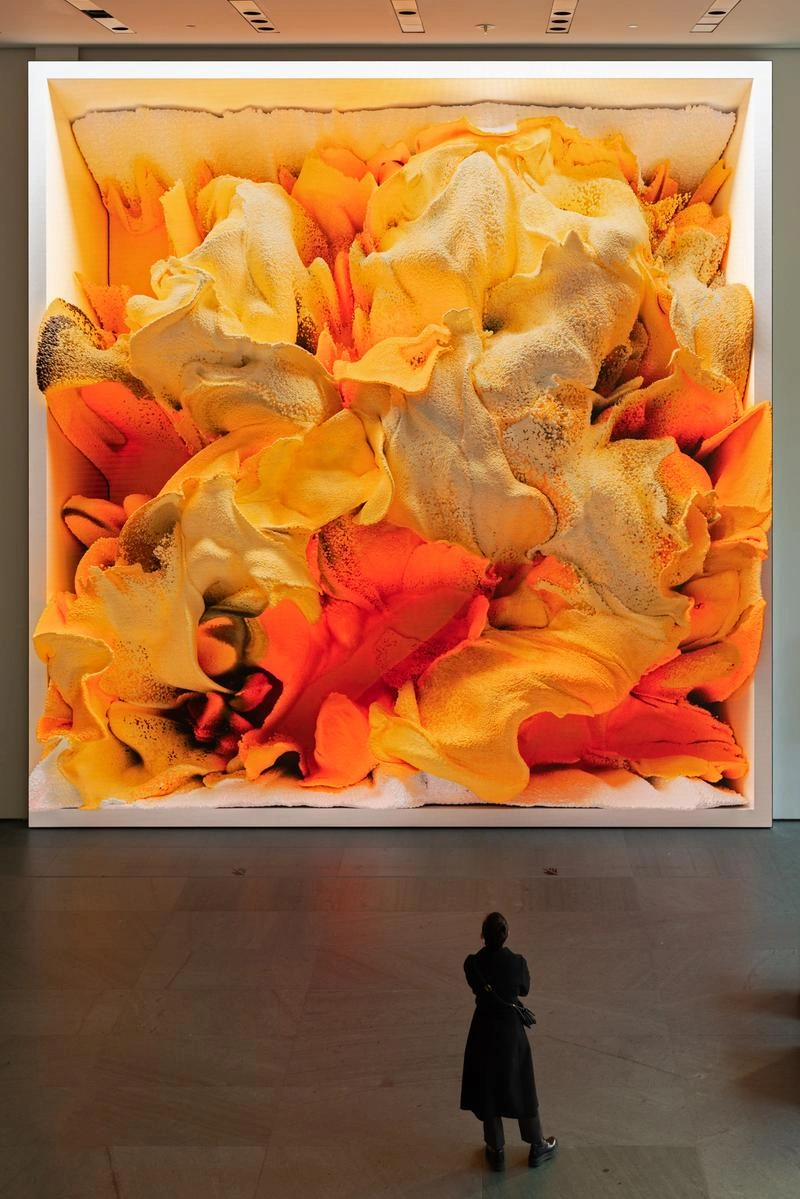
Refik Anadol, Unsupervised, 2023, Installation view MoMA, New York. Via MoMA
Ultimately, the institutional integration of these works and technologies does not necessarily guarantee a critical reflection on the uses of AI or its consequences. While some museums legitimize these new practices, other artists and theorists question their cultural and economic implications.
Between efficiency and experimentation: art in the age of artificial intelligence
Perhaps, we should begin by asking whether, in a world already overpopulated with images as Joan Fontcuberta warned in his Post-photographic Manifesto (2011), it is truly necessary to see a 25% increase in artistic production, as recent studies on AI-assisted creativity suggest (Zhou & Lee, 2024, PNAS Nexus). Does this mean that art has now fully entered the logic of the capitalist production machine, where speed and quantity prevail over reflection and quality?
Paradoxically, these same studies show that artworks created with the help of AI receive up to 50% more positive ratings, which is a figure that invites us to reflect on how aesthetic value is measured today and on the role that visibility and recommendation algorithms play (Zhou & Lee, 2024, PNAS Nexus). We thus find ourselves in a delicate moment: the expansion of generative models may lead to the formation of a standardized visual language which, as Paglen and Crawford warn in Excavating AI (2021), reduces novelty and reinforces dominant imaginaries. In their article, the authors argue that the automated interpretation of images is, above all, a social and political project rather than a purely technical one, revealing the presence of bias embedded in the very architecture of data.
How, then, does AI participate in the production of content aligned with a global and predictive taste? And how can artists resist or subvert these conditions, creating works that reintroduce chance, error, or human subjectivity into an increasingly automated environment?
I believe that it is in this particular context where the role of the artist acquires renewed relevance. Alongside the production of images, their task becomes examining the systems that generate them and questioning the conditions of their emergence. If AI tends to homogenize visual language, art can be the space where doubt, interpretation and error are reintroduced as strategies of resistance. Perhaps this is where I find the most compelling promise of AI in art: not in its capacity to produce, but in its ability to mirror our own contradictions.
A recent example, presented at Ars Electronica 2025, illustrates how the interest of art that employs artificial intelligence lies not only in the images it produces, however striking or provocative, but in its capacity to reveal patterns and contemporary behaviors through the massive analysis of data. This is the case of XXX Machina by British artists Erin Robinson and Anthony Frisby, a work that received an Award of Distinction in the Prix Ars Electronica 2025. It is an immersive multimedia installation that examines how AI destabilizes erotic desire, identity and intimacy.
Conceived as an “autonomous desire machine,” the piece generates images and deepfakes of the artist’s own face using diffusion models trained on data scraped from AI-based pornography platforms. Through this process, the work reveals the dual role of algorithms in reproducing and reshaping our fantasies and our relationship with the body, unveiling the cultural and emotional dimensions of artificial intelligence.
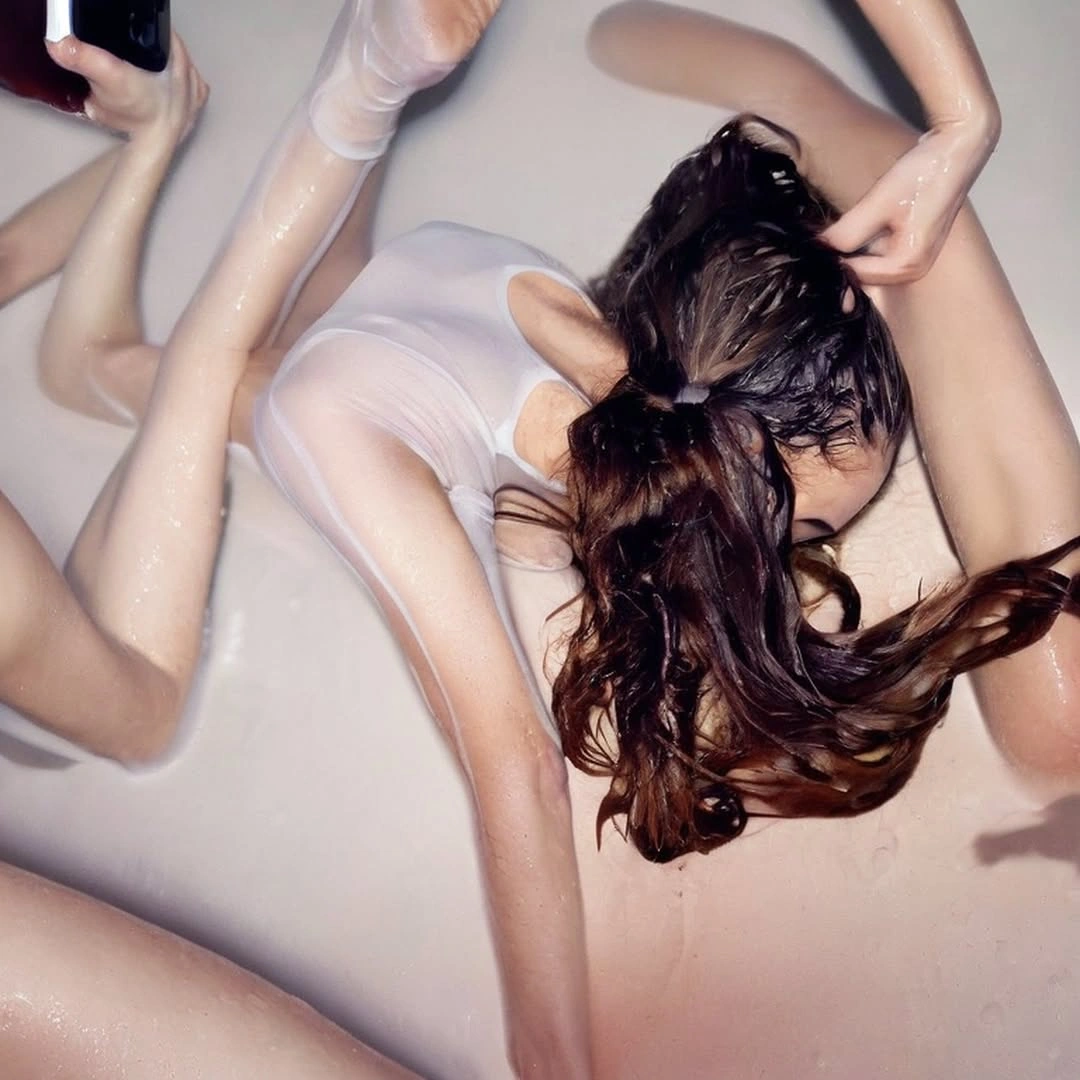
Erin Robinson and Anthony Frisby, XXX Machina, Photo: Erin Robinson, Anthony Frisby