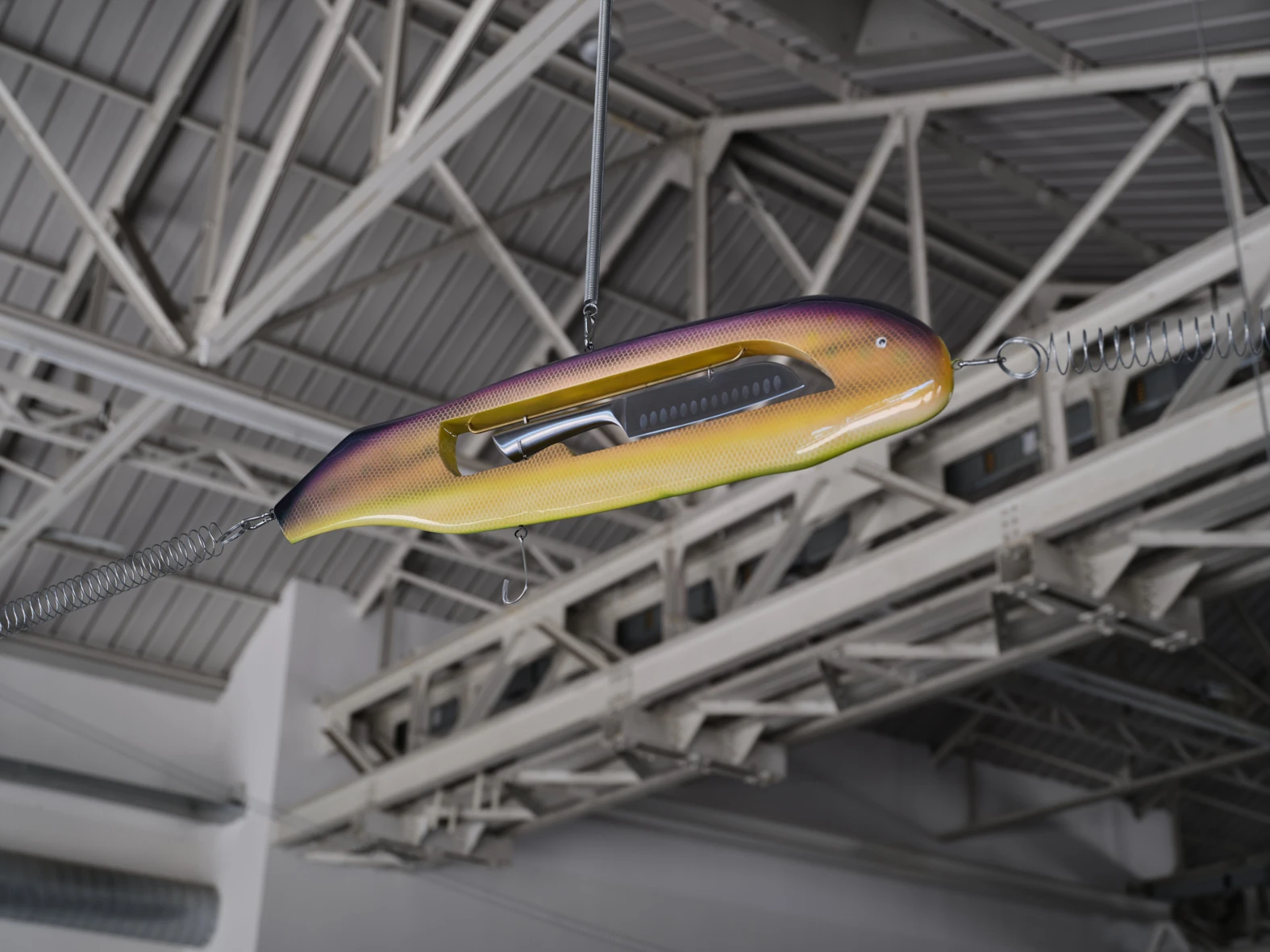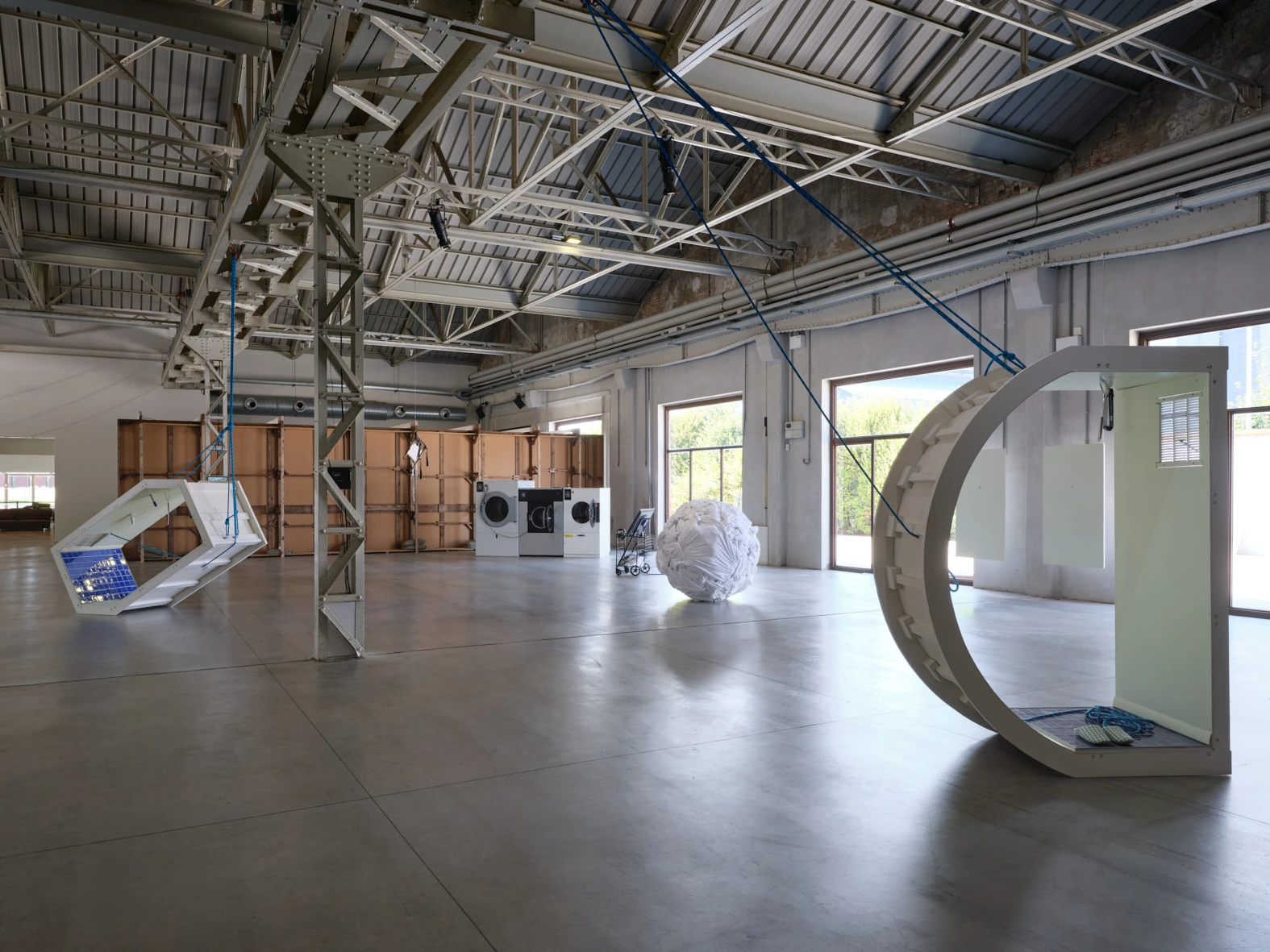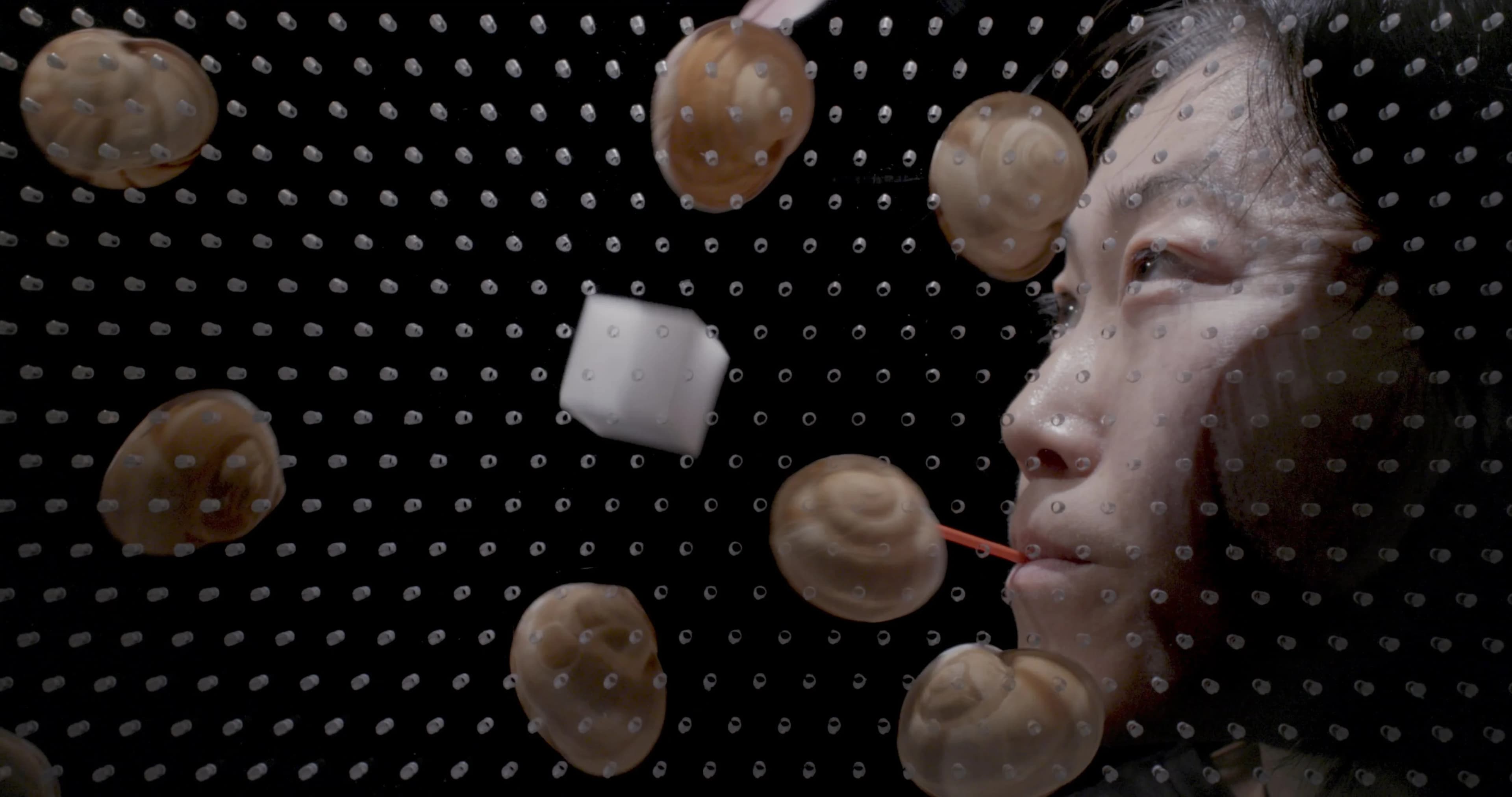
There are suspended springs and large fishing lures incorporating kitchen utensils; metal structures that rise and fall while opening and closing alternately; and washing machines, glasses, and a block of ice that produces a sound amplified by hidden microphones as it melts. Though these disparate objects seem to be at the mercy of a mysterious force, one can recognize behaviors from one's own experience behind each of their movements: attraction, fear, the need for control, the need to distance oneself, the impulse to draw near, the will to hold on, and the desire to let go. At the Pirelli HangarBicocca in Milan, Aki Sasamoto’s first solo exhibition at a European institution showcases over twenty years of work that defies easy categorization. Performance, sculpture, installation, and video coexist with mathematics, dance, social psychology, meteorology, and eco-behavioral sciences. But behind this apparent heterogeneity of languages, a persistent question emerges: How can one give form to that which has no form? How can one measure an emotion, represent a relationship, or translate the instability that governs relationships between individuals? “The world I touch and the world I understand via language are so different. The world only makes sense somewhere between what I make and what I end up doing with it,” explains Aki Sasamoto.
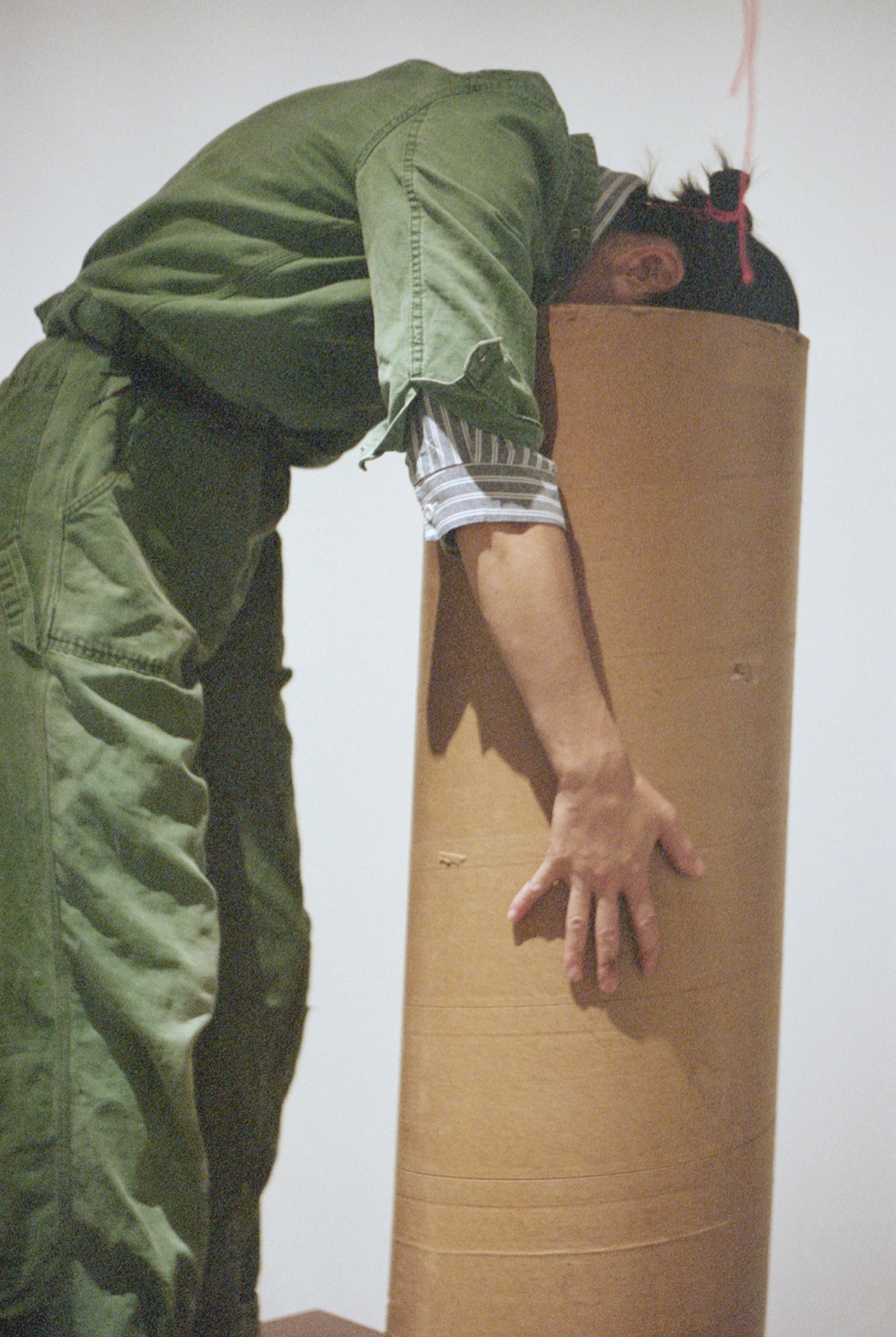
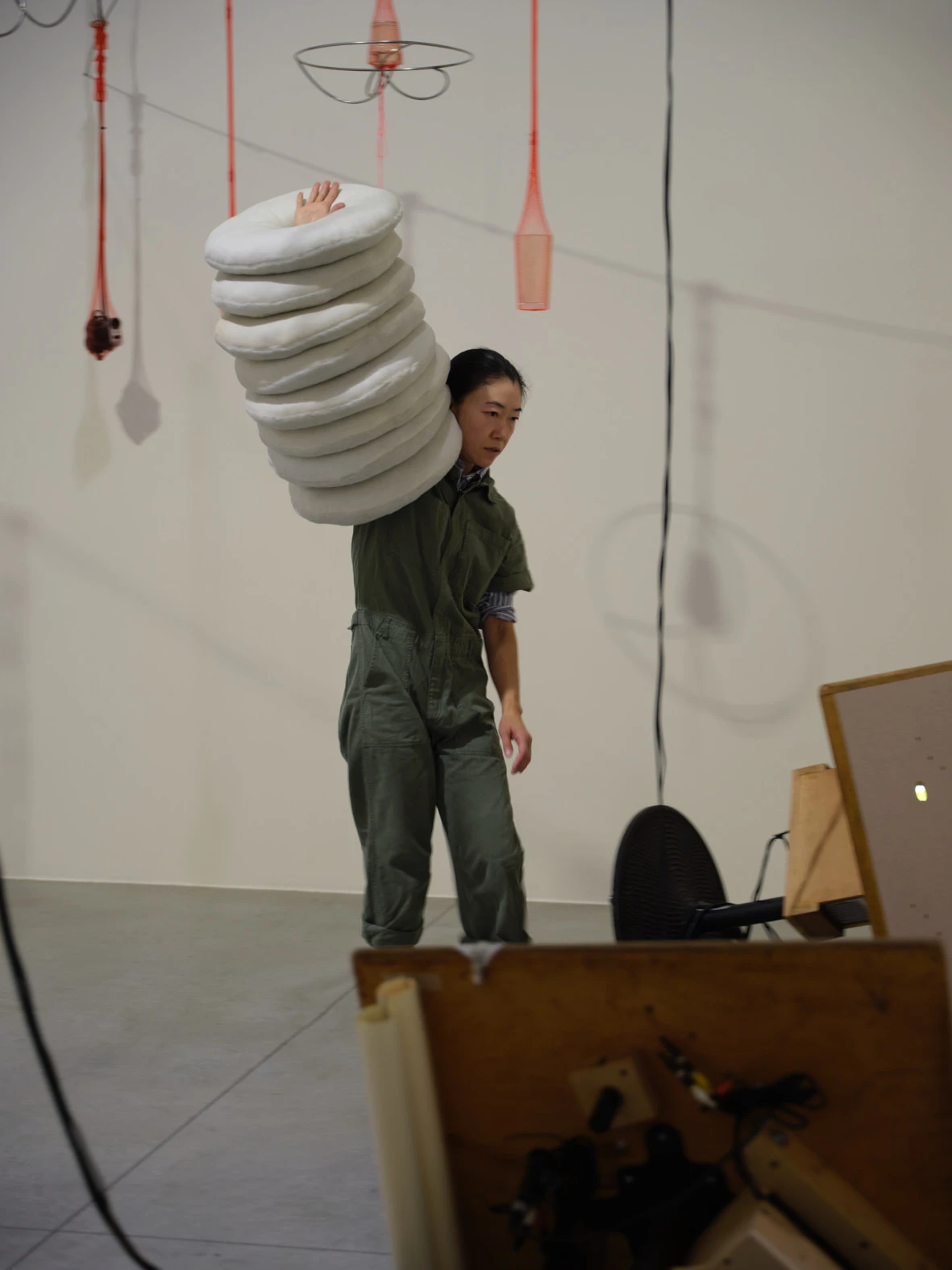
Aki Sasamoto performance of Strange Attractors , 2010. “Aki Sasamoto’ Life Laboratory,” Museum of Contemporary Art Tokyo, 2025. Ninagawa Maerkle Family Collection. Courtesy the artist and Take Ninagawa, Tokyo. Photo: Yurika Kono
Aki Sasamoto: Where Mathematics Meets the Body
Born in Kanagawa, Japan, in 1980, and a longtime New York resident, Sasamoto developed her practice by engaging with various disciplines. After leaving Japan to study in Wales and the United States, she developed an interest in mathematics before earning bachelor's and master's degrees in dance and visual arts, respectively, from Wesleyan and Columbia universities. Her transition from the theoretical and rigorous field of mathematics to the physical realm of dance is not a break in her artistic journey, on the contrary, it contains some of the polarities that characterize her work, such as the tension between organizing the world through rational structures and the impossibility of reducing experience to a stable construct. The body becomes an instrument of knowledge, just as a number, formula, or diagram does. Everyday objects—a washing machine, a glass, a kitchen utensil, a table, a bed—lose their original connotations and become devices through which to explore behaviors, memories, desires, and obsessions. Sasamoto manipulates these objects, turning them into oversized presences, setting them in motion, and altering their function. Even in Cooking Show (2005), one of the earliest works featured in the exhibition through video documentation, there were elements that would become central to Sasamoto's subsequent artistic practice. In the piece, she used oversized kitchen utensils, turning ordinary tasks into comically impractical actions. Everyday objects became obstacles and tools for highlighting the difficulty of communication.
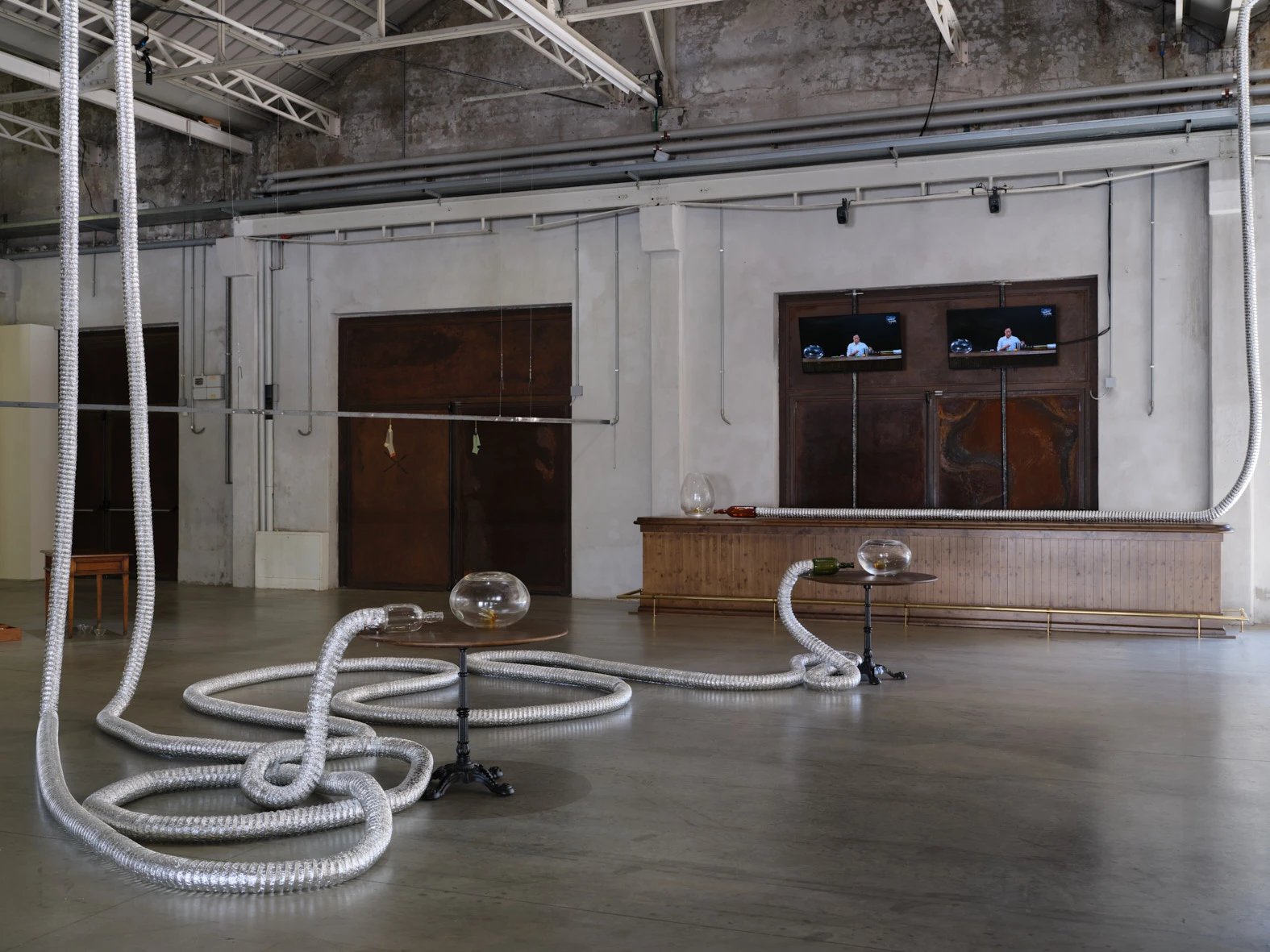
Aki Sasamoto “XYZ” Exhibition view, Pirelli HangarBicocca, Milan, 2026. Courtesy the artist and Pirelli HangarBicocca, Milan. Photo: Agostino Osio
Diagrams, Emotions, and the Problems of Life
"My work deals with the problems of life, not art," she states. This helps us understand why, despite frequently drawing on scientific and mathematical models, her work is anything but a formalist exercise. Sasamoto is not interested in the system itself, but rather in what it can reveal about life, particularly relationships, when subjected to the pressure of experience. The diagram is one of the most significant tools in this research. Graphs, coordinates, lines, formulas, and trajectories crisscross “XYZ,” continually linking what can be measured with what seems to elude quantification. “The diagrams are reflectors of the discomfort in life––an attempt to get to the heart of it. I want to take emotion seriously, but emotion is hard to take as it is. Diagrams appear more light-hearted and distant than speaking in serious language with a straight face. I prefer facing the board, drawing, with my back to the world.”
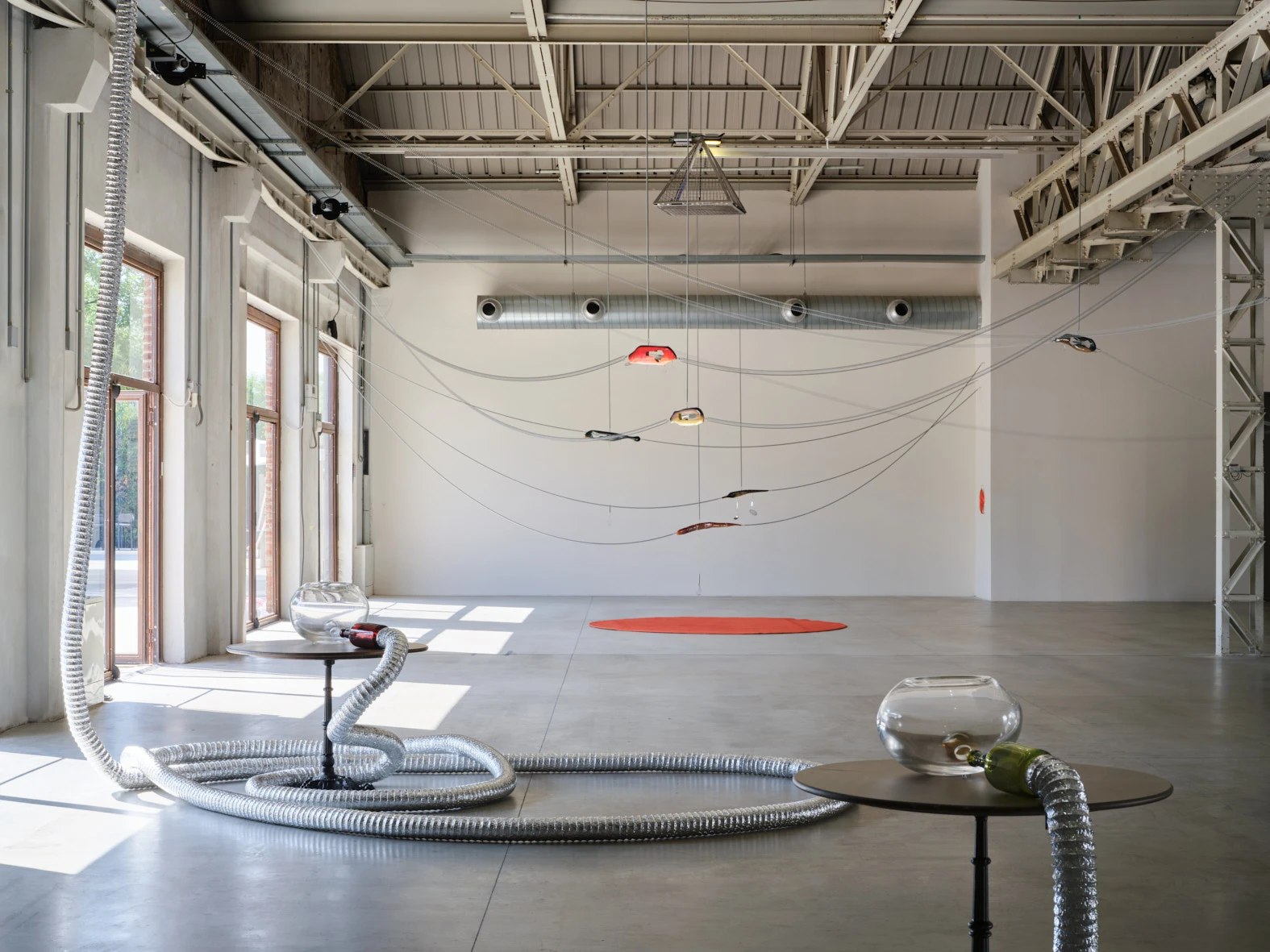
Aki Sasamoto “XYZ” Exhibition view, Pirelli HangarBicocca, Milan, 2026. Courtesy the artist and Pirelli HangarBicocca, Milan. Photo: Agostino Osio
Inside “XYZ” at Pirelli HangarBicocca
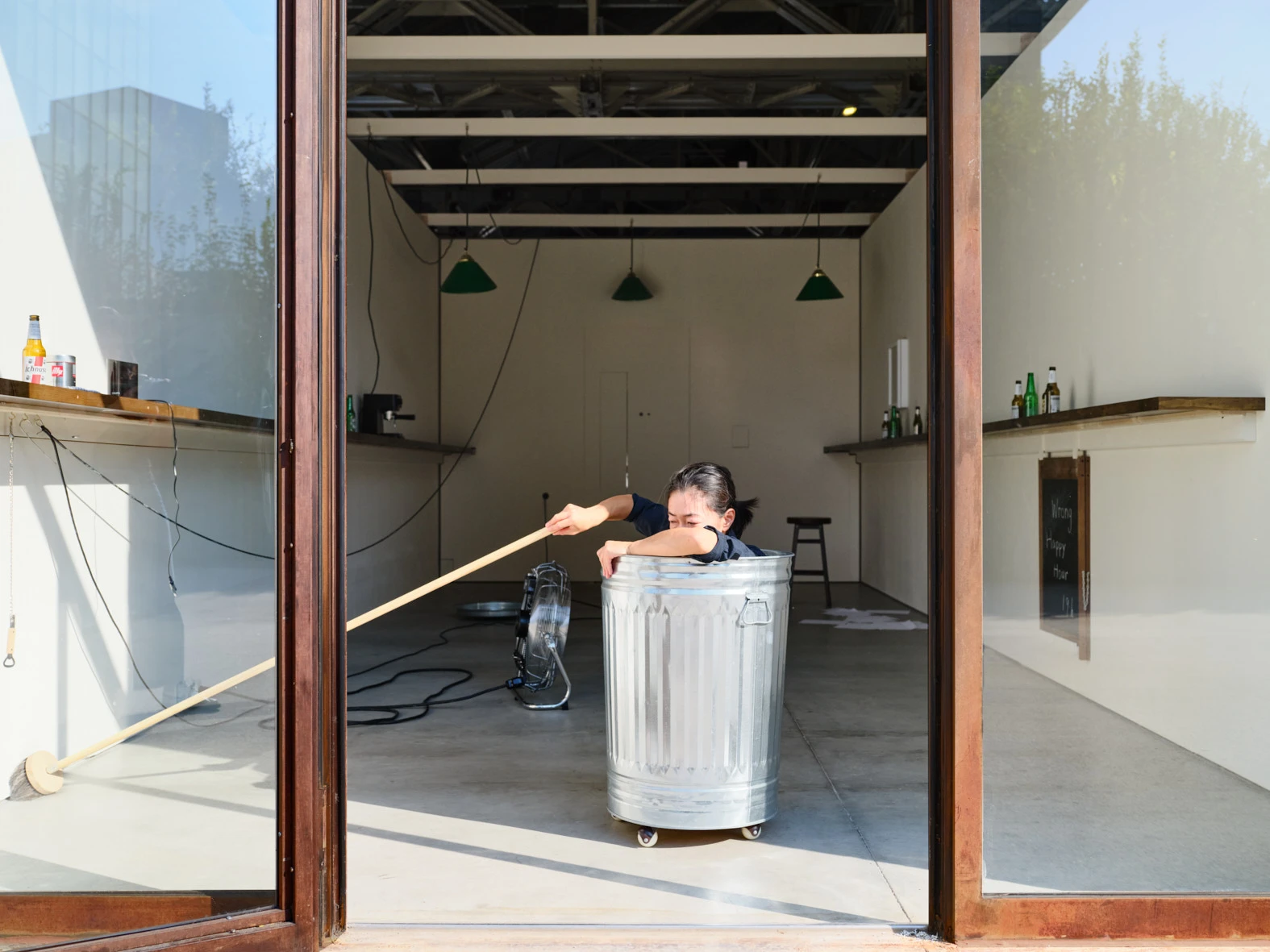
When asked about her approach to the relationship between the artworks and the Shed at Pirelli HangarBicocca, Sasamoto told WeDirectory that she conceived the installation as a process of adaptation and transformation rather than as the mere application of pre-established structures. Reinstalling a work in a new context introduces a variation, allowing the work to take on new relationships and meanings each time, rather than reproducing something that already exists. Some installations were reimagined and reconstructed to fit the space's characteristics through her collaboration with the curatorial team, composed of Roberta Tenconi and Tatiana Palenzona. The exhibition’s title, “XYZ”, lends itself to many interpretations. They are the last three letters of the alphabet, and when placed at the end of a list, they can indicate an indefinite continuation—something that might extend beyond what has been named. In the Cartesian coordinate system, they identify the three coordinates through which we define the position of a point in space. In a scientific context, they can denote variables. In American colloquial usage, XYZ is an acronym for "eXamine Your Zipper"—a discreet way of letting someone know their pants zipper is open. However, the title also refers to the importance of the line as a tool for interpreting and organizing space. "An excuse for me to start thinking," as the artist defines it. Sasamoto explains that she started mentally tracing lines within the architecture. Once the first line was established, other relationships began to emerge almost inevitably. Thus, the line became a way to orient oneself within the environment and build connections between works created at different times. What becomes fundamental is what happens when the works begin to "touch" one another, forming relationships while maintaining their autonomy. The concept of "touching" is significant because it draws a parallel with human beings. Individuals can also enter into relationships without eliminating the distance that separates them.
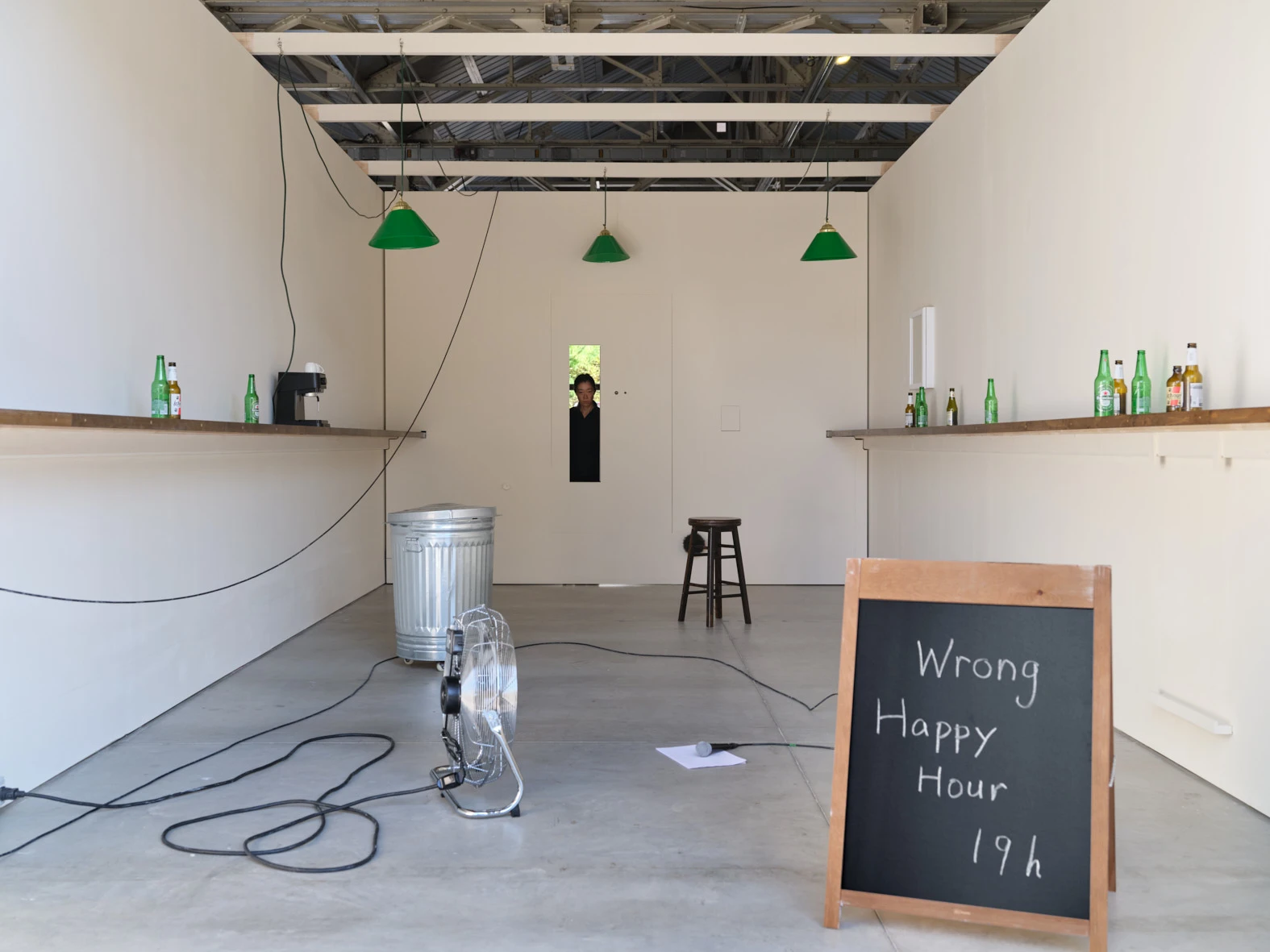
Aki Sasamoto performance of Wrong Happy Hour, 2014/2026. Installation view, Pirelli HangarBicocca, Milan, 2026. Courtesy the artist and Pirelli HangarBicocca, Milan. Photo: Agostino Osio
Attraction, Distance, and the Mechanics of Human Relationships
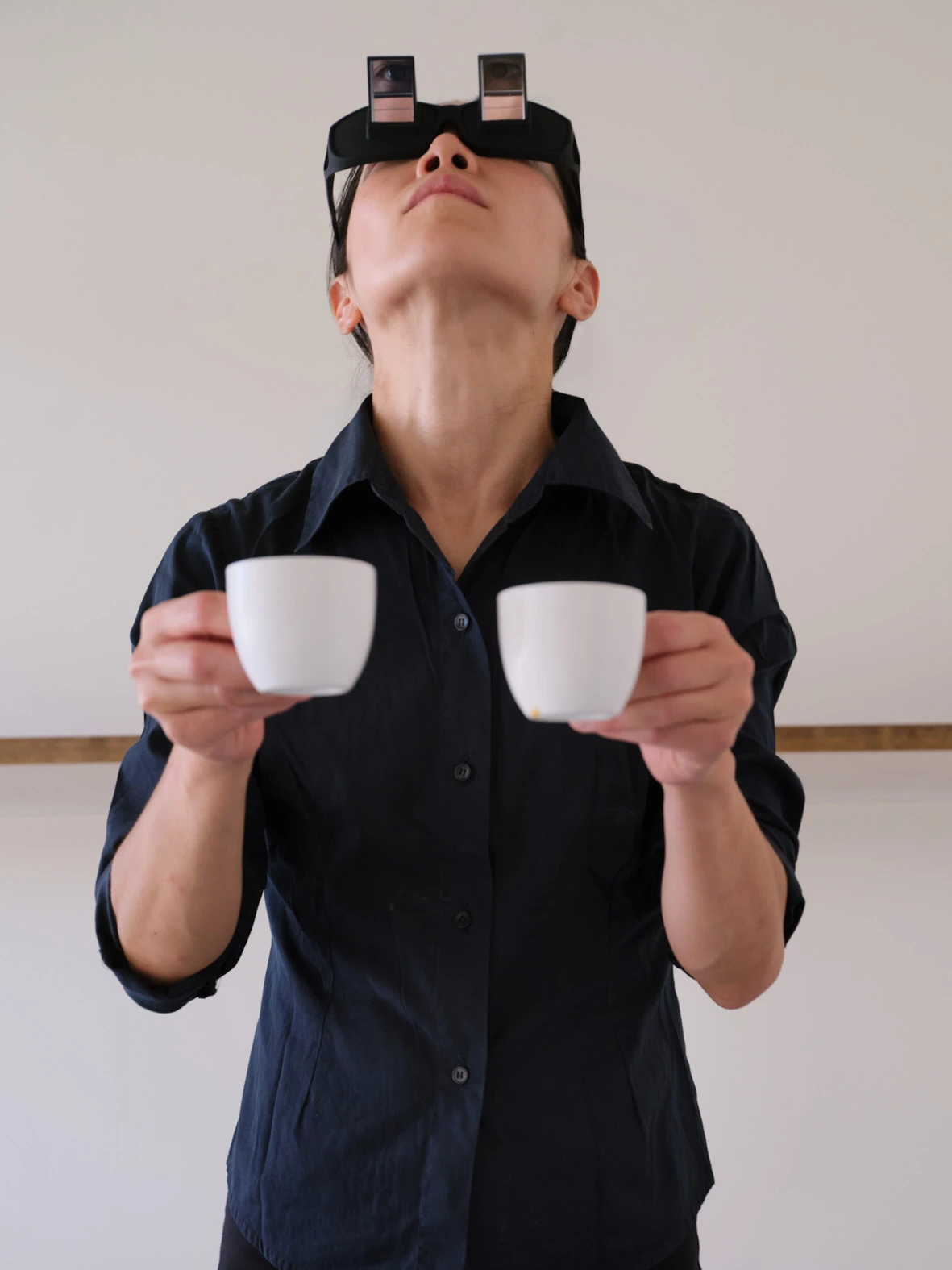
The exhibition continually explores this invisible boundary: How close can we get to another person? When does proximity become contact? And when does contact turn into an invasion? The answer lies in the exhibition's original and complex arrangement of machines, gears, and artifacts. In Secrets of My Mother's Child (2009), a piece stemming from the artist's personal experiences with her mother, furniture and household items create a space representing the intimacy and contradictions of family life. The theme of secrecy becomes the focus of a broader reflection on the possibility of truly knowing another person. "That transition from secret to revealed fact is fascinating to me," says Sasamoto. She translates the relationship into a mathematical form: a suspended metal bar follows the curve of the function X × Y = 1. Its asymptotes gradually approach one another without ever meeting. This oscillating movement of drawing near and moving away recurs throughout the exhibition.
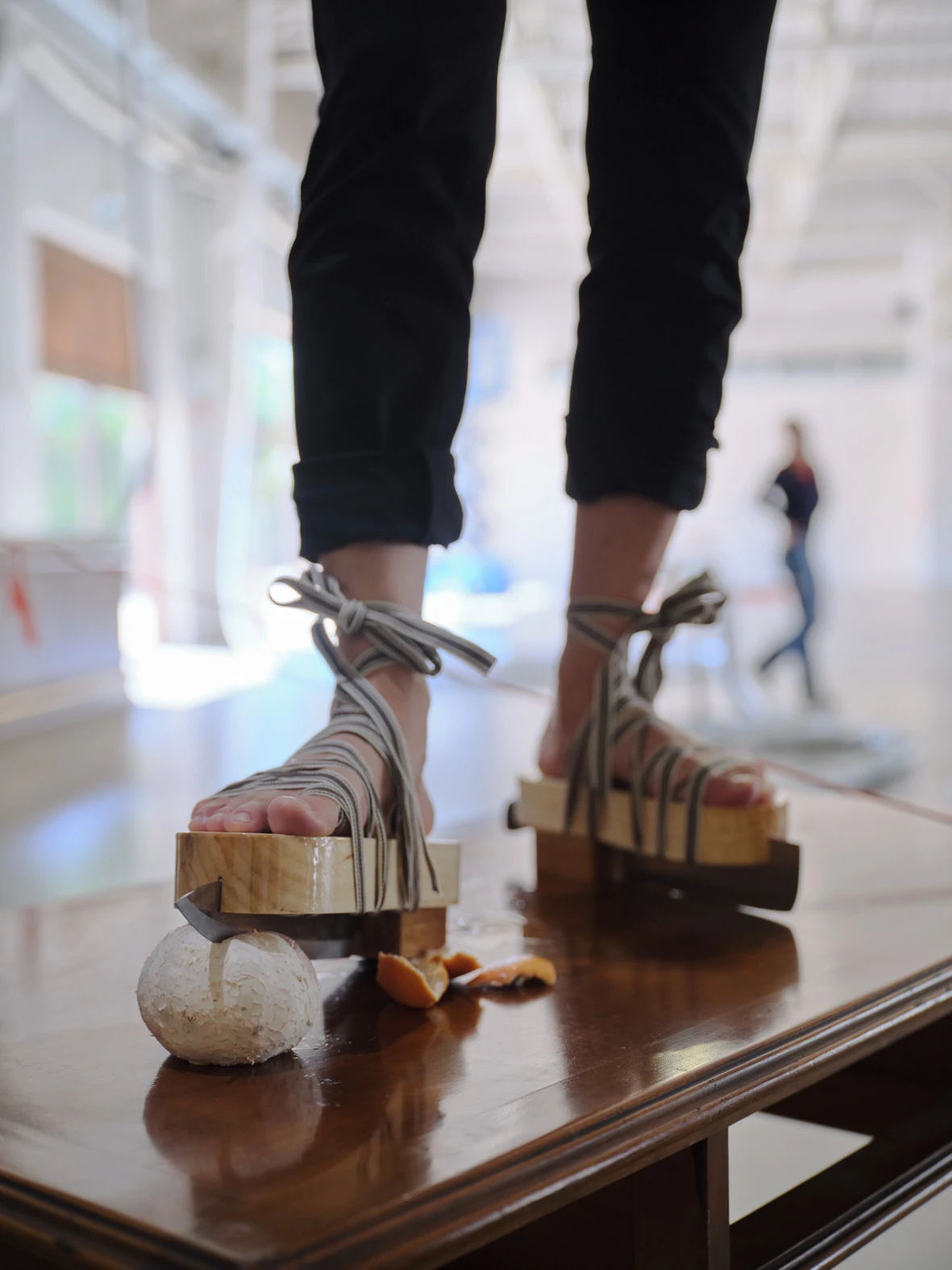
Aki Sasamoto performance of Secrets of My Mother’s Child, 2009/2026. Installation view, Pirelli HangarBicocca, Milan, 2026. Courtesy the artist and Pirelli HangarBicocca, Milan. Photo: Agostino Osio
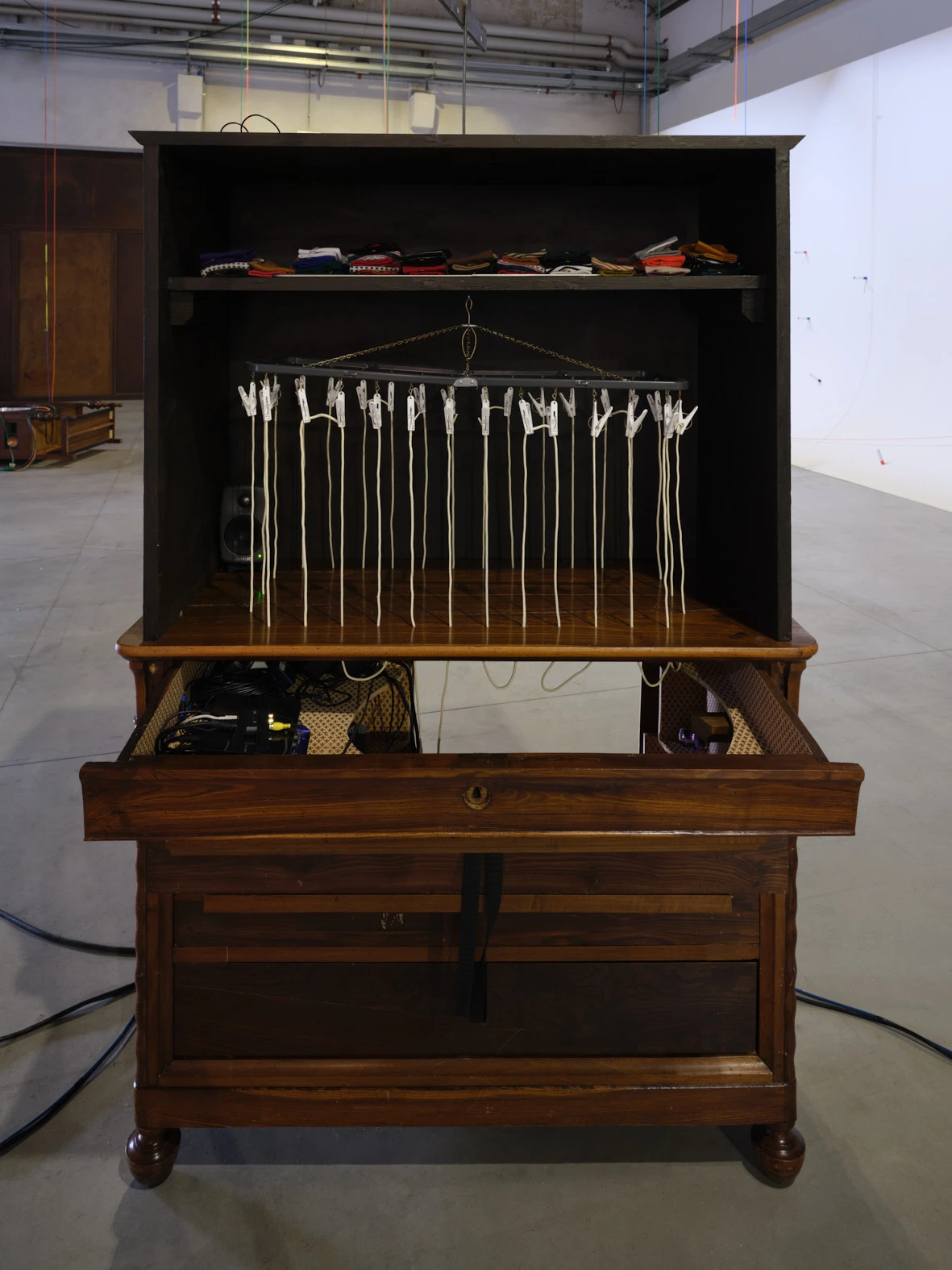
Aki Sasamoto, Secrets of My Mother’s Child, 2009/2026 (detail). Installation view, Pirelli HangarBicocca, Milan, 2026. Courtesy the artist and Pirelli HangarBicocca, Milan. Photo: Agostino Osio
In Sounding Lines (2024), for instance, springs suspended from the ceiling and large fishing lures incorporating kitchen utensils are set in motion by programmed motors. By its very nature, the lure is a relational object. It exists because something must be drawn to it. It simultaneously embodies promise and deception, desire and capture. Sasamoto associates this imagery with the kitchen and food, recurring elements in her visual vocabulary, once again bringing the domestic sphere and social behavior into collision.